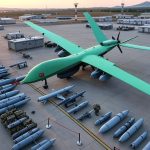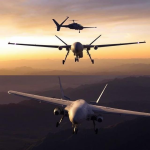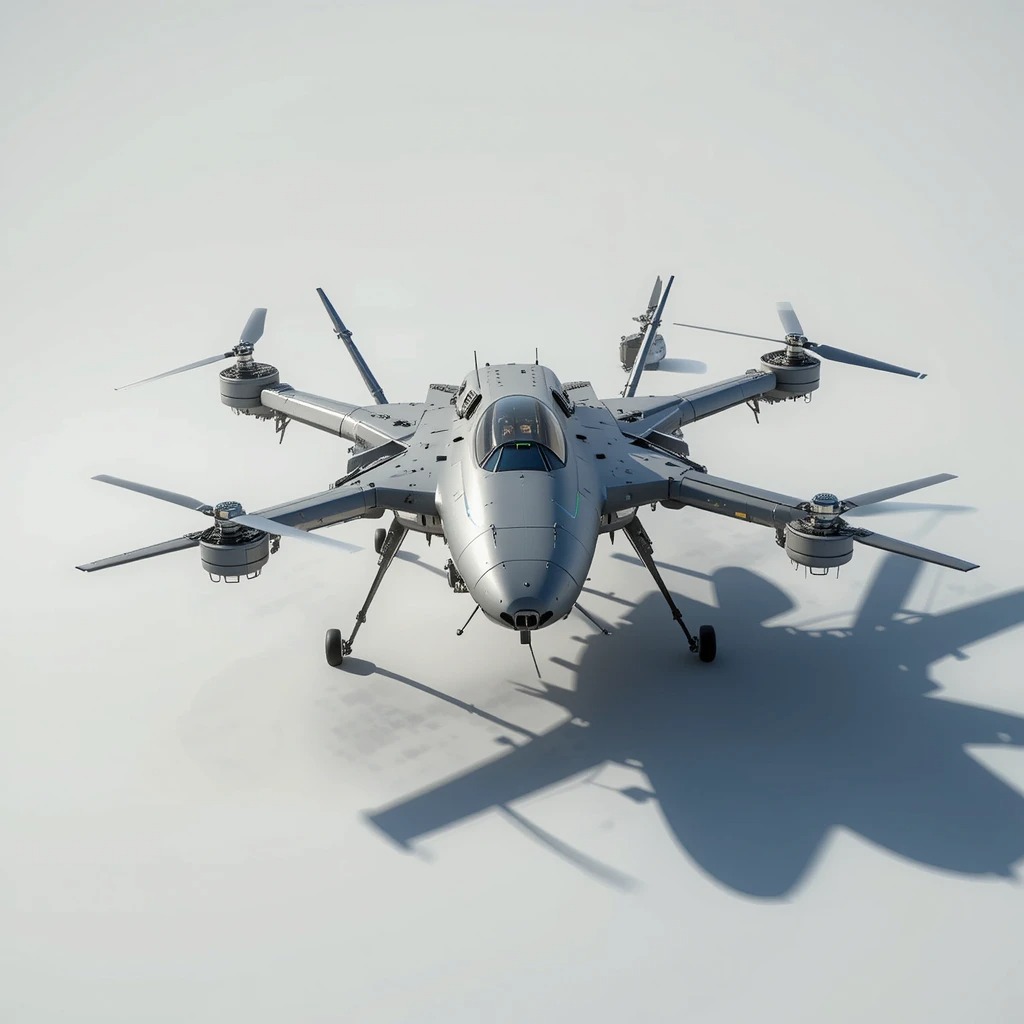
Image Credentials: Image Title: Unmanned Combat Aerial Vehicle (UCAV) AI & Autonomy Source: AI-Generated Image (Aiease.ai) Date: April 2025 Attribution: Created by AI-generated imagery (Aiease.ai), and it does not depict a real-world scene.
Unmanned Combat Aerial Vehicles (UCAVs), also known as combat drones, are aerial systems capable of performing offensive missions without a human pilot on board. The integration of Artificial Intelligence (AI) and autonomy into UCAVs has significantly transformed modern aerial warfare, enabling new capabilities in surveillance, target acquisition, precision strike, and autonomous operations.
Overview
AI-powered UCAVs leverage machine learning, computer vision, and real-time data processing to perform complex tasks with minimal human intervention. These systems can operate in contested environments, make tactical decisions, and coordinate with manned and unmanned systems alike. The evolution from remotely piloted drones to autonomous combat systems marks a major shift in military doctrine and force structure.
Historical Development
The concept of autonomous UCAVs emerged in the early 21st century, evolving from surveillance UAVs such as the MQ-1 Predator and MQ-9 Reaper. Initial systems relied heavily on remote control by human operators. However, advances in AI algorithms, sensor fusion, and onboard processing power paved the way for increasing levels of autonomy. Programs like the U.S. Air Force’s Skyborg, the U.K.’s Project Mosquito, and Russia’s S-70 Okhotnik have been at the forefront of integrating AI into UCAV platforms.
Core AI Capabilities in UCAVs
1. Autonomous Navigation
AI systems enable UCAVs to fly pre-planned or adaptive flight paths while avoiding obstacles, navigating complex terrain, and responding to dynamic threats. Advanced guidance systems combine GPS, inertial navigation, and visual SLAM (Simultaneous Localization and Mapping) for precise control.
2. Target Identification and Engagement
Using computer vision and deep learning, UCAVs can autonomously detect, classify, and prioritize targets. AI-based target recognition minimizes reliance on remote operators and reduces decision-making latency in high-threat environments.
3. Swarm Coordination
AI enables multiple UCAVs to operate as a coordinated swarm, sharing data in real-time and adapting roles (e.g., scout, decoy, strike) dynamically. This collective intelligence enhances mission resilience and complicates enemy defenses.
4. Decision-Making & Mission Planning
Advanced UCAVs use reinforcement learning and adversarial AI to simulate combat scenarios and choose optimal strategies. Mission autonomy includes dynamic retasking, threat avoidance, and risk assessment, all performed onboard.
5. Electronic Warfare and Cyber Defense
AI systems in UCAVs are capable of conducting electronic attacks, jamming communications, and defending against cyber intrusions in-flight. Autonomous behavior also aids in countering GPS spoofing and signal interference.
Levels of Autonomy
UCAV autonomy is typically categorized across a spectrum:
-
Level 0–2: Human-in-the-loop control with basic automation.
-
Level 3: Conditional autonomy with limited independence.
-
Level 4: High autonomy where the UCAV can execute entire missions with minimal oversight.
-
Level 5: Full autonomy including self-directed strategic decision-making in contested environments (currently theoretical or experimental).
Ethical and Legal Considerations
The deployment of AI-powered lethal autonomous weapons (LAWs) raises complex ethical and legal issues. Questions about accountability, rules of engagement, and compliance with international humanitarian law remain central to ongoing global debates. Several organizations and treaties, such as the United Nations Convention on Certain Conventional Weapons (CCW), have explored regulatory frameworks for autonomous weapons.
Operational Platforms and Programs
-
XQ-58A Valkyrie (U.S.): A stealthy, semi-autonomous UCAV developed under the Skyborg program.
-
BAE Systems Tempest Loyal Wingman (U.K.): Designed to pair with manned fighters in coordinated missions.
-
S-70 Okhotnik-B (Russia): A heavy UCAV with stealth capabilities and advanced autonomous systems.
-
Wing Loong II (China): Capable of autonomous strike and ISR (Intelligence, Surveillance, Reconnaissance) roles.
Future Prospects
The future of AI in UCAVs includes deeper integration with manned aircraft in “manned-unmanned teaming” (MUM-T), greater autonomy in denied environments, and the use of quantum computing for faster decision-making. Emerging technologies like neuromorphic chips and edge AI are expected to enhance onboard processing and adaptability.
References
-
U.S. Department of Defense. “AI Strategy for DoD.” 2023.
-
RAND Corporation. “The Future of UCAVs in Great Power Conflict.” 2022.
-
NATO ACT. “Autonomous Systems in Military Operations.” 2021.
-
Jane’s Defence Weekly. “UCAVs and the AI Revolution.” 2024.
Explore this subject
Continue exploring related Open Chronicle Encyclopedia entries through the categories associated with this article.

Staff Writers at Open Chronicle produce trusted journalism, strategic analysis and authoritative reference content across global affairs, geopolitics, defense, science, history, technology, business, culture and sport. Their work combines accurate reporting with historical perspective and analytical depth, helping readers understand not only what is happening, but why it matters. Beyond daily news coverage, Staff Writers contribute to the Open Chronicle Encyclopedia, investigative features, original research projects and long-form reports, building a comprehensive knowledge platform designed to inform, educate and preserve reliable information for a global audience.