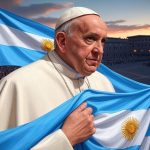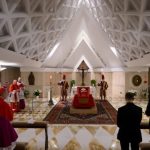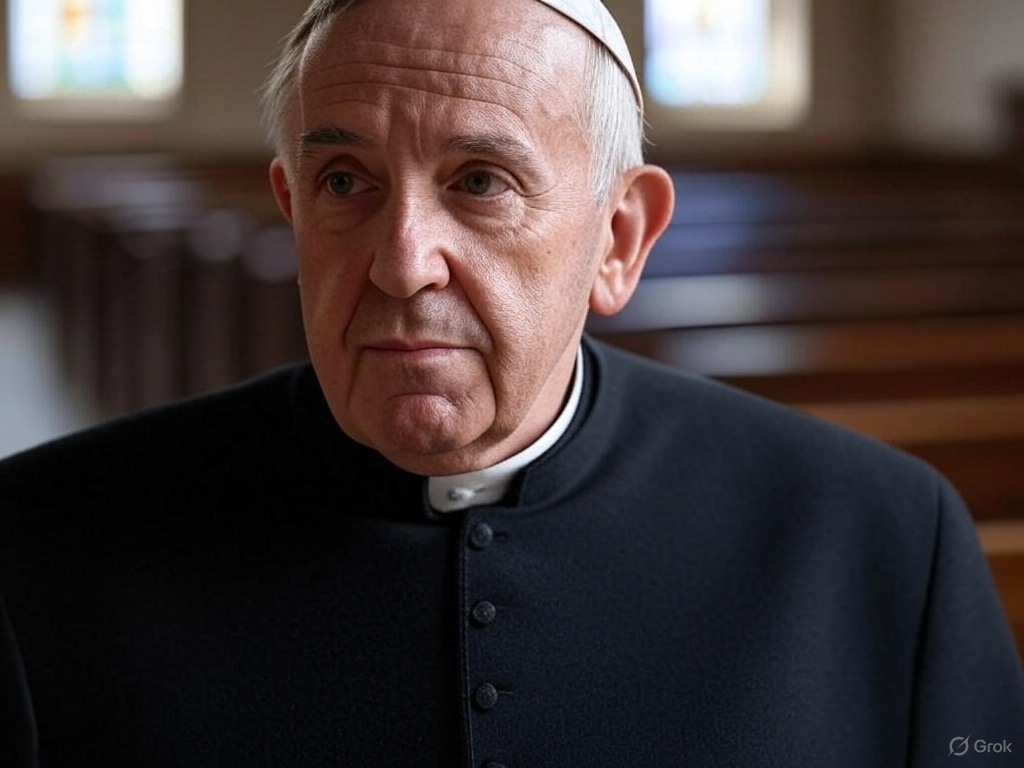
Image Credentials: Image Title: Pope Francis: Presbyterate (1969–1992) Source: AI-Generated Image (Grok, xAI) Date: April 2025 Attribution: Created by AI-generated imagery (Grok, xAI), and it does not depict a real-world scene.
Early Jesuit Career of Pope Francis
Theological Formation and Ordination
In 1967, Jorge Mario Bergoglio, who would later become Pope Francis, began his theological studies at the Facultades de Filosofía y Teología de San Miguel in Argentina. He had previously studied philosophy and humanities as part of his Jesuit formation. After completing his theological training, Bergoglio was ordained a priest on 13 December 1969 by Archbishop Ramón José Castellano, then the Archbishop Emeritus of Córdoba.
Following his ordination, Bergoglio served as master of novices for the Jesuit province in Argentina. He also took on the role of professor of theology, contributing to the academic formation of young Jesuits within the order.
Final Vows and Leadership in the Jesuit Order
Bergoglio completed his tertianship, the final stage of Jesuit formation, at Alcalá de Henares in Spain. He professed his final vows on 22 April 1973, including the fourth vow of obedience to the pope, specific to the Jesuit order.
That same year, he was appointed provincial superior of the Society of Jesus in Argentina, a post he held for six years until 1979. His leadership coincided with a turbulent period in both the Church and Argentina’s political landscape. Bergoglio was known for emphasizing popular religiosity and direct pastoral work rather than the liberation theology approach that was becoming more prevalent in Jesuit circles at the time.
In 1973, he undertook a pilgrimage to Jerusalem, though the visit was cut short by the outbreak of the Yom Kippur War.
Academic Administration and International Experience
After completing his term as provincial superior, Bergoglio was appointed in 1980 as rector of the same theological faculty in San Miguel where he had previously studied. Before assuming the role, he spent three months in Ireland at the Jesuit Centre at the Milltown Institute of Theology and Philosophy in Dublin to improve his English proficiency.
He served as rector of San Miguel from 1980 to 1986, continuing to influence the formation of Jesuits in Argentina. However, in 1986, Jesuit Superior-General Peter Hans Kolvenbach decided to replace him with a figure more aligned with the order’s global orientation toward social justice. This change was part of a broader shift within the Society of Jesus during the late 20th century.
Studies in Germany and Return to Argentina
Following his removal from the rectorship, Bergoglio spent several months in Germany at the Sankt Georgen Graduate School of Philosophy and Theology in Frankfurt, where he explored potential topics for doctoral research. He showed particular interest in Romano Guardini, a German-Italian theologian. Bergoglio focused on Guardini’s concept of “contrast,” especially as presented in the 1925 work Der Gegensatz.
However, he returned to Argentina earlier than planned, where he began working as a confessor and spiritual director for the Jesuit community in Córdoba.
Spiritual Influences and Tensions within the Jesuits
Bergoglio’s spiritual formation had early influences beyond traditional Latin Rite Catholicism. While attending a Salesian school, he was mentored by Stefan Czmil, a Ukrainian Greek Catholic priest. During this time, he frequently woke up before dawn to assist Czmil in serving the Divine Liturgy, reflecting his broad liturgical exposure and early spiritual discipline.
Despite his deep roots in the Society of Jesus, Bergoglio’s relationships with the Jesuit leadership grew strained in the 1990s. In 1992, due to ongoing theological and ideological tensions, Jesuit superiors requested that Bergoglio refrain from living in Jesuit residences. His conservative views, skepticism toward liberation theology, and growing influence as auxiliary bishop of Buenos Aires led to a virtual estrangement from the Jesuits.
As a bishop, Bergoglio was no longer under the authority of Jesuit superiors, effectively severing his active ties with the order. This estrangement continued until he was elected pope in 2013, after which relations between Pope Francis and the Jesuit community were gradually restored.
References
-
^ “Pope Francis: A Man of the Church.” Jesuit Curia, Society of Jesus, 2013.
-
^ “Bergoglio’s Early Priesthood and Jesuit Leadership.” The Tablet, March 2013.
-
^ Allen, John L. Francis: A Pope for Our Time. New York: Time Books, 2013.
-
^ Ivereigh, Austen. The Great Reformer: Francis and the Making of a Radical Pope. New York: Henry Holt and Company, 2014.
-
^ “Pope Francis Biography.” Catholic News Agency. Accessed April 2025.
-
^ Reese, Thomas J. Inside the Jesuits: How Pope Francis Is Changing the Church. HarperOne, 2015.
-
^ “The Yom Kippur War and Its Global Effects.” BBC History, 2019.
-
^ “Milltown Institute and the Jesuit Tradition in Ireland.” Irish Catholic Historical Quarterly, Vol. 58, 2012.
-
^ “Sankt Georgen Graduate School of Theology and Philosophy.” Frankfurt Archdiocese Archives. Accessed 2025.
-
^ Rubin, Sergio. El Jesuita. Buenos Aires: Ediciones B, 2010.
-
^ Vallely, Paul. Pope Francis: Untying the Knots. Bloomsbury Publishing, 2013.
-
^ “Czmil and the Byzantine Rite Influence on Pope Francis.” Ukrainian Catholic University Review, 2016.
-
^ “The Jesuit Divide: Liberation Theology and the Argentine Church.” National Catholic Reporter, 2005.
-
^ “Bergoglio’s Displacement and Tensions with Jesuit Leadership.” America Magazine, March 2013.
-
^ “From Jesuit Provincial to Pontiff: Jorge Mario Bergoglio.” La Nación, March 2013.
Explore this subject
Continue exploring related Open Chronicle Encyclopedia entries through the categories associated with this article.

Staff Writers at Open Chronicle produce trusted journalism, strategic analysis and authoritative reference content across global affairs, geopolitics, defense, science, history, technology, business, culture and sport. Their work combines accurate reporting with historical perspective and analytical depth, helping readers understand not only what is happening, but why it matters. Beyond daily news coverage, Staff Writers contribute to the Open Chronicle Encyclopedia, investigative features, original research projects and long-form reports, building a comprehensive knowledge platform designed to inform, educate and preserve reliable information for a global audience.