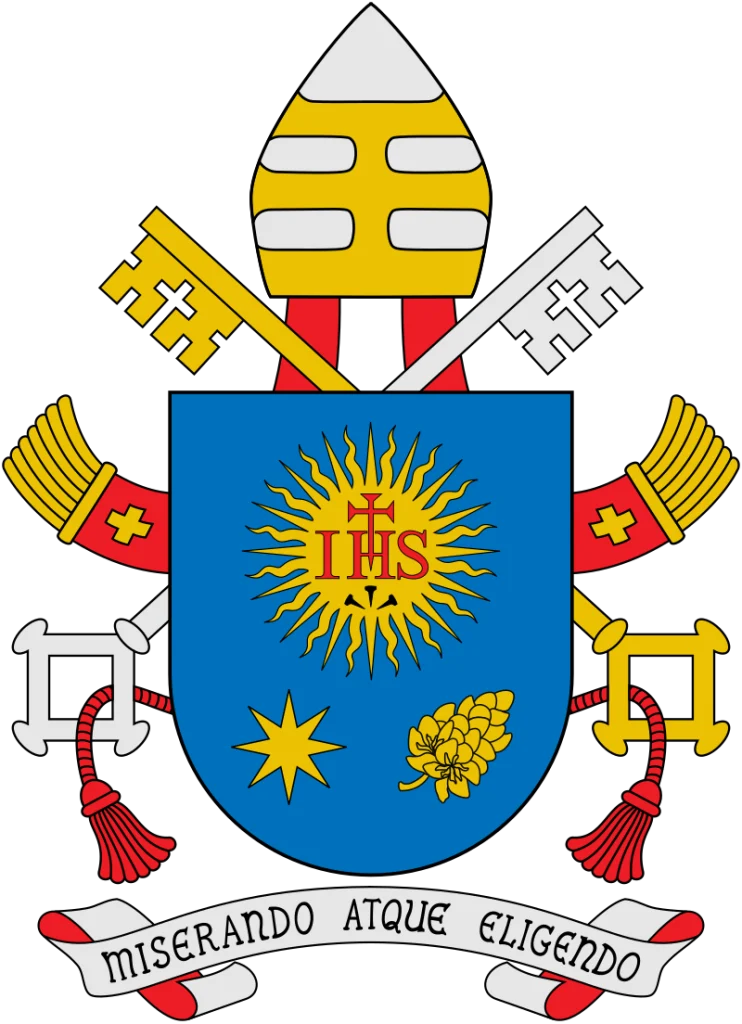
Image: Francis’s coat of arms – By SajoR, CC BY-SA 2.5, (Wikipedia)
On 18 March 2013, Pope Francis adopted in his papal coat of arms the coat of arms and the motto that he had used since his episcopal consecration in 1991, differenced following his election as Supreme Pontiff.
Charges and field
His coat of arms displays three charges on an Azure (blue) field. About Francis being a Jesuit, the uppermost charge is the emblem of the Society of Jesus. The emblem is composed of a radiant Sun, within which is the IHS christogram (a monogram of the Holy Name of Jesus) in red, with a red cross surmounting the H and three black nails below the H.
Below the Jesuit emblem is an eight-pointed star, the star being a long-standing symbol of the Virgin Mary, and a spikenard representing Saint Joseph. In Hispanic iconographic tradition, Saint Joseph is often depicted with a branch of spikenard in his hand.
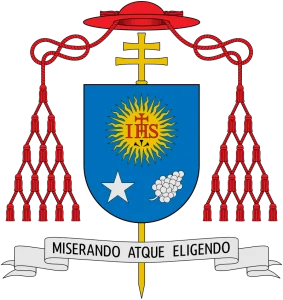
These charges appeared on Bergoglio’s previous coat of arms displayed when he was Archbishop of Buenos Aires, but as Pope, the tincture of the star and the spikenard were elevated from Argent (silver) to Or (gold). The first version of the papal coat of arms published by the Vatican showed a five-pointed star from Bergoglio’s previous one, but this was later amended to eight points; the representation of the spikenard was also slightly altered so it would resemble leaves rather than what appears to be grapes.
Blazon
The Vatican has not published the official blazon of the arms, but an approximation has been made by John Hamilton Gaylor, as follows:
- Azure on a Sun in Splendour Or the IHS Christogram ensigned with a Cross paty fitchy piercing the H Gules all above three Nails fanwise points to centre Sable, and in dexter base a Mullet of eight points and sinister base a Spikenard flower Or.
External ornaments
Traditionally, a Pope’s coat of arms was externally adorned only by the three-tiered papal tiara with lappets and the crossed keys of Saint Peter with a cord. The tiara represented the roles of authority of the Pope, while the keys represent the power to loose and bind in Heaven as on earth.[7] Pope Francis’ arms maintain the keys, but he replaced the tiara (as did his predecessor) with a triband mitre.
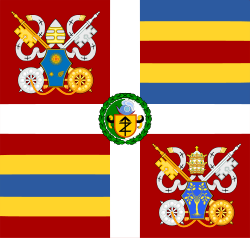
The tiara and keys remain the symbol of the papacy and appear on the coat of arms of the Holy See and (reversed) on the flag of Vatican City.
Mitre
As with his predecessor’s arms, Francis replaced the traditional papal triregnum by adopting a silver mitre with three gold bands. These bands allude to the papal tiara’s three crowns, which came to represent the three powers of Orders, Jurisdiction, and Magisterium, all joining at the centre, depicting unity in the same person.
Motto
Unusually, Francis also decided to retain his motto: Miserando atque eligendo. It is taken from the 21st homily of Saint Bede, which is on the Gospel of Matthew and refers to the vocation of Saint Matthew. He writes:
- “Vidit ergo Iesus publicanum et quia miserando atque eligendo vidit, ait illi ‘Sequere me’.” (Om. 21; CCL 122, 149-151)
- “Jesus saw the tax collector and, because he saw him through the eyes of mercy and chose him, he said to him: Follow me.” (trans. Liturgy of the Hours 1975, p. 1418)
Bede is here discussing Matthew 9:9-13. The salient point is that Jesus chose Matthew as his disciple, not in spite but because he was a sinner. In the KJV translation:
- And as Jesus passed forth from thence, he saw a man, named Matthew, sitting at the receipt of custom: and he saith unto him, Follow me. And he arose and followed him.
- And it came to pass, as Jesus sat at meat in the house, behold, many publicans and sinners came and sat down with him and his disciples.
- And when the Pharisees saw it, they said unto his disciples, Why eateth your Master with publicans and sinners?
- But when Jesus heard that, he said unto them, They that be whole need not a physician, but they that are sick.
- But go ye and learn what that meaneth, I will have mercy, and not sacrifice: for I am not come to call the righteous, but sinners to repentance.
The statement from the Vatican announcing the Pope’s coat of arms and motto explained that the phrase had a special meaning for Francis as he felt it recalled his vocation, when at the age of 17, he went to confession on St Matthew’s day in 1953.
 |
|

References
- ^ Thavis, John (18 March 2013). “The pope’s coat-of-arms and motto”. Decoding the Vatican.
- ^ “Lo Stemma di Papa Francesco” (in Italian). L’Osservatore Romano. March 18, 2013. Retrieved March 18, 2013.
- ^ “Pope Francis : “Miserando atque eligendo”…” Vatican Information Service. March 18, 2013. Archived from the original on October 18, 2017. Retrieved March 18, 2013.
- ^ “Pope stresses simplicity, ecumenism in inaugural Mass plans”. National Catholic Reporter. 18 March 2013. Retrieved 18 March 2013.
- ^ “Lo Stemma di Papa Francesco” (in Italian). L’Osservatore Romano. March 18, 2013. Retrieved 4 December 2016. “La stella, secondo l’antica tradizione araldica, simboleggia la Vergine Maria, madre di Cristo e della Chiesa; mentre il fiore di nardo indica San Giuseppe, patrono della Chiesa universale. Nella tradizione iconografica ispanica, infatti, San Giuseppe è raffigurato con un ramo di nardo in mano.”
- ^ “Wedvick of Jarlsby – Religious/Francis, H. H. Pope 3”. Archived from the original on 2013-12-06.
- ^ (Matt 16:19)
Explore this subject
Continue exploring related Open Chronicle Encyclopedia entries through the categories associated with this article.

Staff Writers at Open Chronicle produce trusted journalism, strategic analysis and authoritative reference content across global affairs, geopolitics, defense, science, history, technology, business, culture and sport. Their work combines accurate reporting with historical perspective and analytical depth, helping readers understand not only what is happening, but why it matters. Beyond daily news coverage, Staff Writers contribute to the Open Chronicle Encyclopedia, investigative features, original research projects and long-form reports, building a comprehensive knowledge platform designed to inform, educate and preserve reliable information for a global audience.