
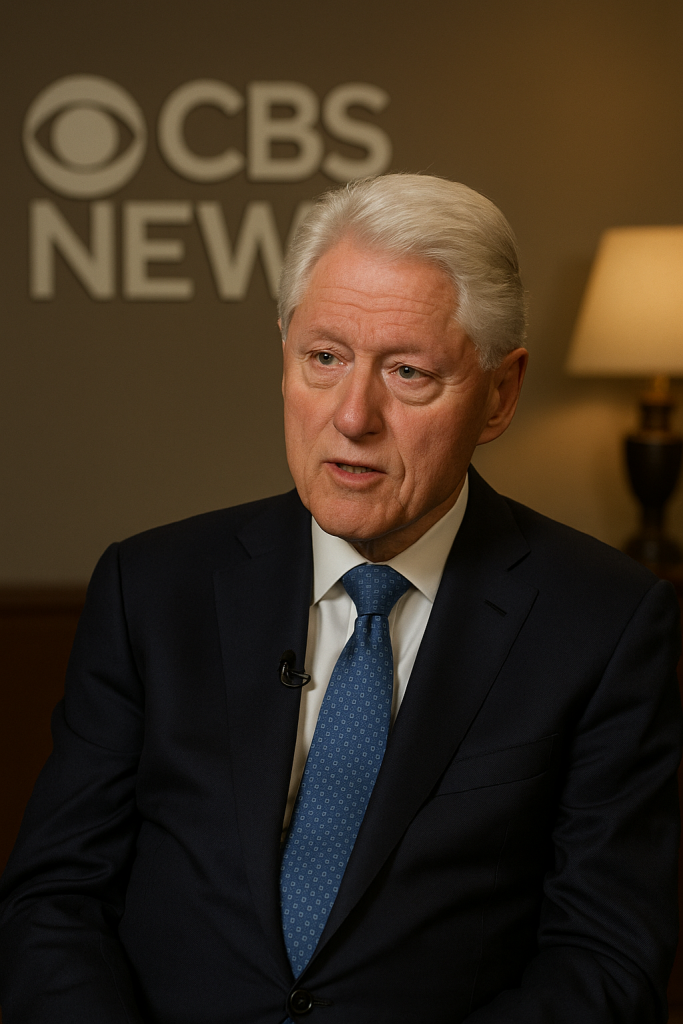
Image Credentials: Image Title: Bill Clinton Says Trump Is Paying ‘a Price’ for Bullying and Overreach Source: (sora.chatgpt) Date: June 2025 Attribution: Created by AI-generated imagery (sora.chatgpt), it does not depict a real-world scene.
June 3, 2025 | Washington, D.C. — National Desk
By Staff Writer with Agencies
Former President Bill Clinton is sounding the alarm about Donald Trump’s leadership style and its consequences, saying the former president is “paying a price” for his bullying, disdain for legal norms, and authoritarian rhetoric.
In a pointed interview on CBS News’ Sunday Morning, Clinton reflected on the turbulent political era defined by Trump’s combative tactics and growing tensions between the executive branch and the judiciary. “We’ve never seen anything like this before in my lifetime,” Clinton said. “Somebody who says, ‘Whatever I want should be the law of the land. It’s my way or the highway.’ And most Americans don’t agree with that.”
Clinton, now 78, acknowledged the political fallout Trump faces, noting that his aggressive behavior and scorched-earth approach to opposition have chipped away at his popularity. “I like to think that he’s paid a price for this, you know, name-calling and throwing his weight around. I think it’s made him less popular,” he said.
Trump’s War on the Judiciary
Trump’s second presidency has been marked by increasingly hostile attacks on the U.S. judicial system. Judges who have ruled against his policies have frequently been labeled “radical leftists” or “deep state agents” in speeches and social media posts.
A recent national poll found that nearly 60% of Americans believe Trump has “gone too far” in how he wields presidential power, particularly in seeking to sidestep judicial constraints.
Clinton warned that Trump’s attempts to undermine the courts represent a direct challenge to America’s legal foundations. “He is looking for ways to basically defy all these court orders,” Clinton said. “But I think he’ll have a hard time doing that. And if he does, I think it will hurt him in America.”
He further criticized Trump’s effort to restrict legal representation in federal matters, saying, “That ain’t America. The whole purpose of having a legal system is to have both sides be heard.”
The Democratic Strategy: Focus Local, Think National
Looking forward, Clinton urged Democrats to shift focus toward gubernatorial races and reclaiming control of the House of Representatives in order to slow the advance of the Trump agenda. “Only elections are going to change this,” he said. “Someone needs to stand up and say, ‘Damn it, what we have in common matters more. We cannot throw the legacy of this country away.’”
With 2026 midterms on the horizon, Clinton’s comments seem aimed at rallying the Democratic base around legislative and state-level races where policy traction is more attainable.
Defending Biden Amid Fitness Questions
Clinton also took time to defend President Joe Biden amid renewed speculation about his mental fitness, following the release of Original Sin, a book by CNN’s Jake Tapper and Axios’ Alex Thompson. The book, which portrays Biden as showing signs of cognitive decline, has fueled bipartisan concern about the 82-year-old president’s capacity to lead.
But Clinton dismissed the claims, saying Biden appeared “in good shape” the last time they met. “The book didn’t register with me because I never saw him that way,” he said. “He’s not president anymore, and I think he did a good job.”
Biden himself responded defiantly last week, quipping, “You can see that I’m mentally incompetent, and I can’t walk, and I can beat the hell out of both of them,” referring to Tapper and Thompson.
A Battle of Legacies
Clinton’s interview underscores a broader clash of presidential legacies—between his own centrist, coalition-building politics and Trump’s confrontational populism. As Trump continues to escalate rhetoric against courts and critics, Clinton’s words carry a warning for both political camps: that the rule of law, public trust, and institutional norms cannot be taken for granted.
“In the end,” Clinton said, “it’s not about one person’s power. It’s about whether we’re still a nation of laws—and whether we’re willing to fight to stay one.”