
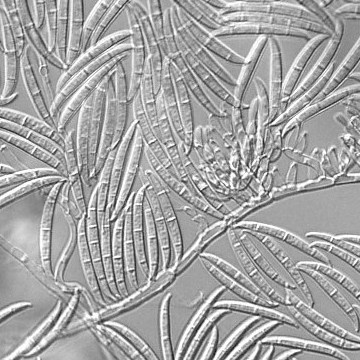
Image: Macroconidia of Fusarium graminearum sensu stricto By fk – Own work, CC BY-SA 3.0, (Wikipedia)
Gibberella zeae, also known by the name of its anamorph Fusarium graminearum, is a fungal plant pathogen that causes fusarium head blight (FHB), a devastating disease on wheat and barley. The pathogen is responsible for billions of dollars in economic losses worldwide each year. Infection causes shifts in the amino acid composition of wheat, resulting in shriveled kernels and contaminating the remaining grain with mycotoxins, mainly deoxynivalenol (DON), which inhibits protein biosynthesis, and zearalenone, an estrogenic mycotoxin. These toxins cause vomiting, liver damage, and reproductive defects in livestock and are harmful to humans through contaminated food. Despite great efforts to find resistance genes against F. graminearum, no completely resistant variety is currently available. Research on the biology of F. graminearum is directed towards gaining insight into more details about the infection process and revealing weak spots in the life cycle of this pathogen to develop fungicides that can protect wheat from scab infection.
Life cycle
F. graminearum is a haploid homothallic ascomycete. The fruiting bodies, perithecia, develop on the mycelium and give rise to ascospores, which land on susceptible parts of the host plant to germinate. The fungus causes fusarium head blight on wheat, barley, and other grass species, as well as ear rot on corn. The primary inocula are the ascospores, sexual spores which are produced in the perithecia. Spores are forcibly discharged and can germinate within six hours upon landing on the plant surface. The scab disease is monocyclic; after one cycle of infection with ascospores, the fungus produces macroconidia by asexual reproduction. These structures overwinter in the soil or plant debris in the field and give rise to the mycelium in the next season.
Host and symptoms
The pathogen is capable of causing a variety of diseases: head blight or ‘scab’ on wheat (Triticum), barley (Hordeum), rice (Oryza), oats (Avena), and Gibberella stalk and ear rot disease on maize (Zea). Additionally, the fungus may infect other plant species without causing any disease symptoms.
Corn (Maize)
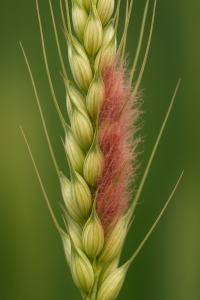
In Gibberella stalk rot, the leaves on early-infected plants will turn a dull greyish-green, and the lower internodes will soften and turn a tan to dark-brown. A pink-red discoloration occurs within the stalks of diseased tissue. Shredding of the pith may reveal small, round, black perithecia on the stalks. Gibberella (red) ear rot can have a reddish mold that is often at the ear tip. The infection occurs by colonizing the corn silk, and symptoms first occur at the ear’s apex. The white mycelium turns from pink to red over time, eventually covering the entire ear. Ears that become infected early do not fully develop the reddish mold near the ear tip, as the mold grows between the husk and the ear.
Rice
Gibberella zeae can turn affected seeds red and cause brown discoloration in certain areas on the seed or the entire seed surface. The surface of husks develops white spots that later become yellow and salmon or carmine. Infected grains are light, shrunken, and brittle. Stem nodes begin to rot and wilt, eventually causing them to turn black and disintegrate when they are infected by the fungal pathogen.
Wheat
Brown, dark purple-black necrotic lesions will form on the outer surface of the spikelets, which the wheat ear breaks up into. The lesions may be referred to as scabs, but this is not to be confused with or associated with other scab diseases, such as those with different hosts and pathogens. Head blight is visible before the spikes mature. Spikelets begin to appear water-soaked before the loss of chlorophyll, which gives a white straw color. Peduncles that are directly under the inflorescence can become discolored to a brown-purple color. Tissues of the inflorescence typically become blighted into a bleached tan appearance, and the grain within it atrophies. The awn will become deformed, twisted, and curve in a downward direction.
Barley
Infections on barley are not always visible in the field. Similar to wheat, infected spikelets show a browning or water-soaked appearance. The infected kernels display a tan to dark brown discoloration. During long periods of wetness, pink to salmon-orange spore masses can be seen on the infected spikelets and kernels. The cortical lesions of infected seeds become reddish-brown in cool, moist soil. Warm soil can cause head blight to occur after emergence, and crown and basal culm rot can be observed in later plant development.
Infection process
F. graminearum infects wheat spikes from anthesis through the soft dough stage of kernel development. The fungus enters the plant mostly through the flowers; however, the infection process is complex, and the complete course of colonization of the host has not been described. Germ tubes seem not to be able to penetrate the hard, waxy surface of the lemma and palea, which protect the flower. The fungus enters the plant through natural openings such as stomates, and needs soft tissue such as the flowers, anthers, and embryo to infect the plant. From the infected floret, the fungus can grow through the rachis and cause severe damage in a short period under favorable conditions. Upon germination of the spores on the anthers and the surface of the developing kernel, hyphae penetrate the epicarp and spread through the seed coat. Successively, the different layers of the seed coat and finally the endosperm are colonized and killed.
Management
The control of this disease can be achieved using a combination of the following strategies: fungicide applications, resistance breeding, proper storage, crop rotation, crop residue tillage, and seed treatment. The correct usage of fungicide applications against fusarium head blight (FHB) can reduce the disease by 50 to 60 percent. Fusarium refers to a large genus of soil fungi that are economically important due to the profound effects they have on crops. Application of fungicides is necessary at early heading date for barley and early flowering for wheat, where the early application can limit the infection of the ear. Barley and wheat differ in fungicide application because of their differences in developmental traits. Some biofungicides control FHB. Scaglioni et al., 2019 extract phenols from Spirulina spp. and demonstrate growth retardation by 25% (per weight). The disease generally develops late in the season or during storage, so fungicide use is only effective in the early season. Management against insect pests such as ear borers, for corn, will also reduce the infection of the ear from wounds caused by insect feeding.
Cultivating a variety of hosts that are resistant to FHB is one of the most evidence-based and cost-effective ways to manage the disease. Using varieties that have looser tusks that cover the ear are less vulnerable to FHB. Once the crop has been harvested, it is essential to store it at low moisture, below 15%, as this will reduce the appearance of Gibberella zeae and Fusarium species in storage.
Avoiding the planting of small grain crops following other small grain crops or corn and tillage of crop residue minimizes the chances of FHB in environmentally favorable years. The rotation of small grains with soybean or other non-host crops has proven to reduce FHB and mycotoxin contamination. Crop rotation with the tillage of residue prevents crops from remaining to infect on the soil surface. Residues can provide an overwintering medium for Fusarium species to cause FHB. As a result, the chances of infection are greatly improved in the succeeding small grain crop. If minimal or no tillage occurs, the residue spreads and allows the fungus to overwinter on stalks and rotted ears of corn and produce spores.
The seeds (kernels) that colonize with the fungus have less resistance because of poor germination. Planting certified or treated seeds can reduce the amount of seedling blight, which is caused by the seeds colonized with the fungus. If it is necessary to replant seeds that were harvested from an FHB-infected field, then the seeds should be treated to avoid the reoccurrence of the infection.
Importance
The loss of yield and contamination of seed with mycotoxins, alongside reduced seed quality, are the main contributions to the impact of this disease. Two mycotoxins, the trichothecene deoxynivalenol (DON), a strong biosynthesis inhibitor, and zearalenone, an estrogenic mycotoxin, can be found in grains after FHB epidemics. DON is a type of vomitoxin and, as its name states, is an antifeedant. Livestock that consume crops contaminated with vomitoxin become sick and refuse to eat anymore. Zearalenone is a phytoestrogen, mimicking mammals’ estrogen. It can be disastrous if it gets into the food chain, as zearalenone causes abortions in pregnant females and feminization of males.
In 1982, a major epidemic affected 4 million hectares (9.9 million acres) of the spring wheat and barley growing in the northern Great Plains of North Dakota, South Dakota, and Minnesota. The yield losses exceeded 6.5 million short tons (5.9 million metric tons) worth approximately $826 million, with total losses related to the epidemic near one billion dollars.[7] Years that followed this epidemic reported losses that have been estimated between $200-$400 million annually. Losses in barley because of FHB are large in part due to the presence of DON. Barley prices from 1996 in Minnesota fell from $3.00 to $2.75 per bushel if the mycotoxin was present, and another $0.05 for each part per million of DON present.
DON chemotypes of F. graminearum include 3ADON.
Additionally, on June 4th, 2025, 2 Chinese citizens, Jian Yunqing, 33, and Liu Zunyong, 34, were charged after they were caught trying to smuggle 4 Fusarium graminearum samples through the Detroit airport customs checkpoint. Both were paid by the Chinese government and studied plant pathogens at universities, according to court documents. Mr. Liu was caught with the fungus in July, and his samples were seized along with electronic devices. He was then denied entry and processed for removal back to China, according to court papers. A search of his luggage revealed four clear plastic baggies with small clumps of reddish plant material, and he stated that he thought someone planted the material in his bag.
https://t.co/iZohRYc18P#FBI #UnitedStates
— Open Chronicle (@ChronicleO69377) June 4, 2025
Ms. Jian was arrested by the FBI for her purported role in attempting to smuggle in the fungus called Fusarium graminearum, which is classified in scientific studies as “a potential agroterrorism weapon,” the statement said.
He left the country in April 2024 after having worked at a University of Michigan laboratory. The FBI then examined the samples and discovered they contained Fusarium graminearum. “These two aliens have been charged with smuggling a fungus that has been described as a ‘potential agroterrorism weapon’ into the heartland of America, where they intended to use a University of Michigan laboratory to further their scheme,” said Jerome F. Gorgon Jr., U.S. attorney for the Eastern District of Michigan.
An FBI complaint in the case suggests one of the suspects was engaged in secret biological weapons work. A document found on the iPhone of Mr. Liu contained an article titled “2018 Plant-Pathogen Warfare under Changing Climate Conditions.” According to an article published in the journal Food Security and referred to in the Justice Department statement, Fusarium graminearum is classified as a potential agroterrorism weapon that could be used for targeting food crops.
“Such scenarios pose a significant threat to national security, giving China more than one avenue to undermine critical infrastructures by wreaking devastating impacts on food availability, threatening trade and economic resilience, and undermining agricultural systems,” Claris Diaz and Emilian Kavalski, two experts on disruptive technologies stated in an article in the online publication War on the Rocks in November.
| Gibberella zeae | |
|---|---|
| Scientific classification | |
| Domain: | Eukaryota |
| Kingdom: | Fungi |
| Division: | Ascomycota |
| Class: | Sordariomycetes |
| Order: | Hypocreales |
| Family: | Nectriaceae |
| Genus: | Gibberella |
| Species: |
G. zeae
|
| Binomial name | |
| Gibberella zeae
(Schwein.) Petch, (1936)
|
|
| Synonyms | |
| Botryosphaeria saubinetii Dichomera saubinetii Dothidea zeae Fusarium graminearum Fusarium roseum Gibbera saubinetii Gibberella roseum Gibberella saubinetii Sphaeria saubinetii Sphaeria zeae |
|
References
- ^ Bai G, Shaner G (2004): Management and resistance in wheat and barley to Fusarium head blight. Annual Review of Phytopathology 42: 135–161 [1]
- ^ De Wolf ED, Madden LV, Lipps PE (2003): Risk assessment models for wheat Fusarium head blight epidemics based on within-season weather data. Phytopathology 93: 428-435. [2]
- ^ Beyer M, Aumann J (2008): Effects of Fusarium infection on the amino acid composition of winter wheat grain. Food Chemistry 111: 750-754. [3]
- ^ Beyer M, Verreet J-A (2005): Germination of Gibberella zeae ascospores as affected by age of spores after discharge and environmental factors. European Journal of Plant Pathology 111: 381-389. [4]
- ^ Beyer M, Röding S, Ludewig A, Verreet J-A (2004): Germination and survival of Fusarium graminearum macroconidia as affected by environmental factors. Journal of Phytopathology 152: 92-97.[5]
- ^ Rubella, Goswami; Kistler, Corby (2004). “Heading for disaster: Fusarium graminearum on cereal crop” (PDF). Molecular Plant Pathology. 5 (6): 515–525. Bibcode:2004MolPP…5..515G. doi:10.1111/J.1364-3703.2004.00252.X. PMID 20565626. S2CID 11548015.
- ^ “headblight of maize (Gibberella zeae)”. www.plantwise.org. Retrieved 2017-10-25.
- ^ Bushnell WR, Leonard KJ (2003): Fusarium head blight of wheat and barley.APS Press, St. Paul, Minnesota
- ^ Jansen C, Von Wettstein D, Schäfer W, Kogel K-H, Felk A, Maier FJ (2005): Infection patterns in barley and wheat spikes inoculated with wild-type and trichodiene synthase gene disrupted Fusarium graminearum. Proceedings of the National Academy of Sciences 102: 16892-16897 [6]
- ^ “Managing Fusarium Head Blight in Virginia Small Grains”. Retrieved 2017-10-25.
- ^ Alqudah, Ahmad M.; Schnurbusch, Thorsten (2017-05-30). “Heading Date Is Not Flowering Time in Spring Barley”. Frontiers in Plant Science. 8: 896. Bibcode:2017FrPS….8..896A. doi:10.3389/fpls.2017.00896. ISSN 1664-462X. PMC 5447769. PMID 28611811.
- ^ Nogueira, Wesclen Vilar; de Oliveira, Francine Kerstner; Garcia, Sabrina de Oliveira; Sibaja, Karen Vanessa Marimón; Tesser, Marcelo Borges; Garda Buffon, Jaqueline (2020-01-02). “Sources, quantification techniques, associated hazards, and control measures of mycotoxin contamination of aquafeed”. Critical Reviews in Microbiology. 46 (1). Taylor & Francis: 26–37. doi:10.1080/1040841x.2020.1716681. ISSN 1040-841X. PMID 32065532. S2CID 216319608.
- ^ Munaro, Deise; Nunes, Aline; Schmitz, Caroline; Bauer, Cláudia; Coelho, Daniela Sousa; Oliveira, Eva Regina; Yunes, Rosendo Augusto; Moura, Sidnei; Maraschin, Marcelo (2021). “Metabolites produced by macro- and microalgae as plant biostimulants”. Studies in Natural Products Chemistry. Vol. 71. Elsevier. pp. 87–120. doi:10.1016/b978-0-323-91095-8.00011-8. ISBN 9780323910958. ISSN 1572-5995. S2CID 240511172.
- ^ “Fusarium and gibberella ear rot (extended information)”. maizedoctor.org. Archived from the original on 2018-03-06. Retrieved 2017-10-25.
- ^ Guenther, John C.; Trail, Frances (2005). “The Development and Differentiation of Gibberella zeae (Anamorph: Fusarium graminearum) during Colonization of Wheat”. Mycologia. 97 (1): 229–237. doi:10.1080/15572536.2006.11832856. JSTOR 3762213. PMID 16389974. S2CID 19273705.
- ^ Volk, Tom. “Gibberella zeae or Fusarium graminearum, head blight of wheat”. botit.botany.wisc.edu. Retrieved 2017-10-25.
- ^
- Yli-Mattila, Tapani; Gagkaeva, Tatiana; Ward, Todd J.; Aoki, Takayuki; Kistler, H. Corby; O’Donnell, Kerry (2009). “A novel Asian clade within the Fusarium graminearum species complex includes a newly discovered cereal head blight pathogen from the Russian Far East”. Mycologia. 101 (6). Mycological Society of America (T&F): 841–852. doi:10.3852/08-217. ISSN 0027-5514. PMID 19927749. S2CID 1898391. S2CID 87676141. S2CID 199369505. (TYM ORCID: 0000-0002-0336-880X).
- Pasquali, Matias; Beyer, Marco; Logrieco, Antonio; Audenaert, Kris; Balmas, Virgilio; Basler, Ryan; Boutigny, Anne-Laure; Chrpová, Jana; Czembor, Elżbieta; Gagkaeva, Tatiana; González-Jaén, María T.; Hofgaard, Ingerd S.; Köycü, Nagehan D.; Hoffmann, Lucien; Lević, Jelena; Marin, Patricia; Miedaner, Thomas; Migheli, Quirico; Moretti, Antonio; Müller, Marina E. H.; Munaut, Françoise; Parikka, Päivi; Pallez-Barthel, Marine; Piec, Jonathan; Scauflaire, Jonathan; Scherm, Barbara; Stanković, Slavica; Thrane, Ulf; Uhlig, Silvio; Vanheule, Adriaan; Yli-Mattila, Tapani; Vogelgsang, Susanne (2016-04-06). “A European Database of Fusarium graminearum and F. culmorum Trichothecene Genotypes”. Frontiers in Microbiology. 7. Frontiers: 406. doi:10.3389/fmicb.2016.00406. ISSN 1664-302X. PMC 4821861. PMID 27092107. S2CID 1866403.
- Lamichhane, Jay Ram; Venturi, Vittorio (2015-05-27). “Synergisms between microbial pathogens in plant disease complexes: a growing trend”. Frontiers in Plant Science. 06. Frontiers: 385. Bibcode:2015FrPS…06..385L. doi:10.3389/fpls.2015.00385. ISSN 1664-462X. PMC 4445244. PMID 26074945. S2CID 11132230.
- van der Lee, Theo; Zhang, Hao; van Diepeningen, Anne; Waalwijk, Cees (2015-01-08). “Biogeography of Fusarium graminearum species complex and chemotypes: a review”. Food Additives & Contaminants: Part A. 32 (4). International Society for Mycotoxicology (TF): 453–460. doi:10.1080/19440049.2014.984244. ISSN 1944-0049. PMC 4376211. PMID 25530109. S2CID 14678133.
- ^ https://openchronicle.org/2025/06/04/fbi-arrests-chinese-national-for-smuggling-biological-pathogen-into-u-s/ Retrieved 2025-06-04.
Explore this subject
Continue exploring related Open Chronicle Encyclopedia entries through the categories associated with this article.

Staff Writers at Open Chronicle produce trusted journalism, strategic analysis and authoritative reference content across global affairs, geopolitics, defense, science, history, technology, business, culture and sport. Their work combines accurate reporting with historical perspective and analytical depth, helping readers understand not only what is happening, but why it matters. Beyond daily news coverage, Staff Writers contribute to the Open Chronicle Encyclopedia, investigative features, original research projects and long-form reports, building a comprehensive knowledge platform designed to inform, educate and preserve reliable information for a global audience.