
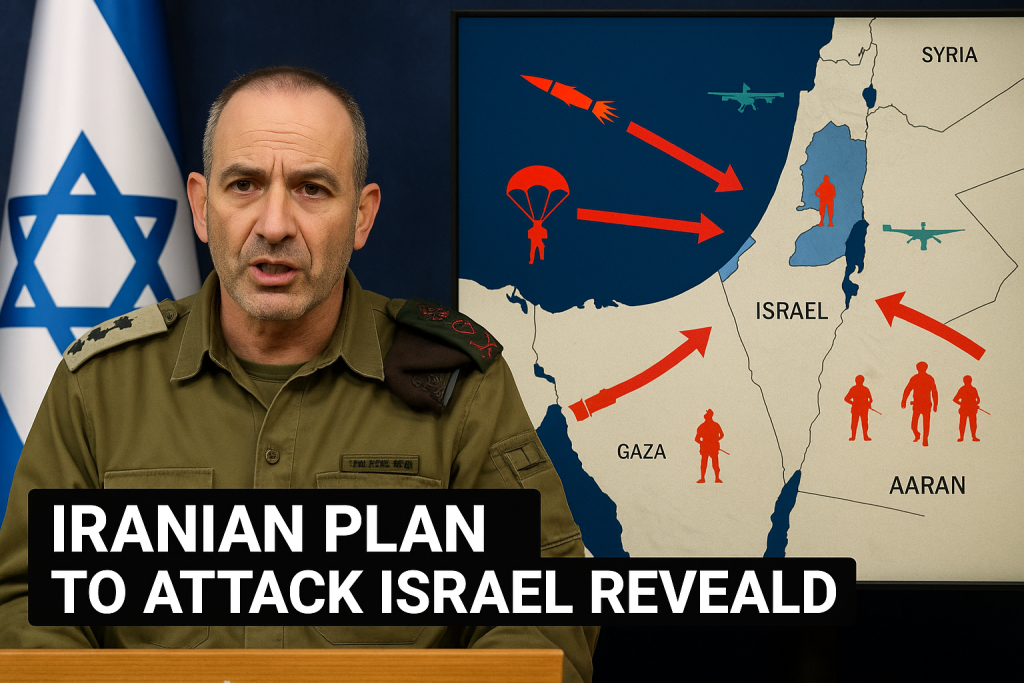
Image Credentials: Image Title: IDF Unveils Iranian Plot to Launch Multi-Front Invasion of Israel (sora.chatgpt) Date: May 2025 Attribution: Created by AI-generated imagery (sora.chatgpt), and it does not depict a real-world scene.
THE OPEN CHRONICLE | DEFENSE & STRATEGY
Tehran’s “Destruction of Israel Plan” triggers preemptive Israeli strikes on nuclear and military targets
By Staff Writer with Agencies
June 13, 2025
Tel Aviv — The Israel Defense Forces revealed on Friday a sweeping Iranian plan to launch a coordinated aerial and ground assault on Israel, describing the operation as a meticulously crafted strategy to “destroy the State of Israel and establish a Palestinian state on its ruins.” The disclosure came just hours after Israeli fighter jets executed preemptive airstrikes on dozens of Iranian military and nuclear installations.
According to Israeli military intelligence, the Islamic Republic of Iran has for years been preparing a comprehensive war doctrine involving “tens of thousands” of rockets, missiles, and attack drones, designed to saturate Israeli defenses—while simultaneously training thousands of militants across the Middle East for a large-scale ground invasion. The IDF referred to the initiative as a “combined ground offensive on multiple fronts,” coordinated through Tehran’s vast proxy network.
“This was not a theoretical threat. This was a concrete operational plan,” an IDF spokesperson said during Friday’s briefing. “We have intelligence collected throughout this war and confirmed by documents seized from Hamas and Hezbollah operatives, proving Iran’s intention to orchestrate a synchronized invasion.”
🚨IDF: Iranians have developed a plan to destroy the State of Israel, by using widespread and precise fire from the entire Iranian axis, a ground invasion using pickup trucks from all borders, and undermining the regimes in Jordan and Egypt. "We are in a strategic window of… pic.twitter.com/BAmgYFJGM2
— ZIONS OF ISRAEL (@Israeli_Sniper) June 13, 2025
The Multi-Front War Plan
The plan, according to the IDF, envisioned a massive barrage of rockets and missiles launched from Iran’s proxies in Lebanon, Syria, Yemen, and Iraq. This aerial onslaught was to mask a simultaneous ground infiltration by thousands of Iran-backed militants entering Israel from Gaza, Judea, Samaria, and across Israel’s northern and eastern borders, including from Jordan and Syria.
The objective, as stated in intelligence documents, was clear: “to overrun Israeli territory, collapse its political and military infrastructure, and replace it with a Palestinian entity under Iranian tutelage.” The IDF said this plan was developed in close coordination with the leadership of Hamas and Hezbollah, and has only accelerated since the October 7, 2023, massacre that triggered the current Swords of Iron war.
Nuclear Parallel
Compounding the threat, Israel’s Military Intelligence Directorate highlighted Iran’s ongoing nuclear ambitions as part of what it calls “The Destruction of Israel Plan.” While publicly denying military intent, Tehran has simultaneously been stockpiling enriched uranium and enhancing long-range missile capabilities, prompting Israel’s decision to strike preemptively.
Early Friday morning, Israeli Air Force squadrons launched what military officials described as a “precise, high-impact operation” against critical Iranian military and nuclear facilities. Targets reportedly included command-and-control hubs, drone manufacturing plants, missile stockpiles, and suspected nuclear research centers.
“This operation is not symbolic,” said Prime Minister Benjamin Netanyahu in a national address. “It is the beginning of a determined campaign to eliminate the Iranian threat to Israel’s existence. We will continue for as long as necessary, with no compromise.”
Regional Fallout and Strategic Implications
The IDF’s disclosure marks a major escalation in Israel’s posture toward Iran and its regional proxies. By publicly unveiling the scope of Tehran’s invasion plan, Israel appears to be signaling both to its domestic population and international allies that its recent actions are not merely retaliatory, but existential.
Analysts note that the scale and sophistication of the Iranian plan indicate a new threshold of regional coordination, one that effectively binds together disparate militant groups under a unified war doctrine. That coordination, Israeli officials claim, is not just ideological—it’s operational.
“People talk about a proxy war,” said one senior defense official. “But what we see here is a direct Iranian command structure embedded into multiple militias. This is not outsourcing. This is ownership.”
A Turning Point?
Whether Iran will escalate in response to Israel’s preemptive strike remains unclear. Tehran has so far not acknowledged the full extent of the damage, though Iranian state media has reported “foreign aggression” against military sites. Hezbollah and other Iran-aligned militias have issued statements of solidarity but have not yet launched coordinated responses.
The IDF remains on high alert. Troop deployments to the northern and southern borders have intensified, while air defense systems across the country remain at peak readiness.
What is certain: Israel is now treating Iran not merely as an ideological adversary or a shadowy backer of regional unrest—but as a direct and imminent military threat. Friday’s revelations represent the clearest articulation yet of what Israeli officials believe they are up against: a regional war designed in Tehran, ready to erupt on multiple fronts, and aimed at erasing Israel from the map.