
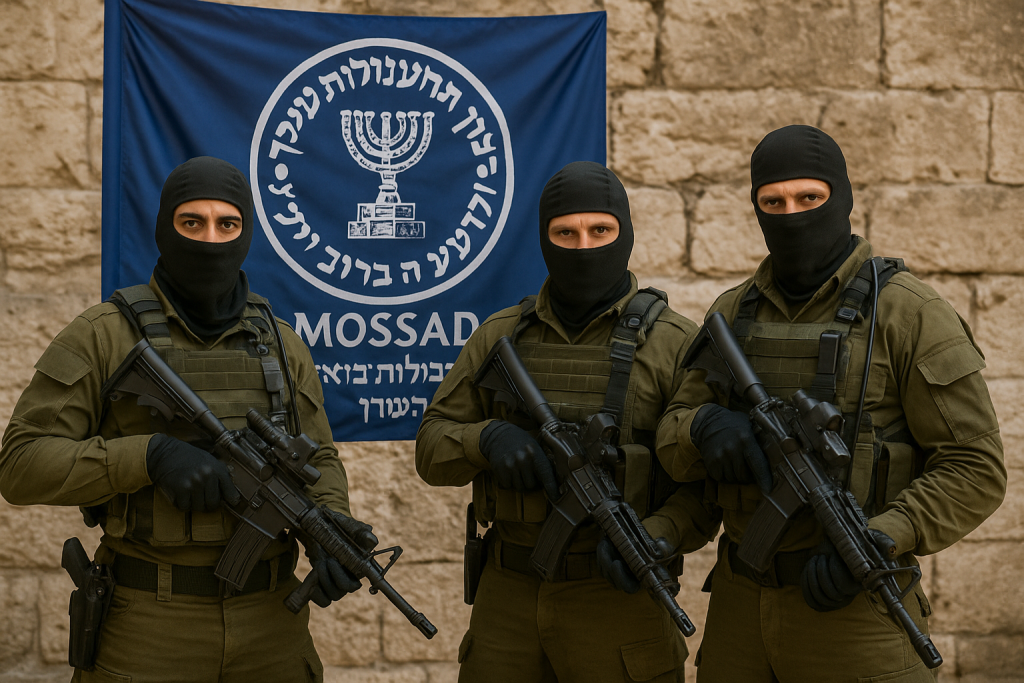
Image Credentials: Image Title: Mossad and Israeli commandos (sora.chatgpt) Date: May 2025 Attribution: Created by AI-generated imagery (sora.chatgpt), and it does not depict a real-world scene.
THE OPEN CHRONICLE
June 13, 2025 | Front Page
By Staff Writer with Agencies, Global Security Desk
In an audacious and unprecedented escalation, Israel has launched a sweeping military and intelligence operation deep into the heart of Iran, striking more than 100 targets—including nuclear facilities, missile sites, and key command centers—in a campaign that Israeli officials confirm was years in the making.
Codenamed Operation Rising Lion, the meticulously coordinated assault shattered assumptions that Israel would restrain itself to rhetoric or symbolic strikes as leverage in nuclear negotiations. Instead, what unfolded was a multi-domain offensive—fusing air power, espionage, cyber sabotage, and covert ground operations—designed to disable Iran’s nuclear program and paralyze its military leadership in one fell swoop.
Behind Enemy Lines: Mossad’s Trojan Horse
Central to the success of Operation Rising Lion was a daring covert effort by Mossad and Israeli commandos to pre-position weapons and sabotage Iran’s formidable air defenses. Israeli operatives, reportedly embedded in Iran for months if not years, smuggled in precision-guided munitions and special weapons systems, concealing them in civilian vehicles and nondescript buildings near strategic military targets.
A shadow drone base—set up near Tehran—served as a launchpad for explosive UAVs that crippled radar arrays and missile batteries as Israel’s Air Force surged into Iranian airspace. Explosions simultaneously erupted in cities including Tehran, Shiraz, Kermanshah, and Bandar Abbas. The Israeli military claims over 330 munitions were dropped in the first wave alone.
“This was not just an air raid. It was a full-spectrum disarmament campaign, planned over years and executed in hours,” a senior Israeli official told The Open Chronicle on condition of anonymity.
Target: Natanz and the Nuclear Core
Nowhere was the strike more symbolically potent—and operationally significant—than at Natanz, the epicenter of Iran’s uranium enrichment program. Though buried under over 20 meters of concrete and earth, Israeli bunker-busting munitions reportedly penetrated the defenses, damaging critical infrastructure and halting centrifuge operations.
“This is no longer a theoretical red line,” said Darya Dolzikova, nuclear policy expert at RUSI. “Israel struck not only at Iran’s nuclear capability but at the very architecture sustaining its nuclear ambitions.”
Iranian state media confirmed damage to the site but reported no radiation leaks. Yet six senior nuclear scientists were among those killed in the assault, according to the semi-official Tasnim news agency.
Leadership Decapitated: A Strategic Earthquake
Equally devastating was the blow to Iran’s military leadership. Iranian authorities confirmed the deaths of Mohammad Bagheri, Iran’s Armed Forces Chief of Staff, Hossein Salami, the Commander of the Islamic Revolutionary Guard Corps (IRGC), and Amirali Hajizadeh, commander of its aerospace force. The meeting where they were killed took place inside a reportedly secure underground facility—a fact Israeli intelligence exploited with chilling precision.
“This is a profound strategic humiliation for Iran,” noted Dr. Burcu Ozcelik of the Royal United Services Institute. “The psychological effect of these assassinations, combined with the collapse of air defenses, creates a power vacuum that could take weeks or months to recalibrate.”
Supreme Leader Ali Khamenei moved swiftly to name General Ahmad Vahidi as the new IRGC commander, but analysts suggest the decapitation of senior leadership will hobble Iran’s capacity to respond decisively.
The Retaliation Question
In the wake of the strikes, Iran vowed “a harsh response,” and unconfirmed reports emerged of over 100 drones launched toward Israel. Yet Iran’s own security sources appeared to contradict these claims, sowing confusion. “We are still preparing,” one source told Fars News Agency, “and our retaliation will not be rushed.”
Whether Iran can mount an effective counteroffensive remains uncertain. Experts suggest its degraded radar systems, destroyed missile launchers, and the death of key commanders have left it exposed and off-balance.
“What comes next,” Dr. Ozcelik warned, “may define the regional security order for years to come.”
A Global Flashpoint
Markets reacted swiftly. Brent crude surged over 12% on fears that extended conflict could curtail Iranian oil production. Equities across Asia and Europe dipped sharply. Though Israel has thus far avoided directly targeting oil infrastructure, the risk of collateral or retaliatory damage looms large.
“This is not a replay of 1981’s Operation Opera,” said Dr. Andreas Krieg, referencing Israel’s historic airstrike on Iraq’s nuclear reactor. “Iran’s nuclear architecture is diffuse, resilient, and far more advanced. What Israel accomplished last night was surgical, but the road to strategic rollback is far from over.”
Geopolitical Shockwaves
The strikes land amid U.S.-Iran nuclear negotiations in Vienna. U.S. Secretary of State Marco Rubio insisted Israel acted unilaterally, while President Donald Trump said Iran “brought this on itself” by resisting U.S. demands.
The International Atomic Energy Agency said Iran had failed to meet its non-proliferation obligations for the first time in two decades, with Tehran vowing to open new underground enrichment sites. Meanwhile, Washington and European allies brace for further escalation.
The Strategic Unknown
Israel has stated the operation will “continue for as many days as it takes,” raising questions about the long-term strategy. Will it press further into Iranian territory? Was the goal to decapitate, or to cripple?
“Israel has demonstrated astonishing reach and coordination,” said Matthew Savill, Director of Military Sciences at RUSI. “But the danger now lies in the next step. Will Iran lash out, will it regroup, or will we see further destabilization of proxy theaters like Lebanon, Syria, and Iraq?”
Conclusion: A New Chapter in Shadow War
What began as whispers of cyber warfare and assassination has erupted into the largest conventional Israeli assault on Iran since the 1980s. Operation Rising Lion has reshaped red lines, recalibrated deterrence, and ignited a new phase in a long-simmering shadow war.
For Israel, it marks a demonstration of overwhelming tactical precision. For Iran, it is both a wake-up call and a national trauma. And for the world, it is a chilling reminder of how quietly wars can be prepared—and how suddenly they can begin.