
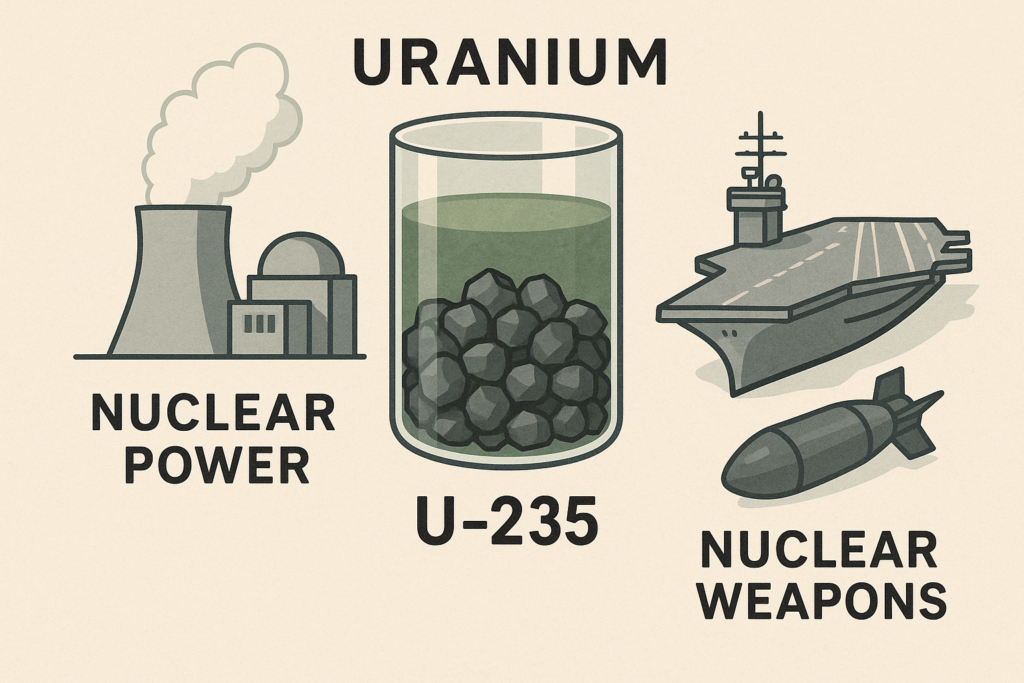
Image Credentials: Image Title: From Power to Peril: How Uranium Enrichment Defines Nuclear Use—From Bombs to Aircraft Carriers (sora.chatgpt) Date: May 2025 Attribution: Created by AI-generated imagery (sora.chatgpt), and it does not depict a real-world scene.
By Staff Writer | Open Chronicle Science & Strategy Desk | June 13, 2025
At the heart of both nuclear power and nuclear weapons lies the same element: uranium. But not all uranium is created—or enriched—equally. While the explosive force of an atomic bomb and the endurance of a nuclear-powered aircraft carrier may seem worlds apart, both rely on a critical characteristic: the concentration of the fissile isotope Uranium-235 (U-235).
Understanding how uranium is enriched, and to what degree, reveals the thin line separating peaceful nuclear power from apocalyptic military potential.
What Is Uranium Enrichment?
Uranium enrichment is the process of increasing the percentage of U-235, the rare isotope capable of sustaining a nuclear chain reaction. Naturally occurring uranium contains only about 0.7% U-235, with the remainder being mostly the inert U-238. For most applications, whether in energy production or weaponry, this natural composition is insufficient.
Through sophisticated technologies such as gas centrifuges, uranium is processed to concentrate the U-235 isotope to various levels, depending on the intended use.
Weapon-Grade Uranium: Enrichment Above 90%
To build a nuclear bomb, uranium must be enriched to more than 90% U-235. This is known as weapon-grade uranium, and it’s the threshold at which the material becomes explosive.
At these levels of enrichment, U-235 atoms are packed closely enough that a sustained, fast, and uncontrollable chain reaction can occur. This is the mechanism behind the terrifying power of nuclear weapons.
Atomic bomb uranium enrichment level:
✅ More than 90% U-235
By comparison, natural uranium is practically inert in weapons terms, and low-enriched uranium—used in civilian nuclear power plants—poses no direct proliferation risk unless further enriched.
Civilian Use: The Low End of the Spectrum
Nuclear reactors that generate electricity for homes and industries typically use low-enriched uranium (LEU) with 3% to 5% U-235. This range allows for a sustained and controllable chain reaction, suitable for energy production but nowhere near capable of causing a nuclear explosion.
Nuclear power plant uranium enrichment:
🔋 3% to 5% U-235
This relatively low level of enrichment is also a key safeguard in non-proliferation efforts, making it much harder to weaponize civilian nuclear programs.
Naval Nuclear Propulsion: High Enrichment, No Explosion
Between the extremes of bombs and power plants lies a unique middle ground: naval nuclear propulsion. The United States Navy, for instance, uses uranium enriched to nearly 90%—on par with weapon-grade material, to power its nuclear aircraft carriers and submarines.
Uranium used in U.S. nuclear-powered aircraft carriers:
🚢 ~90% U-235
Why such high enrichment if the goal isn’t detonation? The answer lies in autonomy. Highly enriched uranium enables U.S. naval reactors to operate for 20 to 30 years without refueling, a strategic advantage that eliminates the logistical burden and vulnerability associated with mid-life reactor overhauls.
Other countries, such as France, use intermediate enrichment levels (5–20%) in naval reactors. These designs trade autonomy for reduced proliferation risk, allowing for more frequent refueling.
At a Glance: Uranium Enrichment Levels by Use
| Application | U-235 Enrichment |
|---|---|
| Atomic bomb | > 90% |
| U.S. nuclear aircraft carrier | ~90% |
| Naval reactor (France, others) | 5–20% |
| Civilian nuclear power plant | 3–5% |
| Natural uranium | 0.7% |
Strategic Implications
The overlap between military and naval-grade uranium raises concerns among arms control advocates. Though nuclear reactors on ships do not explode, the use of near-weapon-grade uranium in naval fleets introduces risks of diversion and proliferation, particularly if naval fuel cycles fall outside international safeguards.
For states pursuing nuclear submarine capabilities, such as Australia under AUKUS, the distinction between peaceful use and latent weapons capacity is becoming increasingly blurred.
Conclusion: Enrichment as a Strategic Choice
Whether lighting cities or fueling warships—or, in the most extreme case, destroying entire regions—the enrichment level of uranium defines its purpose. While the physics remains the same, the politics and ethics diverge sharply. Understanding where the enrichment threshold lies helps decode the global stakes behind every centrifuge spin, every submarine launch, and every international treaty negotiation.
In the nuclear age, knowledge is power—and power, in this case, begins at 90% U-235.
-
International Atomic Energy Agency. Nuclear Fuel Cycle and Materials. Accessed June 13, 2025. https://www.iaea.org/topics/nuclear-fuel-cycle-and-materials.
-
U.S. Nuclear Regulatory Commission. Enrichment of Uranium. Accessed June 13, 2025. https://www.nrc.gov/materials/fuel-cycle-fac/ur-enrichment.html.
-
U.S. Department of Energy, Office of Naval Reactors. Office of Naval Reactors: Annual Reports and Fact Sheets. Accessed June 13, 2025. https://www.energy.gov/nnsa/office-naval-reactors.
-
Federation of American Scientists. Highly Enriched Uranium. Accessed June 13, 2025. https://fas.org/issues/nuclear-weapons/nuclear-materials/heu/.
-
World Nuclear Association. Nuclear Power Reactors. Accessed June 13, 2025. https://world-nuclear.org/information-library/current-and-future-generation/nuclear-power-reactors.aspx.
-
International Panel on Fissile Materials. Naval Nuclear Propulsion and the Non-Proliferation Treaty. Accessed June 13, 2025. http://fissilematerials.org.
-
O’Rourke, Ronald. Navy Nuclear-Powered Ships: Background, Issues, and Options. Congressional Research Service, Report RL33946. Washington, DC: Library of Congress, 2023. https://crsreports.congress.gov/product/pdf/RL/RL33946.
-
National Academies of Sciences, Engineering, and Medicine. Reducing the Use of Highly Enriched Uranium in Civilian Research Reactors. Washington, DC: The National Academies Press, 2016. https://doi.org/10.17226/21818.