
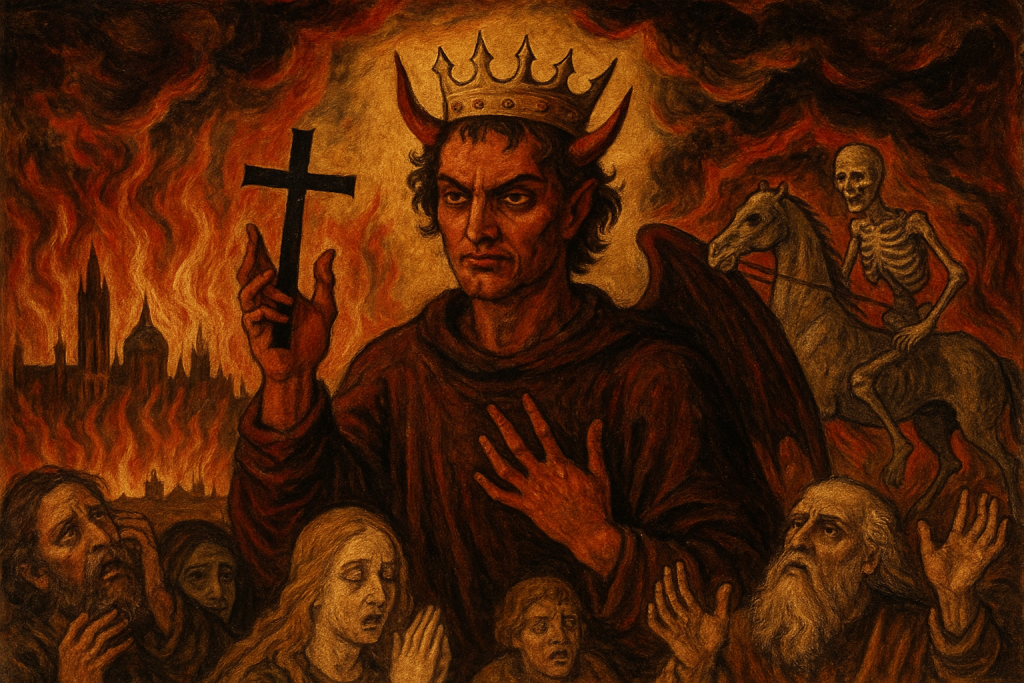
Image Credentials: Image Title: The Two Faces of the Antichrist: A Western Vision of Power, Prophecy, and Parody Source: (sora.chatgpt) Date: June 2025 Attribution: Created by AI-generated imagery (sora.chatgpt), it does not depict a real-world scene.
By Staff Writer | Open Chronicle
In one of the strangest convergences of imagery and ideology in recent history, the United States presidency and the Catholic papacy were visually fused on May 3 when Donald Trump’s Truth Social account posted an AI-generated image of the former president dressed as the pope. Seated on an opulent throne reminiscent of Mar-a-Lago, Trump wore a white cassock and bishop’s miter, raising his finger in a papal gesture. Though he later claimed the image was created “in fun” and without his involvement, its symbolism struck a deep cultural and historical chord—one likely unrecognized by Trump or the White House.
— The White House (@WhiteHouse) May 3, 2025
The image has triggered theological and historical analysis for an unexpected reason: it evokes the two most enduring interpretations of the Antichrist in Western thought—first, the pope as deceiver within the church, and second, the authoritarian world emperor. That these roles now merge in a digitally fabricated “Pope Donald I” is a moment of eerie resonance in a world wrestling with questions of power, truth, and collapse.
Echoes of Apocalypse
Christianity’s oldest warnings suggest the Antichrist would emerge before Christ’s return, signaling the world’s end. As the First Letter of John states, this human figure would embody opposition to Christ, not as a supernatural being, but as a man utterly consumed by sin and wickedness. “He will call himself Almighty God,” wrote Adso of Montier-en-Der, a Benedictine monk who penned the first life of the Antichrist in the 10th century. He would be rich, cruel, charismatic—and his corruption would spread like fire.
Such a figure, according to Adso and generations of Christian thinkers, would not just dominate nations but claim divine authority. In this light, Trump’s joking papal cosplay, coupled with statements like “I run the country and the world” and “I’d like to be pope,” made just days after Pope Francis’ death in April, seem less like humor and more like archetype.
Over centuries, emperors such as Nero, Napoleon, and even more recent figures like Saddam Hussein, Osama bin Laden, and Gorbachev have been labeled Antichrists by various groups. Trump, too, has been named among them—especially in some evangelical circles, where messianic and demonic archetypes remain deeply embedded in political interpretation.
The Papal Antichrist
But Trump’s image also touches a second, older thread in the Antichrist narrative: the “Papal Antichrist.” This idea emerged in the 12th century when King Richard I was told by theologian Joachim of Fiore that the next pope would be the Antichrist. It exploded during the Protestant Reformation, when Martin Luther and other reformers denounced the papacy as a spiritual fraud—“the true Antichrist who has raised himself over and set himself against Christ.”
For these reformers, the pope was not merely a misguided leader but the embodiment of false holiness—an enemy within the church who usurped divine authority to enslave the faithful.
That notion persisted through centuries. In 1988, when Pope John Paul II addressed the European Parliament, firebrand preacher Ian Paisley interrupted him, yelling, “Antichrist!” in front of a stunned chamber. Though such views have retreated to the margins of Protestant fundamentalism, their influence still shadows Western religious consciousness.
To now see Trump artificially depicted as pope—an imperial outsider cloaked in the garb of divine authority—is to fuse these once-opposing visions of the Antichrist. The authoritarian king and the spiritual deceiver have, for a moment, become one.
An Image of an Ending?
In the theological imagination, the rise of the Antichrist has always portended the apocalypse. It is the harbinger of the final battle between heaven and hell, truth and deception, God and Satan. While few today take such eschatology literally, the symbolic resonance of these ideas endures. When the boundaries between secular power and sacred authority blur, when the throne and the altar collapse into one, warning bells ring.
Seen in this light, the image of “Pope Donald I” may be more than a viral curiosity or AI novelty. It may be, in the words of cultural historian Harold Bloom, a “scripture of our own making”—a visual fable about the dangers of charisma, corruption, and cult.
Whether created in jest or crafted with a deeper purpose, the image invites us to reflect on the powerful symbols that still shape the Western mind. In its absurdity, it mirrors a world where politics and religion, spectacle and seriousness, satire and prophecy now bleed together.
It also leaves us with a question that the West has long asked of its leaders, in fear and faith: what, truly, does the Antichrist look like?
Sources
-
The Bible. The Holy Bible, English Standard Version. Crossway Bibles, 2001. (Relevant passages: 1 John 2:18, 2 Thessalonians 2, Revelation 13)
-
Adso of Montier-en-Der. Libellus de Antichristo. ca. 950. Translated by Bernard McGinn, Visions of the End: Apocalyptic Traditions in the Middle Ages. New York: Columbia University Press, 1998.
-
Cohn, Norman. The Pursuit of the Millennium: Revolutionary Millenarians and Mystical Anarchists of the Middle Ages. Revised Edition. Oxford: Oxford University Press, 1970.
-
McGinn, Bernard. Antichrist: Two Thousand Years of the Human Fascination with Evil. San Francisco: HarperOne, 2000.
-
Luther, Martin. Against the Papacy at Rome, Instituted by the Devil. 1545. In Luther’s Works, Vol. 41, edited by Eric W. Gritsch and Helmut T. Lehmann. Philadelphia: Fortress Press, 1966.
-
Joachim of Fiore. Expositio in Apocalypsim. ca. 1190. In Marjorie Reeves, The Influence of Prophecy in the Later Middle Ages: A Study in Joachimism. Notre Dame: University of Notre Dame Press, 1993.
-
Newton, Isaac. Observations Upon the Prophecies of Daniel and the Apocalypse of St. John. London: J. Darby and T. Browne, 1733.
-
Pagels, Elaine. Revelations: Visions, Prophecy, and Politics in the Book of Revelation. New York: Penguin Press, 2012.
-
Barkun, Michael. A Culture of Conspiracy: Apocalyptic Visions in Contemporary America. 2nd ed. Berkeley: University of California Press, 2013.
-
“Trump Says He’d Like to Be Pope.” The Atlantic, April 28, 2025. https://www.theatlantic.com.
-
Trump, Donald. Post on Truth Social. May 3, 2025. Image of himself as pope. Screenshot archive available via Truth Social public feed.
-
BBC News. “Pope Francis Dies at 88.” BBC, April 21, 2025. https://www.bbc.com/news.