
OPEN CHRONICLE | GLOBAL NEWS DESK
BREAKING DEVELOPMENTS | RUSSIA–UKRAINE WAR | NOVEMBER 17, 2026
Kyiv says a carefully coordinated campaign of drones and missiles severely damaged one of Russia’s most strategically and symbolically important structures. As Moscow launches retaliatory attacks and Washington prepares for crucial diplomacy, the battle over the Kerch Bridge raises a bigger question: can Ukraine turn a military breakthrough into political leverage?
By Open Chronicle News Desk
November 17, 2026 | Kyiv, Moscow and Washington
The Bridge Putin Built to Cement His Hold on Crimea Is Under Attack Again
For Vladimir Putin, the Kerch Bridge has never been merely a transport connection.
Stretching across the Kerch Strait between Russia and the occupied Crimean Peninsula, the bridge represents one of Moscow’s most visible claims to territory seized from Ukraine in 2014.
For Ukraine, it represents something very different: a strategic supply route supporting Russian military operations and a powerful symbol of occupation.
On Tuesday, November 17, Ukrainian President Volodymyr Zelenskyy announced that his forces had carried out an extensive operation against the crossing, culminating in coordinated drone and missile strikes.
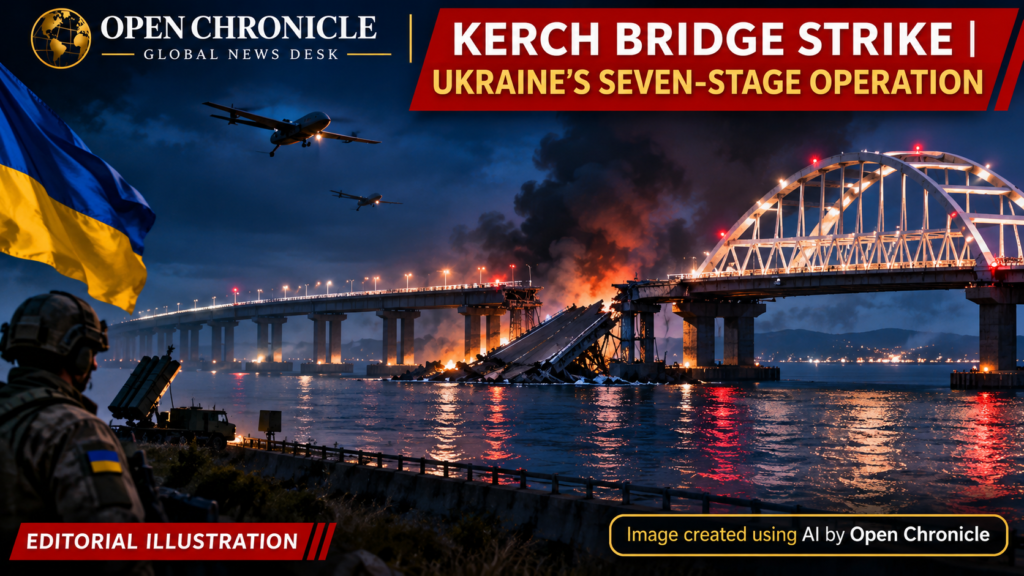
According to Ukraine’s General Staff, part of the bridge’s road structure collapsed, while its railway section sustained damage.
Russian authorities acknowledged that the bridge had been attacked and damaged, but did not confirm the full extent of the destruction claimed by Kyiv.
Images released by Ukrainian officials appeared to show a collapsed arch and sections of roadway in the water. Reuters and the Associated Press said they could not independently verify the imagery.
The distinction matters. The attack itself is acknowledged by both sides, but the full extent of structural damage remains disputed or independently unconfirmed.
The Operation in Numbers
Key figures from the latest military developments and international defence commitments.
Figures reflect statements by the respective governments, not independent verification of every operational claim.
1. Inside the Seven-Stage Operation
The most striking element of Ukraine’s account is that the bridge attack was not simply an overnight barrage.
Zelenskyy described it as the final phase of a campaign lasting several weeks, developed by Ukraine’s Security Service, known as the SBU, together with the General Staff of the Armed Forces.
According to the Ukrainian president, the earlier phases systematically targeted Russian air defence systems, radar installations, electronic warfare equipment and other military assets.
The objective, according to Kyiv’s account, was to weaken the protective network surrounding the crossing before launching the decisive attack.
Ukraine identified a combination of domestically developed unmanned systems and missiles, including Palianytsia drones, Ruta systems, Neptune cruise missiles and FP-5 Flamingo missiles.
Zelenskyy said drones attacked the road section, while Neptune missiles and other weapons struck the railway section. He credited Flamingo missiles with delivering a decisive precision strike.
The operational sequence, if accurately described, suggests a coordinated campaign against both a heavily defended target and the systems protecting it.
It also demonstrates Ukraine’s growing emphasis on combining different long-range weapons rather than relying on a single type of strike platform.
Nevertheless, the precise number of weapons launched, how many reached their targets and which individual strike caused the reported structural collapse have not been independently established.
2. Why the Kerch Bridge Matters So Much
The bridge carries both road and rail traffic between mainland Russia and Crimea.
Its military significance comes from its role in moving personnel, equipment, fuel and supplies toward the peninsula, which Russia uses as a logistical and operational base.
But its importance is not exclusively military.
The crossing also supports civilian transport and commercial activity, meaning significant damage can disrupt everyday movement and increase pressure on alternative transport routes.
Russia has other logistical connections to occupied territory, including overland routes through southern Ukraine.
Consequently, even a severe disruption to the bridge would not automatically sever every Russian supply line.
It could, however, force Moscow to redistribute transport capacity, increase dependence on alternative corridors and devote additional resources to repairing and protecting the crossing.
The bridge’s political significance may be even greater.
Opened after Russia’s annexation of Crimea, it became one of Putin’s most prominent infrastructure projects and a symbol of Moscow’s claim that the peninsula was permanently integrated into Russia.
Ukraine and most of the international community reject that annexation.
For Kyiv, damaging the crossing therefore carries a dual message: Russian logistics remain vulnerable, and Moscow’s control of occupied Crimea is not beyond challenge.
3. Moscow Acknowledges Damage but Promises Reconstruction
Russia’s response has combined acknowledgement of the attack with an effort to minimise its political consequences.
Russia’s Investigative Committee confirmed that drones had struck the bridge and caused damage.
The Russian-installed governor of Crimea, Sergei Aksyonov, said traffic across the crossing had been halted, although railway operations were reportedly restored by Tuesday afternoon.
Kremlin spokesperson Dmitry Peskov promised that the bridge would be repaired.
These statements do not resolve the dispute over the scale of the damage.
Ukraine says the road crossing suffered a structural collapse.
Russian authorities have not publicly confirmed that assessment in the reporting reviewed.
The difference between a temporarily closed bridge, a partially damaged structure and a major structural failure is operationally significant.
It determines how quickly traffic might resume, how much engineering work is required and whether alternative transport routes must absorb prolonged additional demand.
4. A Record Drone Barrage Raises Questions About Russian Defences
The Kerch Bridge strike occurred during an extraordinary escalation in Ukrainian long-range attacks.
Russia’s Defence Ministry claimed its forces intercepted 1,441 Ukrainian drones during the latest overnight attacks, following a reported 1,336 the previous day.
Those figures are Russian government claims and have not been independently verified.
If broadly accurate, however, they illustrate the extraordinary scale of the aerial confrontation.
Russian authorities also reported extensive drone activity near Moscow.
In Bashkortostan, deep inside Russian territory, officials described attacks on industrial facilities around Ufa and Salavat.
Independent reporting indicated that a major petrochemical complex at Salavat may have experienced a significant fire, although regional authorities said industrial operations were continuing.
These developments suggest Ukraine is attempting to impose pressure across several dimensions simultaneously: military logistics, industrial capacity, air defence resources and the symbolic credibility of Russian territorial security.
The strategic question is whether Russia can continue defending an expanding range of potential targets without weakening protection elsewhere.
The answer cannot be determined from one night’s reported interception totals.
High interception numbers may indicate effective defences, exceptionally large incoming attacks or a combination of both.
They do not, on their own, establish how many Ukrainian weapons penetrated Russian airspace or achieved their objectives.
5. Russia Strikes Back at Kyiv’s Bridges
While Ukraine targeted the Kerch crossing, Russian forces attacked major transport infrastructure in Kyiv.
According to Ukrainian officials, seven Russian ballistic missiles struck the Pivnichnyi and Pivdennyi bridges, two important routes across the Dnipro River.
Both crossings were closed to traffic.
The attacks disrupted movement between the Ukrainian capital’s eastern and western districts, creating additional pressure on the remaining transport network.
Ukrainian authorities reported at least two deaths in Kyiv, while attacks in the southern Zaporizhzhia region killed two people and wounded 18 others.
Power infrastructure was also affected, adding to the pressure on civilians as winter approaches.
Russia’s Defence Ministry said its attacks targeted military industrial facilities, energy infrastructure, transport networks and other assets supporting Ukrainian forces.
Those assertions do not independently establish the military status of every location struck.
The simultaneous attacks on bridges in Crimea and Kyiv highlight a broader feature of the war: both sides increasingly view transport infrastructure as a strategic instrument.
For Ukraine, disrupting Russian logistics may weaken Moscow’s ability to sustain military operations.
For Russia, attacks on Ukrainian transport and energy infrastructure can impose military and civilian costs.
The humanitarian consequences are especially serious when strikes interrupt electricity, water supplies and essential civilian movement.
6. A New Generation of Ukrainian Weapons Is Changing the Battlefield
Another important element of the Kerch operation is Ukraine’s reported reliance on domestically developed weapons.
The systems identified by Zelenskyy included several types of long-range drones and the Neptune and Flamingo missiles.
This matters because Ukraine has spent years attempting to reduce its dependence on foreign-supplied strike capabilities.
Domestic production can provide greater flexibility over procurement, adaptation and operational employment, although manufacturing capacity and access to components remain important constraints.
The reported operation also illustrates the increasing importance of combining drones, missiles and electronic warfare capabilities.
Rather than treating each weapon as an isolated system, modern military operations can employ different technologies to perform complementary roles.
The use of multiple systems may complicate an adversary’s defensive planning.
However, one successful strike does not establish that Ukraine has achieved permanent superiority over Russian air defences.
Moscow retains substantial defensive capabilities and can adjust deployment patterns, reinforce important locations and modify its countermeasures.
The more significant question is whether Ukraine can sustain complex operations while maintaining sufficient production capacity and preserving its own defensive resources.
The SpaceX Question
The attack has also renewed interest in the role of satellite communications.
Reuters reported that Ukrainian officials had recently complained about speed restrictions involving Starshield, the military version of SpaceX’s Starlink technology, which they said were complicating some drone operations.
Zelenskyy stated that the communications link supporting the final Flamingo strike functioned successfully.
These statements do not establish which communications systems supported each weapon or whether the reported Starshield restrictions directly affected the Kerch operation.
Nevertheless, the episode illustrates why reliable communications have become an important strategic concern in modern warfare.
7. Why the Attack Matters for Donald Trump
For American readers, the most consequential question may concern diplomacy.
The Kerch Bridge operation occurred just as President Donald Trump prepared for high-level meetings in China with Russian President Vladimir Putin and Chinese President Xi Jinping.
Trump has indicated that the war in Ukraine will feature in those discussions.
At the same time, American representatives are coordinating with Ukraine and European governments over the next stage of negotiations.
According to Axios, Trump’s envoys Steve Witkoff and Jared Kushner are expected to meet Ukrainian and European officials in Berlin to discuss security guarantees and postwar economic arrangements.
The talks are taking place against a difficult diplomatic background.
Ukraine seeks security arrangements that would prevent renewed Russian aggression.
Russia continues to press its own territorial and security demands.
European governments want any settlement to preserve their long-term security interests.
Washington is attempting to bring these competing positions into a negotiating process.
Could the Bridge Strike Strengthen Ukraine’s Negotiating Position?
Potentially, but the outcome is far from certain.
Military operations can influence diplomacy when they change an adversary’s assessment of the costs of continuing a conflict.
If the Kerch Bridge remains significantly disrupted, Ukraine may demonstrate that Russia’s strategically important infrastructure remains vulnerable despite extensive defensive preparations.
That could strengthen Kyiv’s argument that Moscow cannot simply wait for Ukraine to exhaust its military options.
However, the opposite reaction is also possible.
The Kremlin could respond with intensified military operations, increased demands or a more uncompromising negotiating position.
There is no public evidence that the November 17 attack has already changed Russia’s formal negotiating demands.
The political effect will depend on the duration of the disruption, subsequent military developments and the choices made by Washington, Moscow, Kyiv and European governments.
8. Europe Announces New Military Support as Winter Approaches
The Kerch operation coincided with an important announcement from Britain.
The United Kingdom confirmed a £240 million package to strengthen Ukraine’s air defences during the winter.
According to the British Ministry of Defence, the assistance includes more than 1,000 short-range air defence missiles and launchers, together with more than a dozen radars.
Deliveries are expected to begin in mid-December.
The package forms part of a wider £500 million commitment announced in Britain’s budget.
The European Commission also announced the disbursement of €1.71 billion on November 16 to support Ukrainian procurement of drones, ammunition and air defence equipment.
These announcements underline the continuing importance of European assistance even as American diplomacy occupies a central position in discussions about ending the war.
9. Open Chronicle Strategic Assessment | Five Questions That Will Determine the Impact
OPEN CHRONICLE | STRATEGIC ASSESSMENT
Five questions to watch
Five Questions That Will Determine the Impact
The consequences of Ukraine’s reported strike on the Kerch Bridge will depend on more than the immediate damage. Five critical questions will help determine its military, political and diplomatic significance.
How Long Will the Kerch Bridge Remain Disrupted?
The duration of the road and rail disruption will help determine the logistical consequences for Russia.
Can Ukraine Repeat This Kind of Operation?
Sustained pressure would have different strategic implications from a single successful attack.
Will Moscow Intensify Attacks on Ukrainian Infrastructure?
Further strikes against transport and energy systems could increase civilian hardship during winter.
Will Washington Adjust Its Negotiating Approach?
The response of Trump’s administration may reveal whether the strike affects diplomatic calculations.
Can European Military Assistance Arrive Quickly Enough?
The timing of air defence deliveries will matter as Ukraine attempts to protect cities and essential infrastructure.
The strategic consequences of the Kerch Bridge operation remain uncertain. The extent of the damage, Russia’s ability to restore transport capacity, Ukraine’s capacity to sustain long-range operations and the response of international partners will determine whether the strike produces a temporary disruption or a more lasting change in the conflict.
10. Three Possible Scenarios
Scenario One: A Major but Temporary Disruption
Russia restores significant bridge capacity relatively quickly.
Ukraine gains a symbolic victory and imposes repair costs, but Moscow adapts its logistics and maintains military operations.
This scenario would limit the long-term strategic effect of the strike.
Scenario Two: A Prolonged Logistical Problem
Structural damage requires extensive repairs, reducing transport capacity for a significant period.
Russia must rely more heavily on alternative routes and allocate additional resources to protecting vulnerable infrastructure.
Ukraine could use the disruption to intensify pressure on Russian supply networks.
This would represent a more substantial military consequence, although it would not automatically produce a decisive change on the battlefield.
Scenario Three: Escalation Before Negotiations
Russia responds with more extensive attacks on Ukrainian infrastructure.
Ukraine continues long-range strikes against military logistics and industrial facilities.
The resulting escalation increases the urgency of diplomatic negotiations while simultaneously making compromise more difficult.
None of these scenarios is inevitable. They are analytical possibilities rather than predictions.
Conclusion | A Damaged Bridge and a Larger Question About the War
Ukraine’s latest operation against the Kerch Bridge represents an important development in a conflict increasingly shaped by long-range strikes, drones and attacks on critical infrastructure.
Kyiv claims that a carefully coordinated seven-stage campaign caused major structural damage to one of Russia’s most important transport connections.
Moscow acknowledges an attack and damage but has not confirmed the full scale of destruction reported by Ukraine.
The military implications will become clearer as more information emerges about the bridge’s condition and the duration of any disruption.
The political implications may take longer to assess.
With Donald Trump preparing for discussions involving Vladimir Putin and Xi Jinping, and American envoys coordinating with European and Ukrainian officials, the operation arrives at a particularly sensitive moment.
Ukraine has demonstrated its determination to challenge Russia’s control of Crimea. Whether that translates into lasting military advantage or greater diplomatic leverage remains an open question.
Sources and Further Reading
Selected reporting and official statements available November 17, 2026.
Associated Press | Ukrainian Drones and Missiles Strike Kerch Bridge
November 17, 2026. Reporting on the attack, conflicting damage assessments, Russian retaliation and diplomatic developments.
Reuters | Zelenskyy Says Ukraine Struck Crimea Bridge
November 17, 2026. Reporting on the seven-stage campaign, the weapons identified by Ukraine and the limitations of independent imagery verification.
Euronews | How Ukrainian Forces Struck Putin’s Heavily Defended Crimean Bridge
November 17, 2026. Examination of Ukraine’s reported weapons systems, operational preparation and damage claims.
The Guardian | How Ukraine Struck the Kerch Bridge
November 17, 2026. Additional reporting on the operation, its strategic context and Ukraine’s long-range capabilities.
Axios | Top Trump Aides to Meet Europeans and Ukrainians on Peace Plan
November 17, 2026. Reporting on planned negotiations involving US envoys and European and Ukrainian representatives.
UK Ministry of Defence | £240 Million in Winter Air Defence Support
November 17, 2026. Official announcement detailing additional missiles, launchers, radars and delivery plans.
European Commission | €1.71 Billion Disbursed to Ukraine
November 16, 2026. Official statement on funding for drones, ammunition and air defence systems.
This article combines reporting by Associated Press, Reuters, Euronews, The Guardian and Axios with official statements from the British government and European Commission.
Claims concerning the seven-stage operation, weapons employed and the extent of damage to the Kerch Bridge are attributed to Ukrainian officials where appropriate. Russian acknowledgements and responses are presented separately.
Open Chronicle has not independently verified the imagery of the reported structural collapse, the number of drones intercepted by Russian forces or the full operational impact of the attack.
The assessment of military logistics, negotiating leverage and potential future scenarios represents independent editorial analysis rather than confirmed intelligence findings.
Information reflects reporting available on November 17, 2026.