
OPEN CHRONICLE SPORTS MAGAZINE | NFL | 17 NOVEMBER 2026
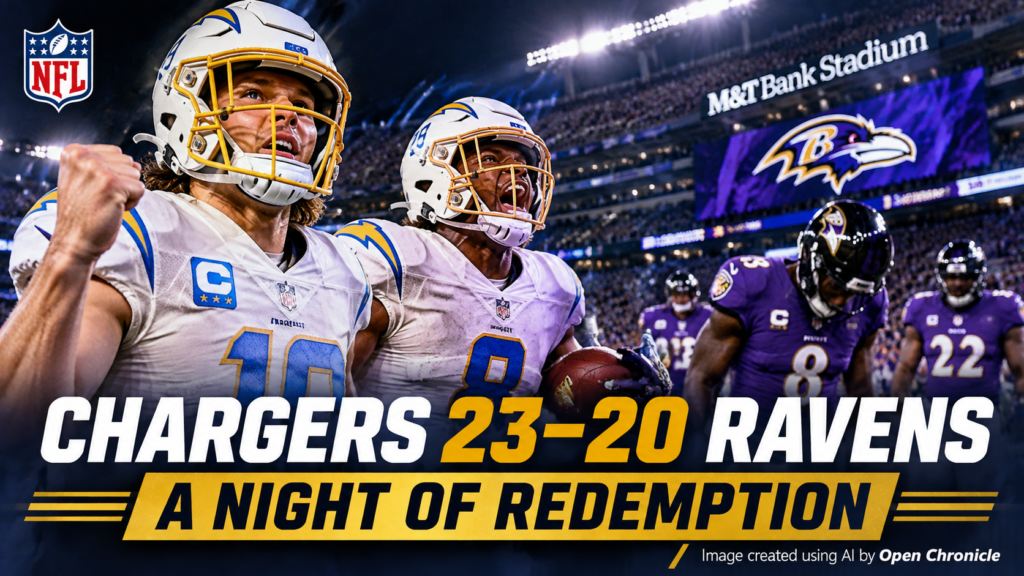
Los Angeles ended an 11-game losing streak with a dramatic 23–20 victory over the Baltimore Ravens. Yet the most revealing statistic was not the final score. Baltimore managed just 16 rushing yards, exposing a team struggling with injuries, offensive instability and a rapidly deteriorating season.
By Open Chronicle Sports
17 November 2026 | NFL | Game Analysis
A Victory That Changed the Narrative
For the Los Angeles Chargers, Monday night was about something more fundamental than playoff positioning or divisional standings.
It was about proving they could still win.
After 11 consecutive defeats stretching across two seasons, Los Angeles travelled to Baltimore facing a team with its own growing problems.
The Chargers entered the encounter without a victory in the 2026 campaign. Their opponents, the Baltimore Ravens, were attempting to arrest a damaging run of defeats while adapting to significant disruption at quarterback.
The result was an intense, imperfect and ultimately dramatic contest.
Los Angeles defeated Baltimore 23–20 at M&T Bank Stadium on 16 November, securing its first victory of the season and ending a prolonged period of frustration.
But the significance of the game extended beyond the Chargers’ celebrations.
Baltimore suffered a fifth consecutive defeat, fell to 4–6 and produced one of the most alarming rushing performances of its season.
The Ravens gained only 16 yards on the ground.
For a franchise whose offensive identity has frequently depended on physical running football, that statistic demands serious attention.
NFL 2026 | Week 10
Chargers
WINNER
Ravens
FINAL
Final score confirmed by the NFL’s official schedule and contemporary match reporting.
The Statistic That Explains Baltimore’s Defeat
Baltimore’s inability to establish its rushing attack became one of the defining factors of the game. Derrick Henry accounted for 10 of the Ravens’ 16 rushing yards on 10 attempts, highlighting the offensive difficulties experienced throughout the contest.
Statistics from the 16 November 2026 game.
The Ravens’ rushing total was extraordinary.
Baltimore finished with just 16 rushing yards, including 10 yards from Derrick Henry on 10 carries.
Henry nevertheless scored two touchdowns.
That contrast illustrates the unusual nature of the performance.
The Ravens were able to produce points in specific situations, but they could not establish a sustainable ground attack.
Their inability to generate consistent rushing yardage made the offense increasingly dependent on passing plays.
That dependency becomes particularly dangerous when a team is operating without its preferred quarterback.
In a conventional Baltimore offensive structure, the threat of the run creates opportunities elsewhere.
Defenders must respect the possibility of a powerful interior rushing attack, opening passing lanes and creating more favourable matchups.
When the running game disappears, the defense can adjust.
The Chargers demonstrated how effectively that adjustment can work.
They limited Baltimore’s ability to dictate the physical terms of the game and forced the Ravens to seek solutions through the air.
The outcome was not a complete defensive shutdown. Baltimore still scored 20 points.
But Los Angeles prevented its opponent from developing the offensive balance required to control the contest.
Justin Herbert and the Value of Doing Enough
Quarterback Justin Herbert did not deliver a statistically spectacular passing performance.
He finished with 129 passing yards.
He also contributed 51 rushing yards and a rushing touchdown.
Those numbers reveal something important about the Chargers’ approach.
Los Angeles did not require Herbert to dominate through passing volume.
Instead, the offense found ways to produce meaningful gains through a combination of quarterback mobility, running back production and situational execution.
Herbert’s rushing contribution was particularly valuable.
Against a defense attempting to contain conventional offensive patterns, a quarterback capable of extending plays or gaining yards himself creates an additional problem.
It forces defenders to account for another potential ball carrier.
In a close game, those additional yards can change field position, sustain drives and create scoring opportunities.
For Herbert, the victory was less about individual statistics than about managing a game in which every possession mattered.
Omarion Hampton Provides the Offensive Foundation
If Herbert supplied the flexibility, Omarion Hampton supplied the foundation.
The Chargers running back gained 105 rushing yards and scored a touchdown.
His performance contrasted sharply with Baltimore’s difficulties on the ground.
While the Ravens struggled to generate even modest gains, Los Angeles established a rushing presence that gave its offense greater balance.
That distinction mattered.
A productive running game can reduce the pressure on the quarterback, limit obvious passing situations and help manage the clock.
It also gives an offense a more reliable way to sustain drives when explosive passing plays are unavailable.
Hampton’s contribution was therefore central to the Chargers’ victory.
His performance helped create the conditions in which Los Angeles could remain competitive deep into the fourth quarter.
The Chargers finished with 160 rushing yards as a team, ten times Baltimore’s total.
Rushing Yards | Team Comparison
Los Angeles Chargers
160
Baltimore Ravens
16
Los Angeles outrushed Baltimore by 144 yards.
Rushing totals from the 16 November 2026 game.
Jacoby Brissett and Baltimore’s Quarterback Emergency
The Ravens’ offensive problems cannot be understood without considering the situation at quarterback.
Baltimore entered the game dealing with long-term injuries to Lamar Jackson and Tyler Huntley.
That left Jacoby Brissett facing the challenge of operating an offense already under significant pressure.
Brissett completed 33 of 49 passes for 340 yards, with one interception.
In terms of passing production, he generated considerably more yardage than Herbert.
Yet the Ravens still lost.
That apparent contradiction highlights the limitations of evaluating quarterback performance through passing totals alone.
Brissett was required to carry a substantial offensive workload because Baltimore could not establish its running game.
His 49 passing attempts reflected an offense increasingly reliant on throwing the ball.
The Ravens moved the football and remained competitive, but they could not convert that production into a victory.
For a quarterback entering an unstable offensive environment, the challenge is considerable.
Timing with receivers, familiarity with protection schemes and confidence in the running game all influence decision-making.
Baltimore’s difficulties were therefore broader than one player’s performance.
They reflected a team struggling to maintain offensive cohesion under difficult circumstances.
The Fourth-Quarter Fumble That Decided Everything
Baltimore did not surrender without a fight.
The Ravens reduced the deficit to three points during the fourth quarter and had an opportunity to complete a comeback.
With the game approaching its conclusion, Baltimore still had possession and a chance to tie or take the lead.
Then came the decisive moment.
Chargers cornerback Tarheeb Still forced a fumble from Ravens receiver Zay Flowers.
Elijah Molden recovered the football with 2:03 remaining.
The turnover effectively ended Baltimore’s final opportunity and preserved Los Angeles’ three-point advantage.
For the Chargers, the play represented the kind of decisive defensive intervention that had been missing during their losing streak.
For Baltimore, it was another costly moment in a season increasingly defined by narrow margins and missed opportunities.
The contrast was striking.
The Ravens had accumulated 340 passing yards through Brissett, recovered from offensive difficulties and positioned themselves for a potential late comeback.
Yet one defensive play changed the outcome.
That is often the unforgiving nature of the NFL.
A team can overcome significant problems for much of a game, only to lose possession at the worst possible moment.
Match Analysis | Three Factors Behind the Result
Three Factors Behind the Result
A tactical examination of the decisive factors behind the Los Angeles Chargers’ victory over the Baltimore Ravens.
Los Angeles Controlled the Running Game
The Chargers gained 160 rushing yards while restricting Baltimore to just 16. That imbalance gave Los Angeles a more dependable offensive foundation and prevented the Ravens from establishing their preferred physical approach.
Baltimore Became Too Dependent on Passing
Jacoby Brissett generated 340 passing yards, but 49 attempts reflected the burden placed on the passing game. Without meaningful rushing production, Baltimore lacked offensive balance.
Defensive Execution Decided the Final Possession
Tarheeb Still’s forced fumble and Elijah Molden’s recovery ended Baltimore’s late opportunity. The Chargers delivered the decisive play when the outcome remained uncertain.
What the Victory Means for the Chargers
Los Angeles improved to 1–8.
That record makes the scale of the team’s difficulties clear.
One victory does not transform a disappointing season into a successful campaign.
Nor does it immediately resolve the underlying problems that contributed to the losing streak.
But the psychological significance of ending such a prolonged sequence should not be underestimated.
A team that repeatedly loses close games can develop uncertainty in decisive moments.
Players may become increasingly conscious of previous failures, particularly when matches enter the final quarter.
Against Baltimore, the Chargers experienced a different outcome.
They protected a narrow advantage and produced the defensive play required to finish the contest.
That provides a tangible example of successful execution under pressure.
The challenge now is to determine whether the performance can become a foundation for improvement.
Hampton’s rushing production offers one potential starting point.
Herbert’s ability to contribute through both passing and rushing provides another.
But sustained progress will require greater consistency across the offense, defense and special teams.
A single victory establishes possibility, not proof of recovery.
Baltimore’s Problems Are Becoming Structural
The Ravens’ situation is more complicated.
Their record stands at 4–6 following five consecutive defeats.
Injuries at quarterback have disrupted offensive continuity, while the running game has become a serious concern.
Those problems interact.
When the rushing attack is ineffective, a replacement quarterback must assume greater responsibility.
When the quarterback position is unstable, defenses can become more aggressive in challenging the running game.
The result can be a cycle in which neither component of the offense functions as intended.
Baltimore’s defeat against Los Angeles illustrated that danger.
The Ravens produced substantial passing yardage but could not establish the physical balance that has historically been central to their identity.
There are also consequences for game management.
A team unable to run consistently may struggle to control possession, protect leads or create manageable third-down situations.
That places additional pressure on the defense.
For Baltimore, the priority must be restoring a functional offensive structure rather than relying on individual moments of production.
THE BIG QUESTION
Can Baltimore remain competitive without a reliable rushing attack?
The Ravens’ 340 passing yards demonstrated that the offense can still move the ball. But until Baltimore restores balance between its running and passing games, even productive quarterback performances may not be enough to deliver victories.
The Wider NFL Picture
The result also illustrates how unpredictable the NFL can become once injuries, confidence and tactical adjustments begin to influence performance.
Los Angeles arrived with no victories in 2026.
Baltimore entered with four wins and the advantage of playing at home.
Yet the Chargers controlled one of the most important statistical categories and made the decisive play in the final minutes.
The victory does not necessarily establish Los Angeles as the stronger team over a full season.
It does, however, demonstrate that a struggling side can still exploit a vulnerable opponent.
For Baltimore, the defeat reinforces the importance of adaptation.
The Ravens cannot simply wait for their preferred offensive personnel to return and assume that previous patterns will automatically reappear.
They must find ways to generate rushing production, protect their quarterback and reduce the frequency of decisive mistakes.
Those adjustments will determine whether their season can stabilise.
The Bigger Picture | One Team Finds Relief, Another Faces a Reckoning
The Chargers’ victory was a moment of relief after a prolonged period of frustration.
It rewarded a productive running game, a flexible quarterback performance and a crucial defensive intervention.
For Baltimore, the same game exposed a much more troubling reality.
The Ravens were unable to establish their ground attack, placed enormous responsibility on a replacement quarterback and lost possession when they still had a chance to recover.
Both teams leave the contest with significant questions.
Los Angeles must prove that its first victory can lead to sustained improvement.
Baltimore must demonstrate that its offensive problems can be addressed before the season deteriorates further.
The Chargers finally found a way to win. The Ravens must now find a way to stop losing.
Sources and Further Reading
Official NFL information, international sports reporting and additional coverage supporting this analysis of the Los Angeles Chargers’ victory over the Baltimore Ravens.
Chargers Hold Ravens to 16 Rushing Yards, Earn First Win of Season
17 November 2026. Primary game report covering the result, player statistics, injuries, decisive fourth-quarter turnover and team records.
Official 2026 Schedule and Results
Official NFL competition schedule, including confirmation of the Chargers’ 23–20 victory over the Ravens.
Chargers vs Ravens GameTracker
Game score, statistical reporting and match information for the 16 November encounter.
NFL Coverage
Additional coverage of Monday Night Football and the Chargers’ first victory of the 2026 season.
Editorial Transparency
This article combines game reporting published on 17 November 2026, official NFL results and independent editorial analysis. Match statistics, the final score, reported injuries and the decisive turnover are drawn from contemporary coverage. Assessments of offensive strategy, team psychology, structural weaknesses and future performance are editorial interpretations rather than confirmed statements from the teams. The analysis reflects information available on 17 November 2026.