
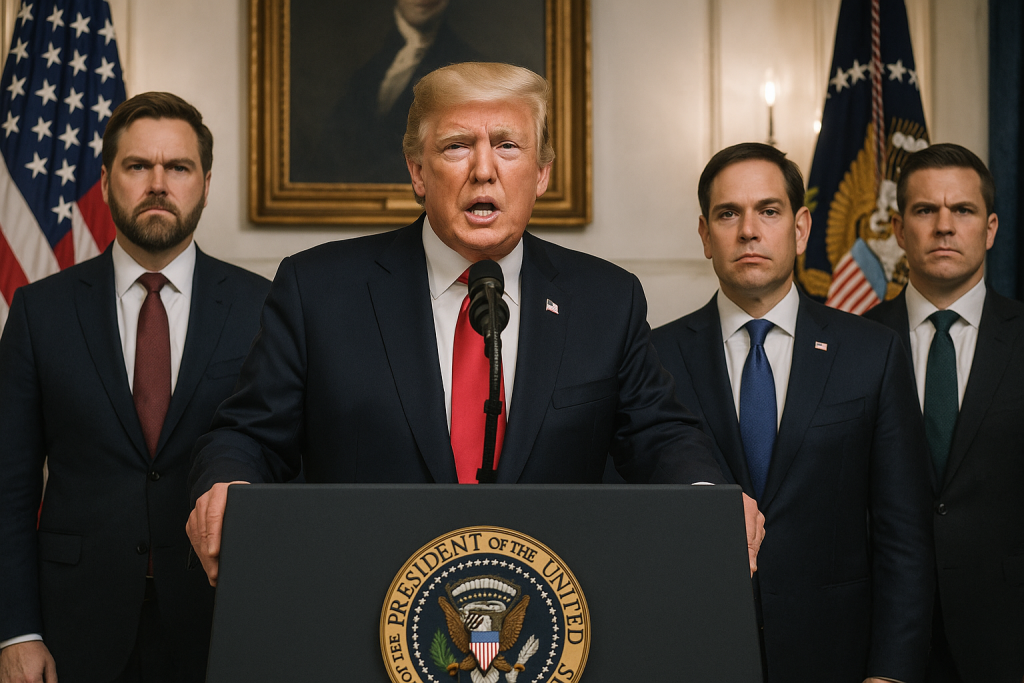
Image Credentials: Image Title: U.S. Launches Airstrikes on Iran: Trump Claims Nuclear Sites “Obliterated” and Demands Peace Source: (sora.chatgpt) Date: June 2025 Attribution: Created by AI-generated imagery (sora.chatgpt), it does not depict a real-world scene.
By Staff Writer with Agencies
Washington, D.C. – June 2025
In a dramatic escalation of Middle East tensions, U.S. President Donald Trump confirmed overnight that American forces carried out coordinated airstrikes on three key nuclear facilities in Iran. In a televised address from the White House, flanked by Vice President J.D. Vance, Secretary of State Marco Rubio, and Defense Secretary Pete Hegseth, Trump declared the attacks a “spectacular military success” and warned Iran to choose between “peace or tragedy.”
“Our objective was the destruction of Iran’s nuclear enrichment capabilities,” Trump said. “We have obliterated the facilities at Fordo, Isfahan, and Natanz. Everyone has heard these names for years, while Iran built this horrible, destructive enterprise. That ends now.”
'Tonight I can report to the world that the strikes were a spectacular military success. Iran's key nuclear enrichment facilities have been completely and totally obliterated'
President Trump addresses the nation following US strikes on Iran.
Latest: https://t.co/je3LeESEFs pic.twitter.com/BFjyiJhk5X
— Sky News (@SkyNews) June 22, 2025
The airstrikes mark the United States’ entry into a conflict that reignited just over a week ago, when Israel launched airstrikes on Iran, citing efforts to halt Tehran’s alleged nuclear weapons program. A series of retaliatory attacks between the two nations followed, escalating tensions across the region. Now, with the U.S. military fully involved, the risk of a broader regional war has sharply increased.
Iranian officials swiftly condemned the U.S. strikes. Foreign Minister Abbas Araghchi called the attacks “outrageous” and vowed that Iran would explore “all options to defend its sovereignty.”
“These actions are a flagrant violation of the UN Charter,” Araghchi posted on the social platform X, formerly Twitter. “They are dangerous, illegal, and criminal. The entire international community should be alarmed.”
Despite the damage, Iran’s Atomic Energy Organization insisted its nuclear program would continue. “With the efforts of thousands of motivated scientists and revolutionaries, we will not allow the progress of this national industry—fueled by the blood of our nuclear martyrs—to be halted,” the agency said in a statement reported by state news agency IRNA.
Tensions further spiked when the Israeli Air Force reported missile launches from Iran toward Israeli territory. Sirens were activated across multiple regions, including Jerusalem and Tel Aviv. Witnesses described hearing loud explosions, though it remains unclear whether the sounds were missile impacts or interceptions by Israel’s Iron Dome defense system.
Emergency services were deployed to reported strike locations in central and northern Israel. According to local media, including The Times of Israel, medical teams and security forces were responding to injuries and damage.
President Trump, speaking in a somber tone, described Iran as “the bully of the Middle East” and said the U.S. had been forced to act after decades of Iranian hostility. “For forty years, they’ve been chanting ‘Death to America, Death to Israel.’ That’s over. If they don’t choose peace, the future attacks will be far greater and far easier.”
Israeli Prime Minister Benjamin Netanyahu praised Trump in a video message, calling the American president’s decision “historic” and “courageous.” “The United States has done what no other country on Earth could do,” said Netanyahu. “This will change the course of history.”
While the full consequences of the strikes remain uncertain, analysts warn of unpredictable fallout in a region already fraught with instability. Iran’s next move, and whether it retaliates against the U.S., may determine whether this moment marks the peak—or just the beginning—of a much wider war.