
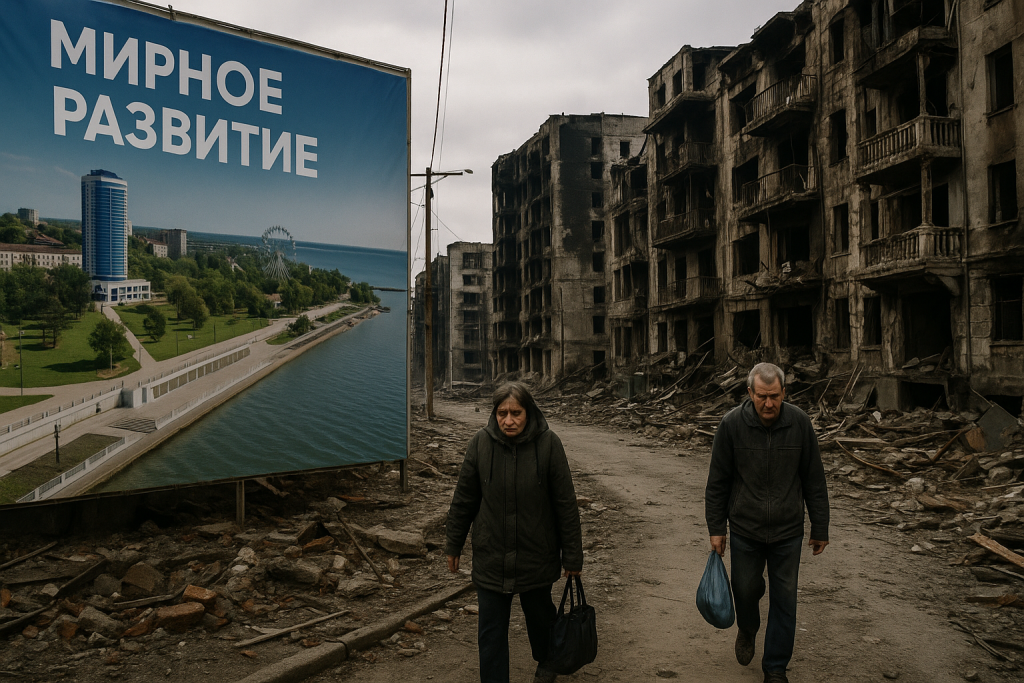
Image Credentials: Image Title: Mariupol’s Hidden Reality: Resistance, Ruins, and Russian Propaganda Source: (sora.chatgpt) Date: June 2025 Attribution: Created by AI-generated imagery (sora.chatgpt), it does not depict a real-world scene.
By Staff Writer with Agencies | June 29, 2025
Mariupol, Ukraine — Beneath a polished facade of recovery promoted by Russian state media, residents of occupied Mariupol describe a city still grappling with devastation, deprivation, and deepening despair—three years after Russian forces seized control in a brutal siege that killed thousands and flattened most of the city.
“What they’re showing on Russian TV are fairy tales for fools,” says John,” a resident whose name has been changed to protect his identity. “Most of Mariupol still lies in ruins. They fix facades where cameras film, but step around the corner and it’s rubble and emptiness.”
Since the early days of Russia’s full-scale invasion of Ukraine in 2022, Mariupol has stood as both a symbol of Ukrainian resistance and a prime example of the human toll of occupation. The UN has estimated that up to 90% of the city’s residential structures were damaged or destroyed during the assault.
Propaganda vs. Reality
Recently, pro-Kremlin influencers and social media personalities have been sharing footage of gleaming apartment blocks and rebuilt streets, portraying Mariupol as a model of post-war recovery. But those images clash with what residents and recent escapees describe.
“There’s a central square—only buildings there have been reconstructed. In other places, debris was cleared, but even dead bodies were not separated. They were scooped into trucks with the rubble,” says Olha Onyshko, 66, who escaped the city late last year.
Necessities like water, electricity, medicine, and food remain critically scarce. “Water comes for a day or two, then nothing for three days,” says James,” another resident involved in the underground resistance. “It’s yellow. Even after boiling it, you’re afraid to drink it.”
Collapsing Infrastructure, Rising Oppression
Power cuts are frequent. Medicines like insulin are difficult to find and prohibitively expensive. The Siverskyi Donets–Donbas Canal, which once supplied the city, was damaged early in the conflict, and no replacement has been found.
Mariupol’s so-called new normal has also come with ideological reprogramming. In schools, children are being taught that cities such as Kherson, Odesa, and Dnipro are “already part of Russia.” Teachers who refuse to comply are dismissed or threatened.
“These aren’t just history lessons—they’re psychological weapons,” says Andrii Kozhushyna, a former university student in the city who has since escaped. “They teach children that Russia liberated us from Nazis. It’s pure propaganda.”
Resistance in the Shadows
Despite the heavy surveillance and intimidation, Mariupol has become a hotbed of silent resistance. Small underground groups continue to operate in secrecy—documenting Russian troop movements, sharing intelligence with Ukrainian forces, and spreading messages of defiance.
At night, Ukrainian flags and slogans like “Liberate Mariupol” appear briefly on walls before being scrubbed away. Railway lines have been sabotaged; military supply chains disrupted. The risks are immense.
“Every day I delete my messages. I don’t call friends in Ukraine unless I’m sure it’s safe,” says James. “One neighbor was arrested just for being suspected of passing information to the Ukrainian army.”
Andrii, now living in Ukrainian-controlled territory, fled the city after learning Russian soldiers were actively seeking him out. “I saw a soldier at a store showing my picture. That was the moment I knew I had to run.”
“Peace” or Surrender?
As international calls for peace negotiations grow louder, many Mariupol residents reject any deal that would legitimize Russian control of their city.
“Giving away territory would be a betrayal,” John declares. “Dozens risk their lives daily to help Ukraine—not for some diplomat to sign a piece of paper that gives us away.”
Their message is clear: they don’t want peace at any cost—they want freedom, truth, and the return of their home.