
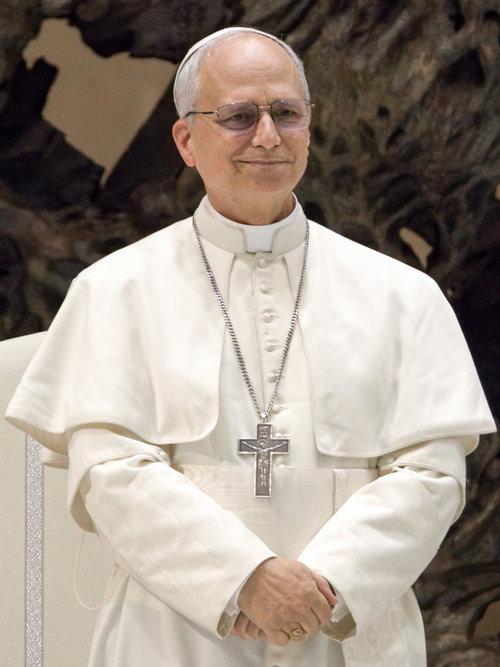
Image: Pope Leo XIV during an audience with the media (May 12, 2025) Por Edgar Beltrán, The Pillar, CC BY-SA 4.0, (Wikipedia)
By Staff Writer | Open Chronicle
In his first hundred days as the spiritual leader of the Catholic Church, Pope Leo XIV has set a clear moral and social agenda for a world in flux, confronting the twin challenges of a new industrial revolution and the rapid advance of artificial intelligence. Drawing inspiration from Pope Leo XIII, the architect of Rerum Novarum and a pioneer of Catholic social teaching, the new pontiff has made it clear that the Church’s social doctrine remains a living resource for defending human dignity, justice, and the rights of labor.
Speaking before the College of Cardinals on May 10, 2025, Pope Leo XIV described his acceptance of the papal office as a burden “clearly far beyond my strength,” a task no one could bear alone. Yet his words in that moment already carried the outline of his mission: to shepherd the Church through a period marked by geopolitical instability, cultural transformation, and moral questioning.
From his earliest addresses, Pope Leo XIV has embraced the role of a peacemaker in what he called, echoing Pope Francis, “a Third World War fought piecemeal.” In the Regina Caeli prayer on May 11, he repeated the timeless plea: “Never again war.” Three days later, in an address to representatives of the 23 Eastern Catholic Churches, he appealed directly to world leaders: “War is never inevitable… weapons can and must be silenced.”
His vision extends beyond conflict resolution. On May 17, speaking to the Centesimus Annus Pro Pontifice Foundation, he urged unity through dialogue and bridge-building. In his inaugural Mass homily on May 18, he denounced economic systems that exploit the Earth’s resources and marginalize the poor, framing such inequities as moral failures as much as political ones.
The plight of war victims has remained a central concern. In successive addresses, the Pope has drawn attention to Gaza, Ukraine, and other regions scarred by violence, invoking prayer and solidarity while condemning the use of hunger as a weapon. At the UN Food and Agriculture Organization on June 30, he called starvation “a very cheap way to wage war”, a phrase both blunt and prophetic.
Environmental stewardship, human fraternity, and the rejection of prejudice have been recurring themes. On July 2, he warned that greed and inequality are driving deforestation, pollution, and biodiversity loss. On July 13, he urged the faithful to “see without passing by,” to allow the suffering of others to “break our hearts” and foster genuine fraternity.
In his outreach to young people, most visibly during the Jubilee of Youth in early August, Pope Leo XIV called for ambition in virtue and holiness, challenging them not to settle for mediocrity. His words, “We are with the young people of Gaza, we are with the young people of Ukraine,” underscored his conviction that a better world can only be built through dialogue, not arms.
Whether addressing the misuse of technology, the urgent need for abuse prevention in the Church, or the cultivation of a truly human digital culture, Pope Leo XIV has demonstrated a pastoral style rooted in both realism and hope. His first 100 days reveal a papacy determined to integrate the Church’s enduring principles with the urgent realities of the twenty-first century, a mission that, like the encyclicals of his namesake, seeks to bridge the gap between faith and the complex social questions of the age