
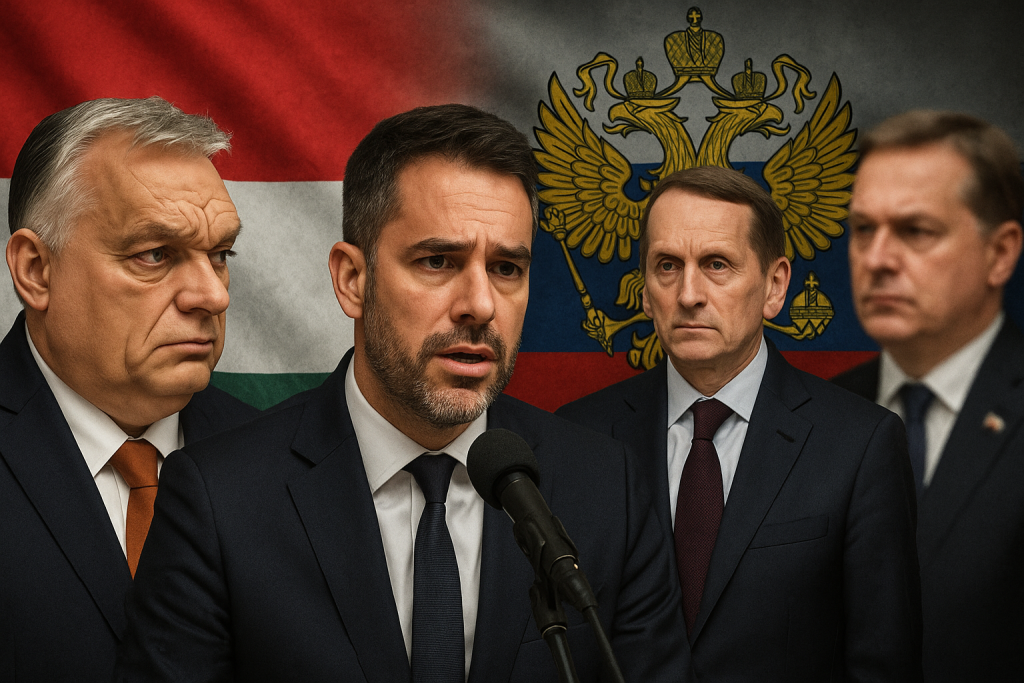
Image Credentials: Image Title: Russian Intelligence Targets Hungary’s Opposition Leader Amid Domestic and International Tensions Source: (sora.chatgpt) Date: August 2025 Attribution: Created by AI-generated imagery (sora.chatgpt), it does not depict a real-world scene.
By Staff Writer | Open Chronicle with Agencies
Hungary’s political climate has grown increasingly tense after the Russian Foreign Intelligence Service (SVR) issued a statement that directly targeted Péter Magyar, leader of the opposition Tisza Party, echoing accusations often voiced by Prime Minister Viktor Orbán’s Fidesz government.
The statement, which appeared on the Hungarian State News Agency MTI, accused the European Union of plotting a “regime change” in Budapest. According to the SVR, European Commission President Ursula von der Leyen views Magyar as the most likely candidate to replace Orbán, claiming that significant financial and lobbying resources from Germany, Norway, and the European People’s Party have already been mobilized to support him.
The SVR also alleged that Ukraine has joined the campaign against Hungary, claiming President Volodymyr Zelensky’s government is “destabilizing” the country with the help of Ukrainian intelligence services and the local diaspora. The rhetoric, heavily reminiscent of Soviet-era propaganda, reinforces Orbán’s narrative that foreign actors are interfering in Hungary’s internal affairs.
US Report Softens Tone on Human Rights in Hungary
In parallel, the latest US State Department human rights report has drawn attention for its strikingly lighter tone toward Hungary compared to previous years. Entire sections on corruption and LGBTQ+ rights were removed. The report concluded there were “no credible reports of significant human rights abuses” in the country and praised government steps to sanction officials where necessary.
The document also noted that freedom of the press is formally guaranteed in Hungary. It mentioned the work of the newly established Office for the Protection of Sovereignty, which has investigated organizations like Átlátszó and Transparency International for allegedly accepting foreign funding to influence national decision-making. Critics argue the agency is being used to intimidate independent watchdogs, though the US report did not voice concerns on this matter.
Hungary’s Healthcare System in Crisis
Domestically, the country faces mounting pressure over its declining healthcare system. Investigative outlet Átlátszó revealed that three-quarters of Hungary’s population, over seven million people, live more than 15 minutes away from a hospital providing comprehensive urgent care. Out of 155 hospitals currently operating, only 44 offer core services such as internal medicine, surgery, obstetrics, and emergency care.
The number of hospitals has steadily declined, from 175 in 2010 to 155 in 2024. Opposition leader Péter Magyar has strongly condemned the government’s handling of healthcare, accusing Orbán of “systematically underfunding and dismantling public healthcare” since returning to power. He cited the 2010 abolition of the health ministry as a turning point in the system’s decline.
A Nation at a Crossroads
Hungary finds itself at the center of overlapping international and domestic pressures. While Russian intelligence pushes narratives of EU-backed “regime change” and foreign destabilization, the United States is downplaying past criticisms in its official reporting. Meanwhile, ordinary Hungarians are struggling with a healthcare crisis that opposition leaders say reflects years of neglect.
How Orbán navigates these challenges, and how Péter Magyar responds to increasing attacks from both domestic and foreign actors, could determine Hungary’s political future in the coming years.