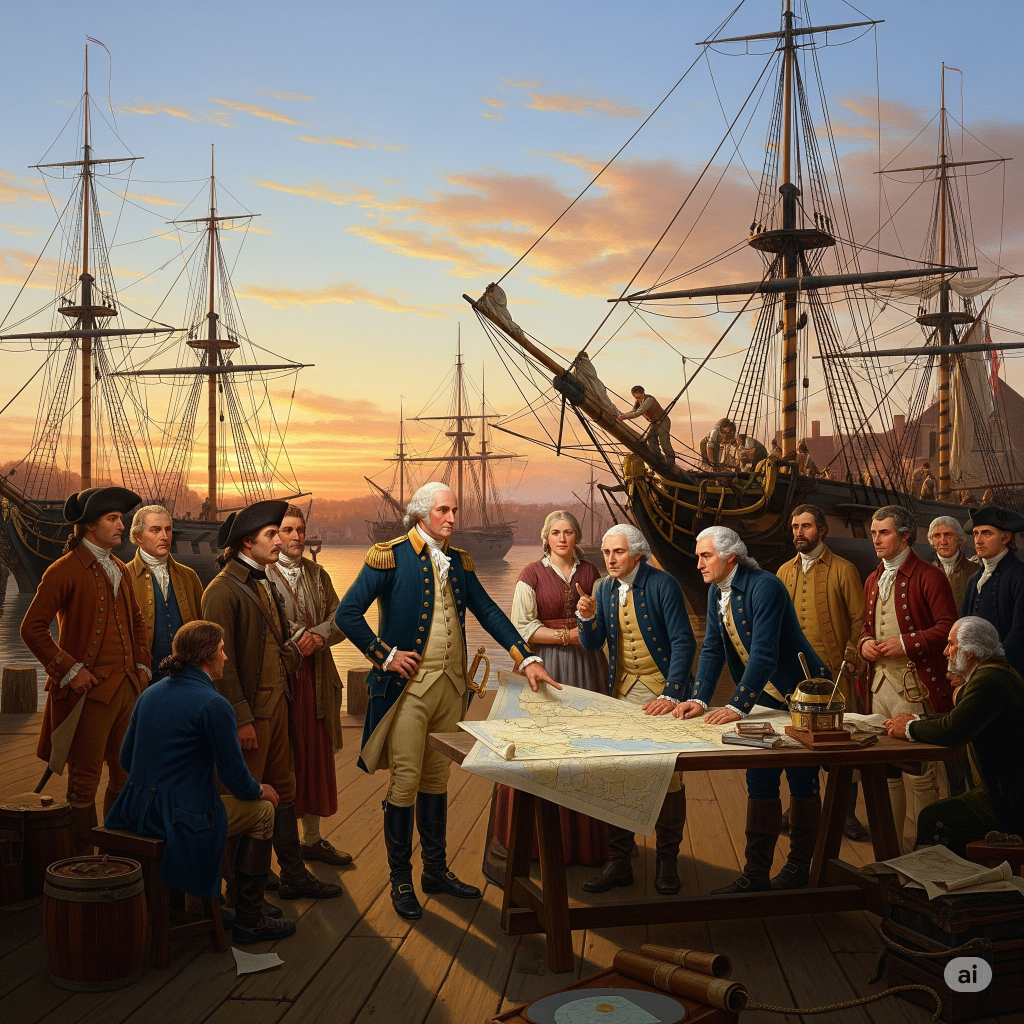
Image Credentials: Image Title: Origins of the United States Navy Source: (gemini) Date: August 2025 Attribution: Created by AI-generated imagery (gemini), it does not depict a real-world scene.
The United States Navy traces its origins to the tumultuous days of the American Revolution. Its creation was heavily influenced by the seafaring traditions of the American colonies, as well as the political and military needs of the fledgling United States. Prominent leaders such as George Washington and John Adams played key roles in establishing the naval force, which would evolve into one of the most powerful and influential navies in the world.
Early Quotes and Motivations
The importance of naval power was recognized early on by American leaders. George Washington, the Commander in Chief during the Revolutionary War, articulated the critical role of naval forces in achieving victory. On November 15, 1781, Washington wrote to Marquis de Lafayette, stating: “It follows then as certain as that night succeeds the day, that without a decisive naval force we can do nothing definitive, and with it, everything honorable and glorious.” Washington’s recognition of the value of naval power reflected the broader understanding that control of the seas was pivotal to securing American independence.
In an earlier letter dated August 15, 1786, Washington further emphasized the need for a formidable navy, writing: “Would to Heaven we had a navy able to reform those enemies to mankind or crush them into non-existence.” Similarly, John Adams, a key founding figure and second President of the United States, declared: “Naval power… is the natural defense of the United States.” These statements encapsulated the growing recognition among U.S. leaders that a strong navy would be essential to national security.
Colonial Seafaring Tradition
The roots of the U.S. Navy lie in the rich colonial seafaring tradition. The colonies had long been engaged in maritime activities, producing skilled sailors, captains, and shipbuilders. By the time of the Revolutionary War, this tradition had fostered a community that was well-prepared to establish a national naval force.
During the early days of the war, Massachusetts maintained its own Massachusetts Naval Militia, providing a base of naval manpower for the Continental forces. The question of whether to create a national navy was a matter of debate in the Second Continental Congress. Supporters of a navy argued that it would be essential for protecting American shipping, defending the coastline, and securing foreign support for the war effort. However, some detractors feared that challenging the British Royal Navy, then the world’s most powerful naval force, was an unwise and impossible undertaking.
Establishment of the Continental Navy
The debate over the creation of a national navy was resolved when George Washington took decisive action. In 1775, Washington commissioned the ocean-going schooner USS Hannah, directing it to intercept British merchant vessels. This action, coupled with the Congressional authorization of two additional vessels, led to the formal establishment of the Continental Navy. On October 13, 1775, the Continental Congress authorized the purchase of two vessels to be armed and sent on missions against British merchantmen, marking the official founding of what would later become the U.S. Navy.
The Continental Navy had mixed success during the Revolutionary War. It achieved a number of notable victories, capturing British merchant ships and disrupting British supply lines. However, it was plagued by a lack of resources and manpower, and by the end of the war, it had lost twenty-four ships. At one point, only two vessels remained in active service. Despite its challenges, the Continental Navy played a significant role in the fight for American independence.
Decline and Disbandment
After the Revolutionary War, the newly formed United States faced significant financial strain. In 1785, with the war over and no funds to support a standing navy, Congress decided to sell off the last remaining ship of the Continental Navy, the USS Alliance. This marked the end of the Continental Navy, but the need for a national naval force would soon be felt again, especially in the face of threats such as piracy and foreign naval powers.
The Navy’s Birthday and Legacy
The legacy of the Continental Navy endured, and in 1972, Admiral Elmo Zumwalt, the Chief of Naval Operations, authorized the U.S. Navy to celebrate its birthday on October 13, the anniversary of the Continental Navy’s establishment. This annual observance honors the Navy’s origins and its continuing role in defending the United States and projecting its power worldwide.
Conclusion
The origins of the United States Navy lie in the strategic foresight of the nation’s early leaders, the maritime tradition of the colonies, and the experiences of the Revolutionary War. The creation of the Continental Navy in 1775 marked the beginning of an enduring institution that would grow into one of the world’s most powerful and essential military forces. The Navy’s early struggles and triumphs were foundational in shaping its modern identity, and the commitment to naval power expressed by George Washington, John Adams, and others continues to resonate in the mission of the U.S. Navy today.
References
-
Washington, George. “Letter to Marquis de Lafayette.” November 15, 1781.
-
Washington, George. “Letter to Marquis de Lafayette.” August 15, 1786.
-
Adams, John. The Works of John Adams, vol. 2. Boston: Little, Brown and Company, 1851.
-
“The Continental Navy,” U.S. Navy Official Website. Last modified 2024. Accessed August 21, 2025. https://www.navy.mil/About/History/.
-
Zumwalt, Elmo R. “Celebrating the U.S. Navy’s Birthday,” U.S. Navy, October 13, 1972.
-
“The Origins of the U.S. Navy.” Naval History and Heritage Command, U.S. Department of the Navy. Last modified 2024. Accessed August 21, 2025. https://www.history.navy.mil/about-us/our-heritage/.
Back to the United States Navy Portal
Explore this subject
Continue exploring related Open Chronicle Encyclopedia entries through the categories associated with this article.

Staff Writers at Open Chronicle produce trusted journalism, strategic analysis and authoritative reference content across global affairs, geopolitics, defense, science, history, technology, business, culture and sport. Their work combines accurate reporting with historical perspective and analytical depth, helping readers understand not only what is happening, but why it matters. Beyond daily news coverage, Staff Writers contribute to the Open Chronicle Encyclopedia, investigative features, original research projects and long-form reports, building a comprehensive knowledge platform designed to inform, educate and preserve reliable information for a global audience.