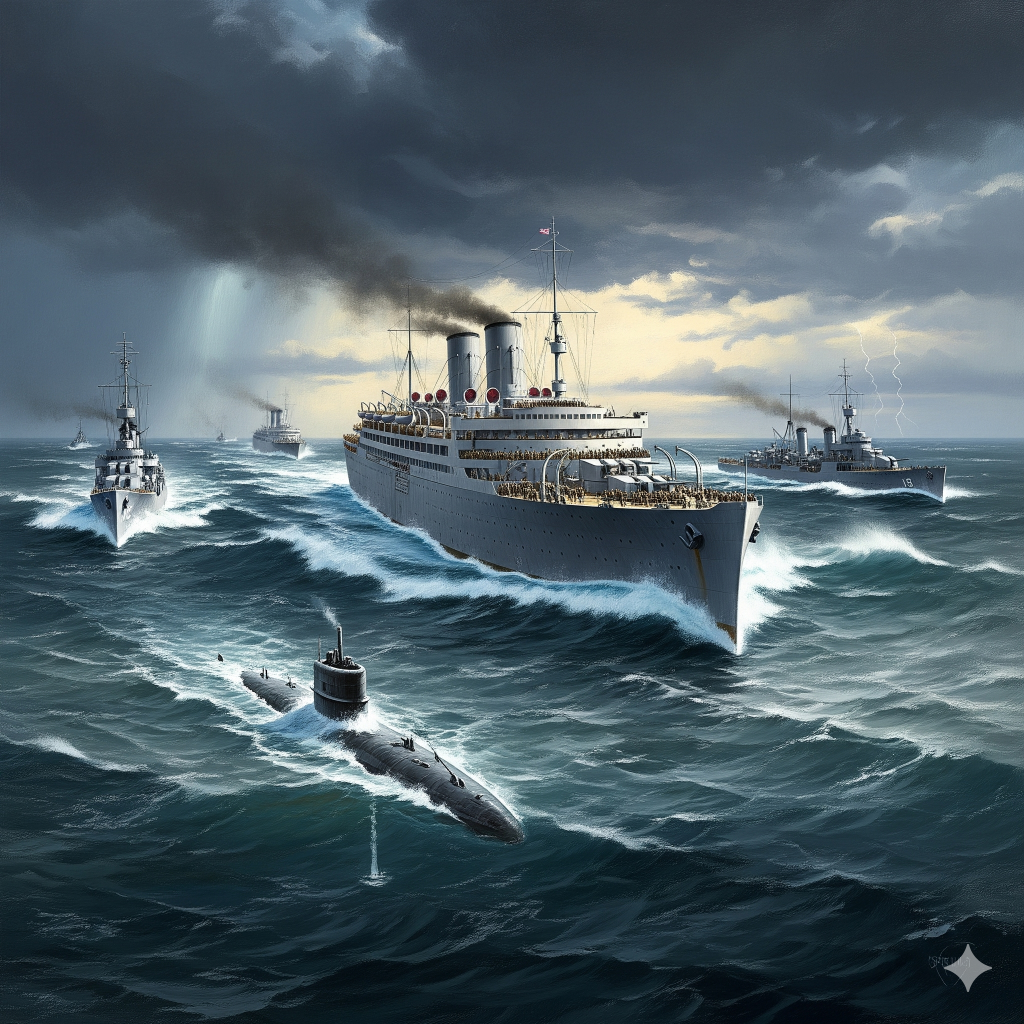
Image Credentials: Image Title: World War I and interwar years of the United States Navy Source: (gemini) Date: August 2025 Attribution: Created by AI-generated imagery (gemini), it does not depict a real-world scene.
World War I
During World War I, the United States Navy dedicated much of its resources to protecting and transporting hundreds of thousands of soldiers and Marines of the American Expeditionary Force across the Atlantic, along with vast quantities of war supplies. These operations were conducted in U-boat–infested waters by the Cruiser and Transport Force.
Another major task was the laying of the North Sea Mine Barrage, a large minefield intended to restrict German U-boat movement. Due to hesitation by senior naval command, significant American naval forces were not deployed to Europe until late 1917.
The U.S. contributed Battleship Division Nine, which was dispatched to Britain and served as the Sixth Battle Squadron of the British Grand Fleet. Its presence allowed the Royal Navy to decommission some older warships and reassign their crews to smaller vessels.
In addition, American destroyers and units of the U.S. Naval Air Force, including the Northern Bombing Group, participated in anti-submarine operations. The U.S. Navy’s overall strength increased as a result of the ambitious Naval Act of 1916, which had authorized a major expansion program before America entered the war.
Interwar years
Following the war, naval construction programs were curtailed by the Washington Naval Conference of 1921–22, the world’s first arms control conference. The treaty limited the size and number of battleships and aircraft carriers that the signatories could possess.
Two of the Navy’s first large aircraft carriers, USS Saratoga (CV-3) and USS Lexington (CV-2), were built on the hulls of partially completed battlecruisers canceled due to the treaty. During the New Deal, Public Works Administration funds were allocated to shipbuilding, resulting in new warships such as USS Yorktown (CV-5) and USS Enterprise (CV-6). By 1936, with the completion of USS Wasp (CV-7), the U.S. Navy possessed a carrier fleet with a displacement of about 165,000 tonnes, though officially recorded as 135,000 tonnes in order to remain compliant with treaty restrictions.
President Franklin D. Roosevelt, who had served as Assistant Secretary of the Navy during World War I, strongly supported the Navy throughout his presidency. In turn, senior naval leaders embraced innovation, experimenting with new technologies such as magnetic torpedoes and developing new strategies. Among these was War Plan Orange, a contingency plan for a possible conflict with Japan in the Pacific, which laid the foundation for U.S. strategy during the later Pacific War of World War II.
References
-
Still, William N. Crisis at Sea: The United States Navy in European Waters in World War I. University Press of Florida, 2006.
-
Halpern, Paul G. A Naval History of World War I. Naval Institute Press, 1994.
-
Morison, Samuel Eliot. History of United States Naval Operations in World War II, Vol. I: The Battle of the Atlantic. Little, Brown and Company, 1947.
-
Maurer, John H. “The U.S. Navy and the Washington Conference on Naval Limitation, 1921–22.” Naval War College Review 36, no. 3 (1983): 53–68.
-
Friedman, Norman. U.S. Aircraft Carriers: An Illustrated Design History. Naval Institute Press, 1983.
-
Reuter, Frank T. Franklin D. Roosevelt and the United States Navy. Greenwood Press, 1995.
-
Hone, Thomas C., and Hone, Trent. Battle Line: The United States Navy, 1919–1939. Naval Institute Press, 2006.
-
Love, Robert W. History of the U.S. Navy: Vol. 1, 1775–1941. Stackpole Books, 1992.
-
Millis, Walter. Arms and the State: Civil-Military Elements in National Policy. Twentieth Century Fund, 1958.
-
Miller, Edward S. War Plan Orange: The U.S. Strategy to Defeat Japan, 1897–1945. Naval Institute Press, 1991.
Back to the United States Navy Portal
Explore this subject
Continue exploring related Open Chronicle Encyclopedia entries through the categories associated with this article.

Staff Writers at Open Chronicle produce trusted journalism, strategic analysis and authoritative reference content across global affairs, geopolitics, defense, science, history, technology, business, culture and sport. Their work combines accurate reporting with historical perspective and analytical depth, helping readers understand not only what is happening, but why it matters. Beyond daily news coverage, Staff Writers contribute to the Open Chronicle Encyclopedia, investigative features, original research projects and long-form reports, building a comprehensive knowledge platform designed to inform, educate and preserve reliable information for a global audience.