
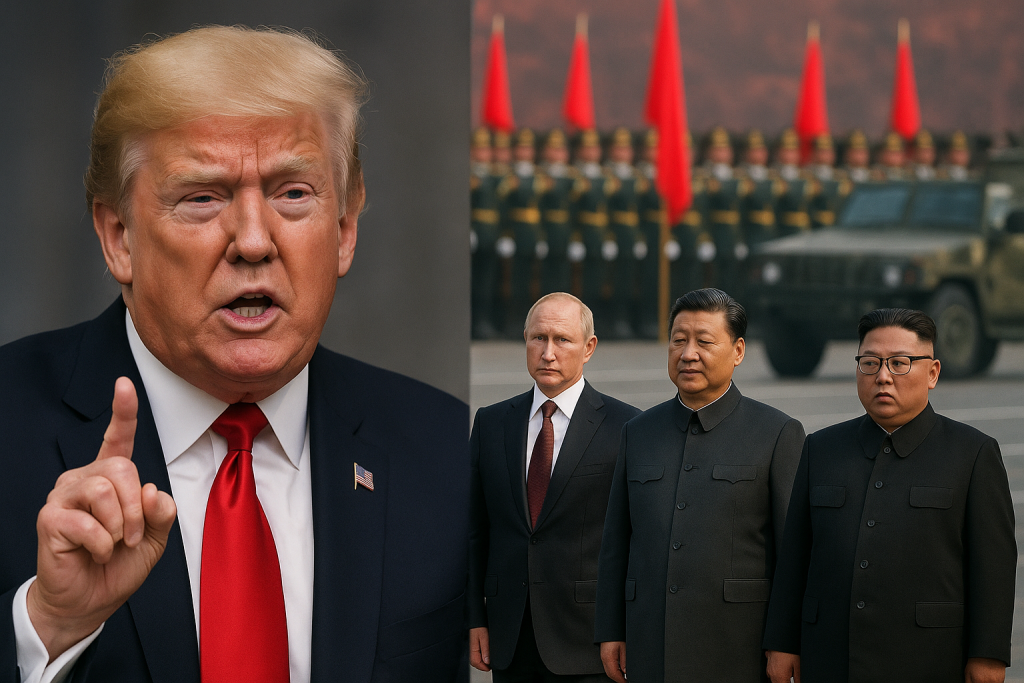
Image Credentials: Image Title: Trump Warns of ‘Conspiracy’ as Putin, Xi, and Kim Showcase Alliance at Beijing Parade Source: (Sora.ChatGpt) Date: August 2025. Attribution: Created using AI-generated imagery (Sora.ChatGpt), this does not depict a real-world scene.
By Staff Writer | Open Chronicle with Agencies
U.S. President Donald Trump’s sharp comments on Truth Social following a high-profile military parade in Beijing underscored a broader concern: the increasingly visible cooperation between Russia, China, and North Korea at a time of escalating global instability.
The parade, commemorating the 80th anniversary of Japan’s surrender in World War II, was more than a ceremonial display. With thousands of troops and cutting-edge weaponry on show in Tiananmen Square, Beijing sent a deliberate message: China’s military ambitions are accelerating, and its partnerships are hardening. The presence of Russian President Vladimir Putin and North Korean leader Kim Jong Un alongside Xi Jinping signaled a united front among three of Washington’s principal adversaries.
As China holds a massive victory day parade in Beijing, President Trump accused leaders of China, Russia and North Korea of conspiring against USA👇🏽#sabcnews pic.twitter.com/Bc6BfCwBBg
— Sherwin Bryce-Pease (@sherwiebp) September 3, 2025
Trump’s remarks, mixing historical references with pointed accusations, touched on a critical theme. He reminded audiences of America’s wartime sacrifices in China during World War II, before pivoting to accuse Xi, Putin, and Kim of conspiring against the United States. While Trump’s style was characteristically provocative, the subtext reflects genuine strategic anxieties in Washington.
Kim’s attendance, his first visit to Beijing since 2019, highlights North Korea’s deepening reliance on its two powerful neighbors. Isolated from the West, Pyongyang has found renewed diplomatic and economic lifelines in Moscow and Beijing. For Putin, the optics of standing shoulder to shoulder with Xi amid the ongoing war in Ukraine reinforced his claim that Russia is far from isolated, despite Western sanctions.
For China, hosting both leaders during a highly choreographed display of military power achieved multiple goals. Domestically, it reinforced Xi’s narrative of strength and national pride. Internationally, it symbolized a counterweight to the U.S.-led order, projecting an image of cohesion among states challenging American dominance.
The geopolitical implications are far-reaching. A closer strategic alignment between Moscow, Beijing, and Pyongyang could complicate U.S. policy across multiple fronts—from the war in Ukraine to nuclear negotiations with North Korea and military positioning in the Indo-Pacific. While the trio’s partnership remains pragmatic rather than ideological, their shared opposition to U.S. influence gives them common cause.
Trump’s commentary may have been delivered in his typical confrontational style, but it draws attention to an uncomfortable reality. The Beijing parade was not just about honoring history, it was about shaping the balance of power in the present—and signaling a possible future in which America’s rivals coordinate more openly than ever before.