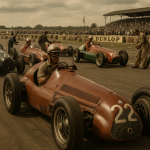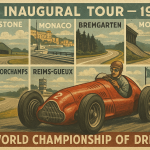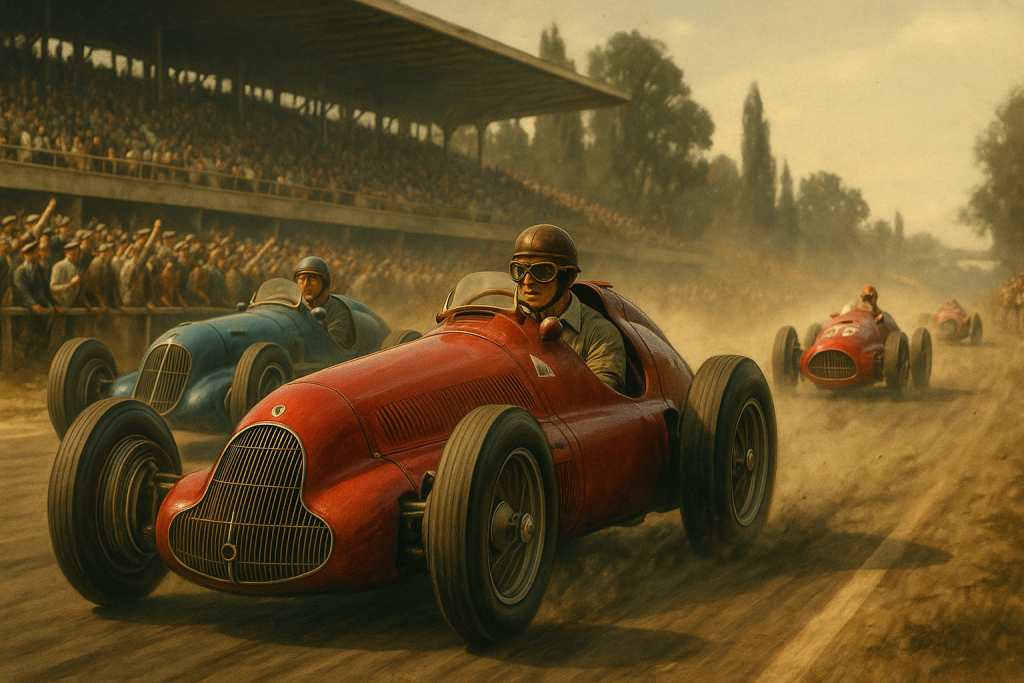
Image Credentials: Image Title: The Genesis of Glory: A Deep Dive into the 1950 Formula One Inaugural Season Source: (Sora.ChatGpt) Date: September 2025. Attribution: Created using AI-generated imagery (Sora.ChatGpt), this does not depict a real-world scene.
By Elliot Hayes | Open Chronicle Senior Editor
The 1950 Formula One season was far more than the fourth year of FIA Formula One motor racing; it was a seminal moment in sporting history. It marked the birth of the FIA World Championship of Drivers, a formalized title that would grow into the pinnacle of motorsport, creating a legacy of global heroes, technological marvels, and legendary rivalries. This inaugural championship was a story of post-war resurrection, absolute dominance, and the dramatic emergence of a defining talent.
The Birth of a World Championship
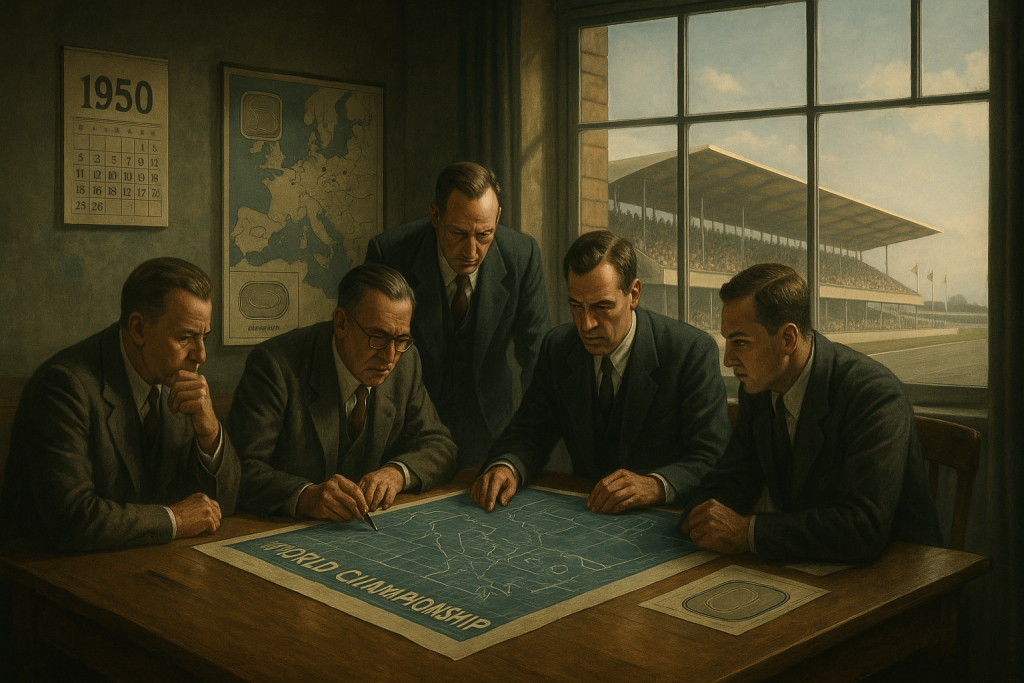
In the aftermath of World War II, European Grand Prix racing was rebuilding. To bring structure, prestige, and a clear pinnacle to the sport, the Fédération Internationale de l’Automobile (FIA) established a formal World Championship for Drivers. The championship was contested over seven races, a mix of classic European circuits and the iconic Indianapolis 500.
However, the inclusion of the Indy 500 was largely in name only. Run to different AAA regulations with its own culture and stars, it existed in a separate universe. No European championship drivers made the trip west, and no American “Indy” drivers came east, creating a curious asterisk in the first championship calendar. The true battles were fought across six European rounds: Silverstone, Monaco, Bremgarten, Spa-Francorchamps, Reims-Gueux, and Monza.
The Unbeatable Alfetta: Alfa Romeo’s Pre-War Masterpiece
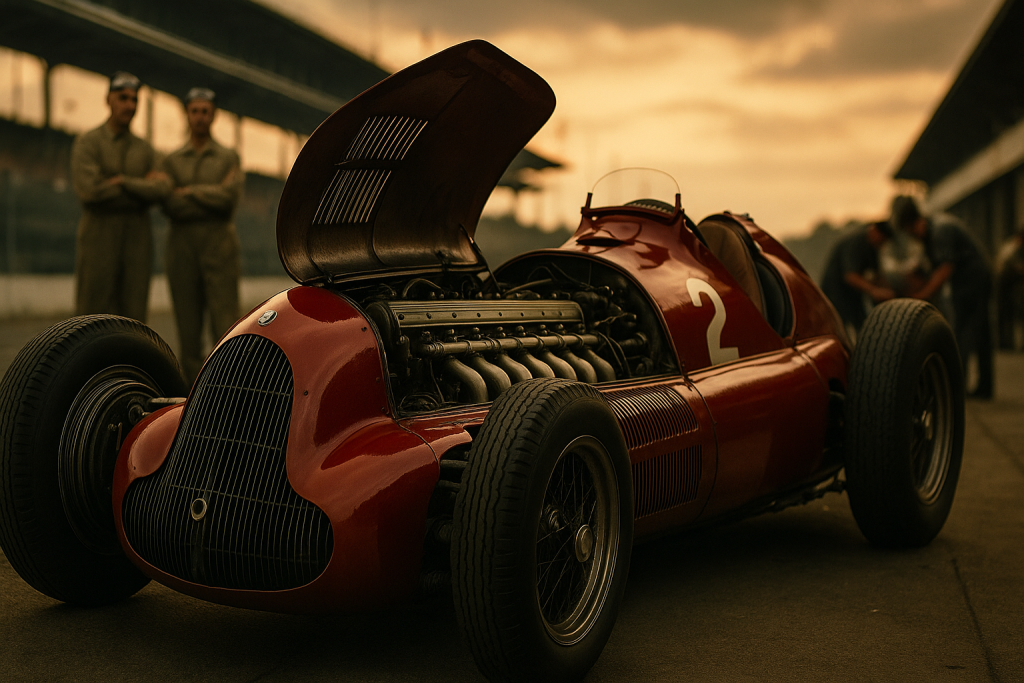
The season was utterly dominated by one machine: the Alfa Romeo 158, affectionately known as the “Alfetta” (little Alfa). This was not a new design; it was a pre-war masterpiece that debuted in 1938. Its genius lay in its sophisticated engineering—a straight-8 engine with a Roots-type supercharger, mounted in a lightweight, streamlined chassis.
The war had forced Alfa’s engineers to hide the cars, and development continued in secret. By 1950, the 1.5-litre supercharged engine produced over 350 bhp, a staggering figure that dwarfed the output of its naturally aspirated rivals like the 4.5-litre Ferraris and Talbot-Lagos. The Alfa Romeo team, led by the meticulous Enzo Ferrari before he focused on his own team, was a factory operation of unmatched professionalism and resources. They entered a trio of driving titans: the experienced Italians, Giuseppe “Nino” Farina and Luigi Fagioli, and a quiet, formidable newcomer from Argentina, Juan Manuel Fangio.
En un día como hoy, pero de hace 75 años…
Se realizó la primer carrera de F1 en la historia, en el circuito de Silverstone.
Alfa Romeo hizo 1-2-3-4
1️⃣ Giuseppe Farina🇮🇹
2️⃣ Luigi Fagioli🇮🇹
3️⃣ Juan Manuel Fangio🇦🇷
4️⃣ Reg Parnell🇬🇧pic.twitter.com/CiePgXFQfd— 🏁【 Alerta F1 】🏁 (@AlertaF1) May 12, 2025
The Championship Battle: Farina’s Consistency vs. Fangio’s Flashes of Brilliance
The narrative of the season was the internal battle within the Alfa Romeo team. The cars were so superior that the only question at each race was which of the three drivers would stand on the top step of the podium. They secured a perfect record, finishing 1-2-3 in five of the six championship rounds they contested.

Juan Manuel Fangio announced himself as a force of nature. His raw speed was breathtaking. He won three races (Monaco, Spa, and Reims) and set three fastest laps. His victory at Monaco, a circuit demanding precision and concentration, was a masterclass. However, his championship challenge was undone by mechanical fragility and misfortune. Retirements in Switzerland and, crucially, at the final race in Italy, shattered his points tally.
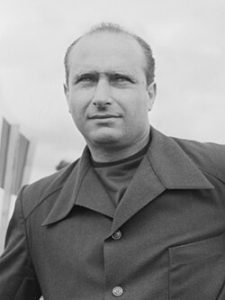
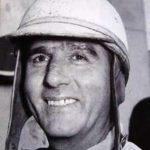
Giuseppe “Nino” Farina, in contrast, was the epitome of polished, calculated speed. He also won three races, including the historic first World Championship race at Silverstone and the season finale at Monza. But his key advantage was consistency. While Fangio scored zero points in three races, Farina’s worst finish was a fourth place in Belgium, a points-paying position that ultimately secured his title. He accumulated 30 points to Fangio’s 27, becoming the first ever Formula One World Champion.

Luigi Fagioli, the third driver, played the perfect lieutenant, consistently finishing in second and third places to secure valuable points for the team but never quite challenging his teammates for a win.
Beyond the Championship: The Wider Landscape
The non-championship races were a vital part of the 1950 season. Events like the Pau Grand Prix and the Goodwood Trophy provided a proving ground for privateers and smaller teams who were completely outclassed by the Alfas in the championship rounds. For them, these races were their championship, offering glory and prize money away from the factory dominance.
These events highlighted the stark divide in Formula One. While Alfa Romeo existed in its own stratosphere, the rest of the field was comprised of brave privateers in Talbot-Lagos, outdated Maseratis, and the fledgling Ferrari team, which showed promise with driver Alberto Ascari but lacked the power to challenge consistently.
Legacy and Significance
The 1950 season set the template for everything that followed.
-
The Dawn of a New Era: It transformed Grand Prix racing from a loose collection of events into a structured, global World Championship, creating a narrative that continues to captivate millions seven decades later.
-
The First Champion: Giuseppe Farina secured his place in history forever as the inaugural titleholder, a refined driver whose smooth style earned him the crown.
-
The Arrival of a Legend: Although he fell just short, Juan Manuel Fangio’s talent was undeniable. He was a champion in waiting, and his subsequent five world titles would cement his status as one of the greatest drivers of all time, a journey that began in earnest in 1950.
-
Technical Philosophy: The season underscored the advantage of supercharged engine technology and factory-backed teams, a dynamic of technical innovation and financial might that remains central to Formula One’s DNA.
In conclusion, the 1950 season was not just a championship; it was a genesis. It was the moment motorsport organized itself into a formal hierarchy of excellence, dominated by a perfect car and a trio of drivers whose rivalry wrote the first unforgettable chapter in the longest-running story in Formula One history.
References
- Cimarosti, A. (1997). The complete history of Grand Prix motor racing. Aurum Press.
- Fangio, J. M. (1961). My twenty years of racing. Temple Press.
- Hamilton, M. (2020). *Alfa Romeo 158/159: The story of a legend*. Evro Publishing.
- Ludvigsen, K. (2008). Red Hot Rivals: The classic struggle of Alfa Romeo and Ferrari. Icon Automobiles.
- Nye, D. (1986). The British Grand Prix: A history. Guild Publishing.
- 1950 Formula One season. (n.d.). In Wikipedia. Retrieved October 26, 2023, from https://en.wikipedia.org/wiki/1950_Formula_One_season
- 1950 Race Results. (n.d.). Formula1.com. Retrieved October 26, 2023, from https://www.formula1.com/en/results.html/1950/races.html
- The first World Championship. (2020, May 12). Formula1.com. https://www.formula1.com/en/latest/article.the-first-world-championship-how-the-1950-season-kicked-off-f1-as-we-know.4VkL8pO9WUcKk2e2Y2MqUI.html
- Tremayne, D. (2017). The Lost Generation: The brilliant but tragic lives of Italy’s Formula One heroes. Evro Publishing.
Back to the 1950 Formula One season Portal
Explore this subject
Continue exploring related Open Chronicle Encyclopedia entries through the categories associated with this article.

Staff Writers at Open Chronicle produce trusted journalism, strategic analysis and authoritative reference content across global affairs, geopolitics, defense, science, history, technology, business, culture and sport. Their work combines accurate reporting with historical perspective and analytical depth, helping readers understand not only what is happening, but why it matters. Beyond daily news coverage, Staff Writers contribute to the Open Chronicle Encyclopedia, investigative features, original research projects and long-form reports, building a comprehensive knowledge platform designed to inform, educate and preserve reliable information for a global audience.