
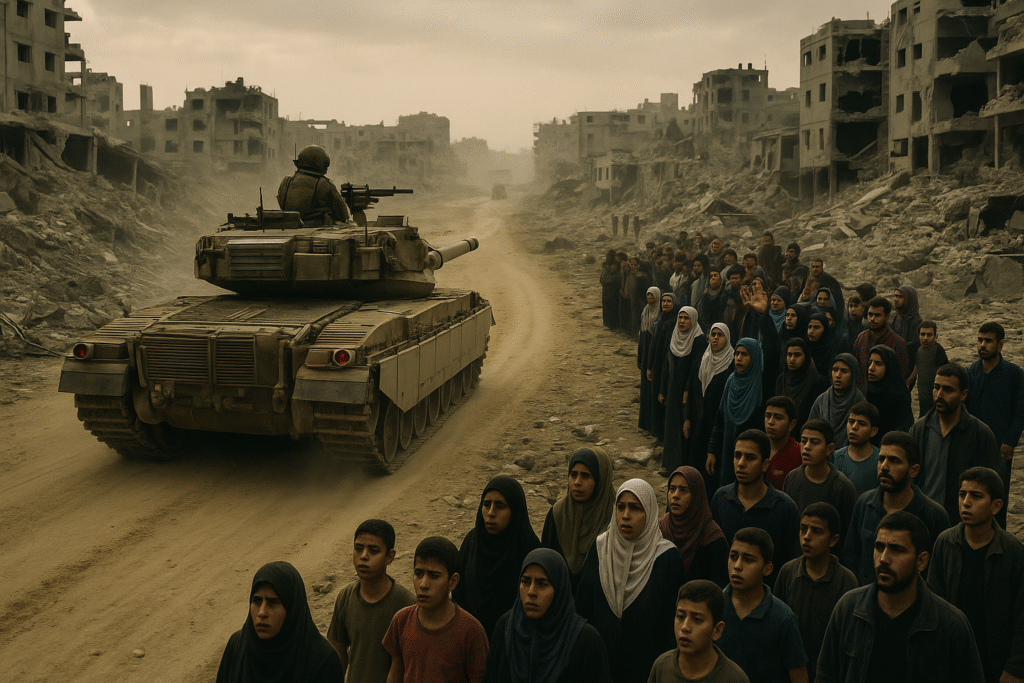
Image Credentials: Image Title: Gaza Hopeful Transition Source: (Sora.ChatGPT) Date: October 2025. Attribution: This image was created using AI-generated imagery (Sora.ChatGPT) and does not depict a real-world scene.
Isabella Harper | Staff Writer with Agencies
In a moment that many hope marks the beginning of a new era for the Gaza Strip, Israeli forces have begun a partial withdrawal to agreed-upon deployment zones under the terms of the Trump-brokered ceasefire deal. The move, hailed by international mediators as a major step toward ending one of the most devastating conflicts in recent history, has brought both relief and apprehension among Palestinians who have endured years of war and hardship.
A Scene of Renewal Amid Ruins
Last Saturday, residents of Gaza witnessed an extraordinary sight: convoys of well-guarded trucks bearing Egyptian flags entering the enclave, offering Palestinians free transport from southern Gaza to the north. The scene carried deep symbolism for many, representing a flow of life and hope back into a land long described as desolate. One resident likened it to “blood returning to the veins of a body that had once been declared dead.”
These convoys passed through streets that had seen immense suffering, destruction, and loss. Entire neighborhoods lay in ruins, reminders of a conflict that the world has condemned repeatedly. Yet amid the devastation, Egypt’s presence has provided a sense of reassurance. Cairo has stood firmly by the Palestinian people, calling for peace and restraint throughout the crisis, and it has played a key role in ensuring that the Trump ceasefire deal moved forward.
The Trump Plan and the Ceasefire Framework
The United States, under President Donald Trump, has positioned itself as a central architect of the current truce. On 4 October, Trump announced via his Truth Social platform that Israel had agreed to an initial withdrawal line and that Hamas had been shown the map. “When Hamas confirms, the Ceasefire will be IMMEDIATELY effective, the Hostages and Prisoner Exchange will begin, and we will create the conditions for the next phase of withdrawal, which will bring us close to the end of this 3,000 YEAR CATASTROPHE,” Trump wrote, using his signature emphatic style.
According to the Times of Israel, this initial withdrawal line corresponds roughly to Israel’s control before the major Gaza City offensive. At that time, the Israel Defense Forces (IDF) occupied nearly 70 percent of the territory. Under the new arrangement, Israel will maintain a presence in parts of southern Gaza, including Rafah and Khan Younis, as well as certain northern areas and buffer zones.
The withdrawal, however, is not an outright end to the war. It is structured in phases, allowing pauses for reassessment and ensuring the IDF remains ready to re-engage if necessary. Lieutenant General Eyal Zamir, Israel’s Chief of Staff, emphasized that the army must “remain alert and prepared for combat at all times,” warning that fighting could resume should political efforts fail.
Hostage Returns and the First Phase of Withdrawal
The first tangible sign of progress came on 10 October, when Israeli Prime Minister Benjamin Netanyahu announced the return of all hostages held by Hamas, both the living and the dead. He described the achievement as “a central goal that we have clung to throughout the entire journey.”
Shortly after the announcement, Israeli forces began their withdrawal to what officials have referred to as the “yellow line.” The move reduced Israel’s territorial control from 70 to approximately 53 percent of the Gaza Strip. The pullback occurred swiftly, with reports confirming that the Israeli army completed the maneuver within a single day of the government’s ratification of the agreement.
Though the operation was accompanied by sporadic artillery fire and airstrikes, the bulk of Israeli troops have repositioned behind designated lines. Armoured units, paratroopers, and support forces remain in place as a deterrent and as a precautionary measure against any renewed hostilities.
Signs of Life Returning to Gaza
In the days following the withdrawal, humanitarian aid began to flow more freely into the enclave. Markets reopened, children returned cautiously to the streets, and for the first time in months, a semblance of daily life re-emerged. Yet, amid these hopeful signs, Hamas fighters have reappeared in public, patrolling the streets in their trademark green headbands. Their presence is a reminder that while Israel may have stepped back, Hamas still holds influence over the population and intends to remain a central player in Gaza’s political and security landscape.
Sherwin Pomerantz, writing for The Jerusalem Post, argued that Hamas cannot simply vanish. “There is no way to eliminate an idea based on religious fervor unless one eliminates every single person who believes in that idea,” he wrote, adding that Hamas’s ideological roots make it an enduring force in Palestinian society, regardless of military setbacks.
During the long conflict, Hamas has relied on asymmetric tactics such as tunnel warfare, ambushes, and indirect attacks, often operating from densely populated areas. Though the group has suffered heavy losses, it continues to draw strength from a sense of resistance that resonates deeply among many Palestinians.
The Future of Militias and the Fragile Balance Ahead
Another emerging question concerns the Palestinian militias that cooperated with Israeli forces during the conflict. These groups, often composed of rival factions and tribal fighters, have not yet been disbanded. Instead, they remain in a phase of regrouping and training, reportedly preparing for future roles in Gaza’s security framework. Their fate, as well as their relationship with both Hamas and Israel, remains uncertain.
Observers believe that this period of cautious calm could either pave the way for a durable peace or collapse under the weight of unresolved tensions. Israel retains significant military capacity and infrastructure inside Gaza, ensuring that any resurgence of hostilities could be met with immediate response. The ceasefire’s endurance will depend on sustained diplomatic engagement, strict adherence to the terms of withdrawal, and, crucially, the political will of all parties involved.
Toward a New Chapter
For many, this turning point represents both an end and a beginning. The Gaza Strip has been the epicenter of suffering and defiance for generations, a place where hopes for peace have repeatedly been crushed under the weight of mistrust and bloodshed. Yet, for the first time in years, the region stands on the threshold of cautious optimism.
Egypt’s steadfast diplomacy and the American push for a structured peace have made possible what once seemed unattainable: a ceasefire that has, at least temporarily, silenced the guns. The challenge now lies in maintaining that silence and transforming it into lasting stability.
The lesson of this moment is clear. The future of Gaza will not be determined by force alone but by the willingness of all sides to embrace restraint, uphold international law, and honor the shared humanity that unites them beyond the battlefield.
If this fragile peace can be preserved, Gaza may yet move from a symbol of endless war to one of hard-earned renewal and resilience.