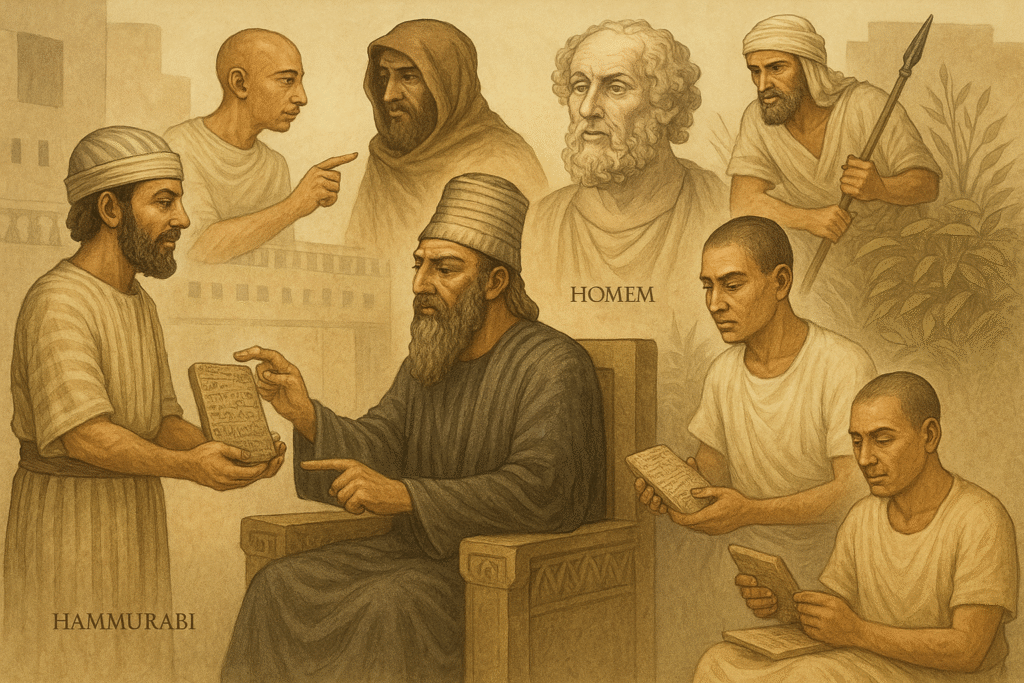
Image Credentials: Image Title: Ancient World Espionage Introduction Source: (sora.openai) Date: October 2025. Attribution: This image was created using AI-generated imagery (sora.openai) and does not depict a real-world scene.
By José Carlos Palma | Editor-in-Chief
Espionage has been recognized as an important element of military and political strategy since ancient times. Historical evidence suggests that the gathering of secret intelligence played a key role in the survival and success of early civilizations.
The oldest known classified document is believed to have been a report prepared by a spy disguised as a diplomatic envoy in the court of King Hammurabi of Babylon, who died around 1750 BC. The ancient Egyptians also maintained a developed secret service, utilizing informants and spies to monitor internal dissent and foreign threats. Espionage is further referenced in classical texts such as Homer’s Iliad, the Bible, and the Amarna letters, which document diplomatic correspondence and intelligence exchanges among Near Eastern states.
In the Greco-Roman world, espionage was a widespread practice, often involving the use of illiterate or lower-class individuals within civil or military positions to gather intelligence undetected. Both Greek city-states and the Roman Empire employed spies and scouts to assess the movements and intentions of rivals, highlighting the institutional importance of intelligence in governance and warfare.
The philosophical and strategic value of espionage was formally articulated in two foundational works: Sun Tzu’s The Art of War and Kautilya’s Arthashastra. These texts emphasize the indispensability of intelligence gathering to statecraft and military success.
In The Art of War, Sun Tzu identifies five types of spies critical to victory:
-
Local spies, or citizen informants operating within enemy territory.
-
Inward spies, who are recruited as double agents embedded within enemy ranks.
-
Converted spies, defectors turned to serve one’s own side.
-
Doomed spies, expendable agents used to spread false information and mislead the enemy.
-
Surviving spies, those who return safely to report accurate intelligence after infiltration.
These classifications remain among the earliest systematic frameworks for understanding espionage operations. Collectively, they demonstrate that even in antiquity, intelligence was regarded as a decisive factor in both war and diplomacy, shaping outcomes across civilizations.
References
-
Kautilya. Arthashastra. Translated by R. Shamasastry. Bangalore: Government Press, 1915.
-
Sun Tzu. The Art of War. Translated by Lionel Giles. London: Luzac and Co., 1910.
-
Andrew, Christopher. The Secret World: A History of Intelligence. New Haven: Yale University Press, 2018.
-
Gaddis, John Lewis. The Landscape of History: How Historians Map the Past. Oxford: Oxford University Press, 2002.
-
Ferrill, Arther. The Origins of War: From the Stone Age to Alexander the Great. London: Thames and Hudson, 1985.
-
Grant, Michael. The Army of the Caesars. New York: Charles Scribner’s Sons, 1974.
-
Whittaker, C. R. Frontiers of the Roman Empire: A Social and Economic Study. Baltimore: Johns Hopkins University Press, 1994.
-
Heeren, A. H. L. Manual of the History of the Political System of Europe and Its Colonies. Oxford: Talboys, 1834.
-
Park, Roger. Intelligence and Espionage in Antiquity. Cambridge: Cambridge University Press, 1997.
-
Kramer, Samuel Noah. History Begins at Sumer: Thirty-Nine Firsts in Recorded History. Philadelphia: University of Pennsylvania Press, 1981.
Explore this subject
Continue exploring related Open Chronicle Encyclopedia entries through the categories associated with this article.

José Carlos Palma is the creator, developer, and Editor-in-Chief of Open Chronicle. With over 14 years of experience in international relations, foreign policy, and military analysis, he specializes in global security and geopolitical strategy. Alongside his analytical expertise, José has a strong background in IT consulting, web development, and network engineering, combining technology and global affairs to deliver clear insights on complex issues.