
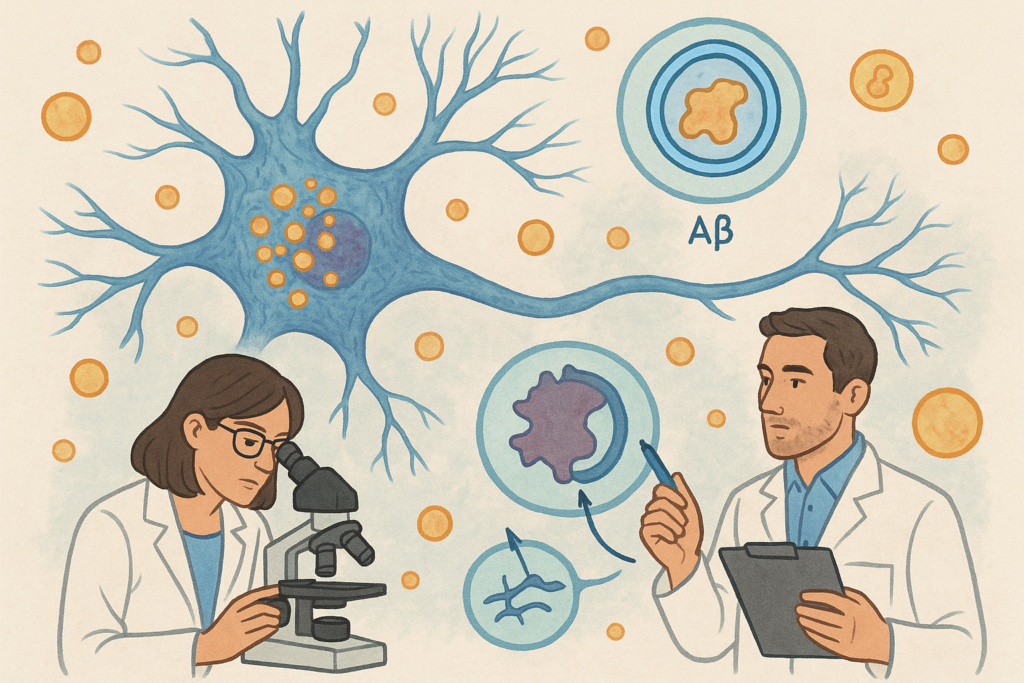
Image Credentials: Image Title: Scientists Discover Hidden Weak Spot in Alzheimer’s Disease: Faulty Exosomes Linked to SORLA Mutation Source: (sora.openai) Date: November 2025. Attribution: This image was created using AI-generated imagery (sora.openai) and does not depict a real-world scene.
By Isabella Harper | Staff Writer
Researchers at Aarhus University have identified a previously hidden cellular weakness that may drive the development of Alzheimer’s disease, offering new avenues for potential treatment. The study, recently published in Alzheimer’s & Dementia: The Journal of the Alzheimer’s Association, reveals that a mutation in the SORLA protein disrupts the production and quality of exosomes, tiny cell-made communication packets crucial for brain health.
Exosomes: Tiny Particles with Big Impact
Exosomes are microscopic vesicles released by cells to communicate and influence nearby cells. Despite their minuscule size, millions could fit on the tip of a grain of rice, and they play a critical role in maintaining neural function. The Aarhus University team, led by Assistant Professor Kristian Juul-Madsen, found that brain cells carrying a mutated form of SORLA produced 30% fewer exosomes. Moreover, these exosomes were up to 50% less effective at supporting the growth and maturation of surrounding cells compared to those from cells without the mutation.
SORLA Mutation Impairs Brain Cell Communication
The SORLA protein, encoded by the Sorl1 gene, is one of four primary genes associated with inherited forms of Alzheimer’s. Mutations in SORLA have long been linked to an increased risk of the disease, but the underlying mechanisms were unclear. The new findings suggest that the mutation reduces both the quantity and the quality of exosomes, weakening the brain’s internal communication network and potentially accelerating neurodegeneration.
“Exosomes produced particularly by the brain’s immune cells appear to be essential for maintaining healthy neural environments,” Juul-Madsen explains. “Mutations that result in fewer and poorer quality exosomes may therefore be a critical factor in Alzheimer’s development.”
Implications for Future Therapies
The discovery opens new possibilities for therapeutic strategies aimed at restoring or enhancing exosome function. Potential approaches include stimulating SORLA activity to boost exosome production or targeting other receptors that can improve exosome quality.
“The potential is very clear,” Juul-Madsen said. “By focusing on improving exosome production and functionality, we may be able to develop novel treatments that slow or prevent the progression of Alzheimer’s disease.”
A Pressing Need for Solutions
Alzheimer’s remains the most common form of age-related dementia in Denmark, affecting an estimated 55,000 people. Despite decades of research, effective therapies are limited, highlighting the urgency of breakthroughs such as this one.
The identification of defective exosomes as a weak point in Alzheimer’s pathophysiology provides a promising new target for researchers, offering hope for more effective interventions in the future.
Story Source:
Materials provided by Aarhus University. Note: Content may be edited for style and length.
Journal Reference:
- Kristian Juul‐Madsen, Ina‐Maria Rudolph, Jemila P. Gomes, Katrina Meyer, Peter L. Ovesen, Malgorzata Gorniak‐Walas, Marianna Kokoli, Narasimha S. Telugu, Malthe von Tangen Sivertsen, Fabia Febbraro, Duncan S. Sutherland, Johan Palmfeldt, Sebastian Diecke, Olav M. Andersen, Matthias Selbach, Thomas E. Willnow. Familial Alzheimer\’s disease mutation identifies novel role of SORLA in release of neurotrophic exosomes. Alzheimer\’s, 2025; 21 (9) DOI: 10.1002/alz.70591