
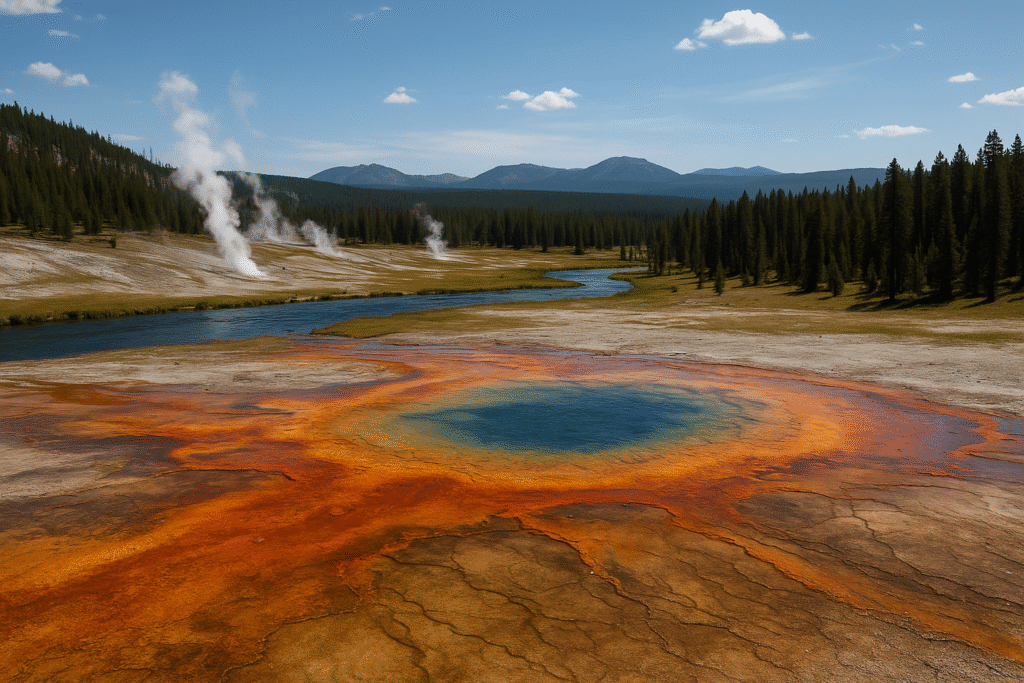
Image Credentials: Image Title: Tiny Quakes Spark Hidden Life Beneath Yellowstone Source: (sora.openai) Date: November 2025. Attribution: This image was created using AI-generated imagery (sora.openai) and does not depict a real-world scene.
By Isabella Harper | Staff Writer
A series of small earthquakes rippled through the Yellowstone Plateau Volcanic Field in 2021, and while the events barely registered at the surface, they unleashed a remarkable transformation in the dark and pressurized world far below. New research published in PNAS Nexus reveals that these subtle seismic tremors injected fresh chemical energy into deep aquifers, triggering a measurable surge in microbial activity.
The study, led by Eric Boyd, offers a rare glimpse into how life endures in environments that lie far from sunlight. In these depths, microbes survive by harvesting energy from chemical reactions that occur as water moves through fractured rock. Earthquakes alter this system by creating new fractures, releasing trapped fluids, and reshaping the flow of groundwater. These changes generate new reactive surfaces and chemical gradients, which in turn refresh the energy supply that microbes depend on.
Deep Fluids Tell the Story
To observe this process in real time, the team sampled water from a borehole nearly one hundred meters deep along the western boundary of Yellowstone Lake. They collected samples five times throughout 2021, capturing the chemical and biological ripple effects of the quake swarm.
Water chemistry shifted significantly after the seismic activity. The researchers measured elevated levels of hydrogen, sulfide, and dissolved organic carbon. These molecules serve as fuel for many subsurface organisms. At the same time, counts of planktonic cells rose, suggesting that microbial populations had temporarily expanded in response to the new energy inputs.
This combination of chemical enrichment and microbial growth points to a short lived boost in habitability deep beneath Yellowstone.
Communities That Refuse To Stay Still
One of the most surprising findings was the rapid change in the composition of microbial communities. Groundwater ecosystems locked in continental bedrock are typically viewed as slow moving and stable, yet Yellowstone proved highly dynamic. The arrival of new chemical resources shifted the balance of species, indicating that even minor geological motions can reorganize life below the surface.
According to the authors, the kinetic energy from earthquakes plays a dual role. It reshapes the physical structure of the subsurface and remodels the chemical landscape, which together alter the ecological conditions within deep aquifers.
What This Means for Earth and Beyond
Yellowstone is not unique in experiencing minor earthquakes. If similar processes occur elsewhere, subsurface ecosystems across the planet may depend on periodic pulses of seismic energy to remain active. This mechanism could also extend to other worlds. Any rocky planet that contains water and undergoes internal geological activity might experience chemical rejuvenation in its subsurface habitats.
Such a process could expand the range of potential environments where microbes might survive. Mars, with its fractured crust and evidence of past water, is an intriguing example. If seismic motions can refresh chemical supplies below ground, then deep microbial ecosystems may be more widespread in the solar system than previously thought.
The findings remind us that life does not always require sunlight. Sometimes, all it needs is a slight shake of the Earth to awaken hidden communities living in the dark.
Story Source:
Materials provided by PNAS Nexus. Note: Content may be edited for style and length.
Journal Reference:
- Eric S Boyd, Daniel R Colman, Ana Menchaca, Rachel L Spietz, Anna Shoemaker, Carol Finn, David Mencin, Eva Andrade-Barahona, Alysia Cox, Thomas Kieft, Susan Bilek, Jefferson Hungerford, Tullis C Onstott. Seismic shifts in the geochemical and microbial composition of a Yellowstone aquifer. PNAS Nexus, 2025; 4 (11) DOI: 10.1093/pnasnexus/pgaf344