
Image: from Mariska den Eelden  X@eeldenden
By José Carlos Palma with Agencies
Efforts to lay the groundwork for a future peace agreement in Ukraine accelerated this week as France and the United Kingdom renewed their call for a multinational force to be deployed once active hostilities end. Both countries argue that a physical security presence will be essential to prevent a renewed attack and to ensure that any negotiated settlement remains credible.
The meeting of the Coalition of the Willing brought together most European states along with Turkey, Canada, Australia, New Zealand and Japan. Participants met virtually to discuss the diplomatic initiative led by the United States and intended to shape a peace framework. An original twenty eight point draft, negotiated discreetly by officials from Washington and Moscow, excluded any presence from the North Atlantic Treaty Organization on Ukrainian territory. This condition reflected Russia’s long standing objections. However, France and the United Kingdom insist that the future stability of Ukraine requires more than written promises.
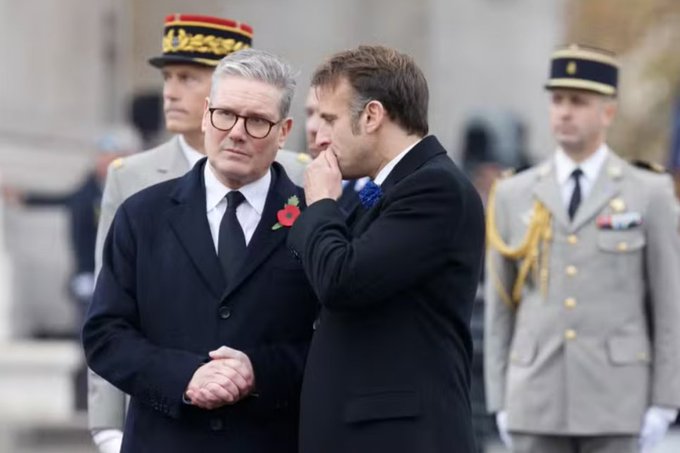
President Emmanuel Macron underlined this point by arguing that Ukraine has already endured the consequences of violated commitments. He explained that the country cannot rely on symbolic assurances and needs concrete protective measures. In his remarks he described a reassurance force that would operate in key Ukrainian cities such as Kyiv and Odessa after the guns fall silent. He added that French, British and Turkish personnel would focus on training and security tasks. According to Macron the mission would not involve front line combat roles.
Prime Minister Keir Starmer set out a similar position and urged coalition members to strengthen their commitments. He highlighted the need to prepare funding and planning for Ukraine’s own future armed forces. He noted that the multinational force that has been envisioned will be essential in the long term. Starmer insisted that a credible political guarantee is required to deter violations by Moscow. He warned that the absence of such credibility might undermine any agreement reached at the negotiating table.
Western unity on this question remains incomplete. Sweden, Denmark and Australia have signalled that they are willing to consider participation while Poland, Greece and Italy have voiced reservations. Even so, the meeting closed with a decision to create a working group that will define the structure of the guarantees and clarify the contributions of each state involved. France and the United Kingdom will lead this group with participation from the United States and Turkey.
Macron and Starmer also stressed the need to preserve sanctions pressure on Russia and to use frozen Russian central bank assets to assist Ukraine. This idea breaks new ground in international policy since the value of these immobilised assets on European Union territory reaches two hundred and ten billion euro.
The diplomatic sprint continues in parallel with bilateral discussions between Kyiv and Washington. Ukrainian officials announced progress toward a shared understanding of the most sensitive points of a potential agreement. Several issues remain unresolved until President Volodymyr Zelenskyy and President Donald Trump meet in person. Zelenskyy indicated that he is open to a joint visit involving European leaders, noting that decisions made without direct Ukrainian involvement would not endure.
The initial twenty eight point proposal provoked strong concern in European capitals because many provisions appeared to align with Russian preferences. One of the most contentious sections stated that the North Atlantic Treaty Organization would refrain from any troop presence inside Ukraine. This clause contradicts the reassurance force promoted by the Coalition of the Willing. A United States delegation met Russian representatives in Abu Dhabi to explain the revisions introduced after consultations with Kyiv in Geneva.
The Kremlin continues to favour the original draft. European governments, meanwhile, have become increasingly assertive. They insist on full involvement in decisions relating to sanctions and frozen Russian assets and they demand an agreement that contains firm and enforceable safeguards against future attacks. Germany’s Chancellor Friedrich Merz emphasised that any proposal affecting European security and sovereignty cannot move forward without European approval. The European Union is preparing plans to achieve sufficient military readiness by the year twenty thirty to counter a possible Russian escalation.
Macron reaffirmed that the common objective remains a ceasefire, a just settlement and long term security for Ukraine and for Europe as a whole. The White House had once aimed for a framework agreement by late November, although recent negotiations have introduced more flexibility into the timeline. Despite the intense pace of diplomacy, many questions remain open and the next weeks will determine whether the emerging framework can produce a durable and enforceable peace.