
OPEN CHRONICLE | WORLD NEWS | MIGRATION & HUMANITARIAN CRISIS
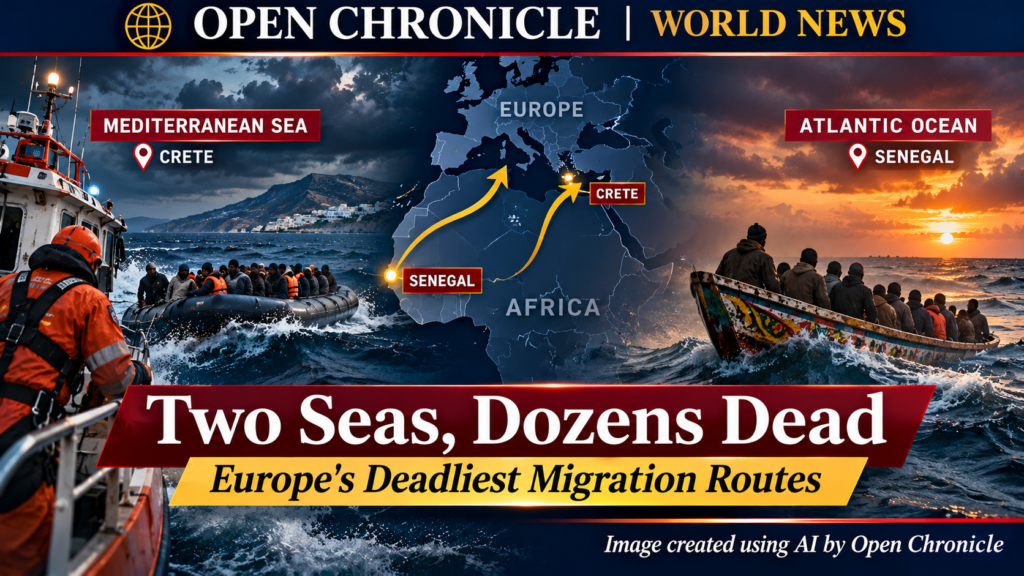
At least 61 people have died in separate maritime disasters near Greece and Senegal, as rescue operations reveal the continuing human cost of dangerous journeys toward Europe. From the Mediterranean to the Atlantic, the tragedies raise urgent questions about smuggling networks, border enforcement and the protection of people at sea.
By Open Chronicle News Desk
November 9, 2026 | Athens, Dakar and Brussels
Two stretches of water separated by thousands of kilometres have become the scenes of devastating migrant tragedies.
In the Mediterranean, Greek authorities have recovered the bodies of at least 22 people following two separate incidents involving boats attempting to reach the island of Crete.
Farther west, in the Atlantic Ocean, emergency services in Senegal have confirmed at least 39 deaths after a vessel carrying migrants overturned while travelling toward Spain.
Together, the disasters have claimed at least 61 lives, according to the latest figures available to Open Chronicle on November 9.
The circumstances of the incidents differ. The people aboard the vessels were travelling along separate migration corridors, facing different maritime conditions and departing from different regions.
Yet the underlying story is strikingly similar.
People seeking safety, employment or a more secure future continue to embark on dangerous sea crossings despite repeated warnings, increased surveillance and efforts to disrupt human smuggling networks.
The latest deaths have once again exposed the limitations of Europe’s migration management system, particularly when prevention, border control and humanitarian protection compete for political attention.
The tragedies also raise a difficult question: why do people continue to risk their lives on routes where the dangers are so widely documented?
1. The Mediterranean tragedy: Deaths south of Crete
The first major incident unfolded in waters south of Crete, where a vessel carrying migrants was discovered near the coastal area of Kaloi Limenes.
According to the Greek Coast Guard, a container ship sailing under the Moroccan flag located the boat approximately 15 nautical miles from the island and alerted the authorities.
Rescuers initially reported recovering 12 bodies and bringing 18 people to safety.
The death toll subsequently increased to 14 after authorities confirmed an additional death aboard the vessel and the death of another survivor following the rescue.
Four survivors, including a young child, required hospital treatment.
The identities and nationalities of those who died had not been fully established when the initial reports were published.
Investigators were also examining the circumstances that led to the deaths.
The vessel may have spent several days at sea, exposing its passengers to prolonged physical hardship.
However, the precise causes of death had not been officially determined.
2. Another boat, another eight lives lost
The November 9 tragedy followed a separate incident south of Crete during the preceding weekend.
Greek authorities recovered eight bodies from a vessel associated with a group of Sudanese migrants.
Twenty-eight people survived.
According to local reporting, severe weather complicated the rescue operation and delayed the recovery of several bodies.
Survivors indicated that the boat had departed Libya several days earlier.
Greek authorities subsequently detained two Sudanese nationals, aged 28 and 16, who were identified by other passengers as allegedly involved in organising the crossing.
Their detention does not establish guilt, and any criminal responsibility must be determined through the judicial process.
The two incidents underline the risks associated with crossings from North Africa toward Crete.
They also illustrate how maritime emergencies can develop even when a vessel is relatively close to European territory.
3. Rescue operations save hundreds more
While authorities were recovering bodies, other vessels were being intercepted in the same maritime area.
On November 9, Greek and European border authorities carried out additional operations involving boats travelling toward Crete.
Aircraft and maritime assets associated with Frontex assisted in locating vessels and coordinating rescues.
Initial reports described 105 people rescued across three operations, including the 18 survivors from the boat carrying the deceased.
Later Reuters reporting indicated that another 187 people had been rescued in three additional operations on Monday.
The changing figures reflect the evolving nature of the response, as separate operations were reported at different times.
The distinction is important because preliminary rescue totals should not be combined indiscriminately with later updates.
The wider pattern nevertheless demonstrates the scale of maritime activity south of Crete.
For the people rescued, the immediate danger may have ended, but their future remains uncertain.
They may face medical assessments, identification procedures, asylum processing or other immigration decisions under Greek and European law.
4. The Atlantic disaster: 39 dead off Senegal
Hundreds of kilometres from the Mediterranean, another tragedy unfolded along the Atlantic migration route.
A boat that departed from Saint-Louis in northern Senegal overturned on November 8 near Kébémer, north of Dakar.
The vessel had reportedly been travelling toward the Spanish coast.
Senegalese authorities initially confirmed 21 deaths.
As rescue teams recovered additional bodies, the toll rose to 39 on November 9.
Only one passenger had been rescued alive when the latest Associated Press report was published.
The total number of people aboard the vessel remained unclear, and several passengers were believed to be missing.
The uncertainty means that the final death toll could change as search operations continue.
Senegalese President Bassirou Diomaye Faye expressed condolences and pledged action against criminal networks involved in organising dangerous maritime crossings.
5. Why the Atlantic route is so dangerous
The Atlantic migration corridor from West Africa toward Spain’s Canary Islands is among the most hazardous routes used by people attempting to reach Europe.
Unlike many Mediterranean crossings, which may involve relatively short distances between departure points and European territory, Atlantic journeys can require several days at sea.
Migrants frequently travel aboard traditional fishing vessels adapted to carry large numbers of passengers.
These boats may lack adequate safety equipment, navigation systems, fuel reserves or emergency communications.
The risks increase dramatically when vessels encounter strong currents, heavy seas, mechanical failures or unexpected changes in weather.
Even when the weather is relatively calm, overcrowding and prolonged exposure can create life-threatening conditions.
A boat that loses power or drifts away from its intended route can become extremely difficult to locate.
The Senegal disaster illustrates the danger of a journey that may begin near familiar coastal communities but quickly enter an unforgiving maritime environment.
6. Why people continue to leave Senegal
The reasons behind migration from Senegal are complex.
Economic insecurity, limited employment opportunities and the desire to support family members can contribute to decisions to leave.
For some young people, migration represents a potential route toward financial independence.
For others, it is a response to the perceived absence of opportunities at home.
The prospect of employment in Europe can be particularly influential when families have invested considerable resources in financing a journey.
Smuggling networks exploit these aspirations by offering passage that may appear organised or achievable.
Yet the reality of the crossing can differ substantially from the promises made before departure.
Passengers may have little knowledge of maritime conditions, the vessel’s capabilities or the true length of the journey.
These circumstances create an imbalance between the organisers of the crossing and the people whose lives depend on their decisions.
The problem cannot be reduced to a single cause.
It involves economic conditions, international labour demand, family expectations, migration policies and the activities of criminal intermediaries.
7. Crete’s changing role in Mediterranean migration
For many years, the Greek islands closest to Turkey were among the most prominent entry points for migrants and asylum seekers attempting to reach the European Union.
Crete has increasingly become part of a different migration pattern.
Boats departing from Libya and other areas of North Africa have sought to reach the island across the central and eastern Mediterranean.
The journey can involve substantial distances across open water.
Passengers may include people fleeing conflict, persecution or economic hardship.
The presence of Sudanese survivors in one of the latest incidents highlights the regional consequences of conflict and displacement.
However, the nationality and individual circumstances of passengers must be established separately.
Not every migrant is necessarily an asylum seeker, and not every person travelling irregularly is fleeing persecution.
International protection claims require individual assessment under applicable law.
The growing significance of Crete creates additional demands on Greek rescue services, reception facilities and European border authorities.
It also raises questions about whether existing maritime surveillance and humanitarian response arrangements are adequate for changing migration routes.
8. Two migration routes, one European destination
Mediterranean and Atlantic: Different Journeys, Shared Dangers
Crete
Two separate incidents reported during the weekend and November 9.
Senegal
One vessel overturned near Kébémer on November 8.
Figures reflect the latest reports reviewed on November 9, 2026. The incidents are separate and the totals may be revised as authorities release further information.
Why the Two Routes Present Different Challenges
The geography of these journeys helps explain why a single European migration policy cannot address every situation in the same way.
The route toward Crete involves the Mediterranean, where coast guards, commercial vessels and European surveillance systems operate across different maritime jurisdictions.
The Atlantic route from Senegal toward Spain presents different challenges, including longer distances, vast search areas and the difficulty of locating small vessels far from shore.
Both routes require cooperation between countries of departure, transit and destination.
But cooperation alone does not guarantee that dangerous crossings will stop.
As long as people believe that reaching Europe offers possibilities unavailable at home, attempts to cross may continue.
MEDITERRANEAN | ATLANTIC | MIGRATION
OPEN CHRONICLE | WORLD NEWS
9. The role of smugglers and criminal networks
Following the Senegal disaster, President Faye promised action against the networks responsible for organising dangerous journeys.
The International Organization for Migration has repeatedly warned about the exploitation of vulnerable people by smugglers and traffickers.
Following the latest tragedies, IOM Director General Amy Pope condemned the practice of sending migrants to sea aboard unsafe vessels.
Human smuggling and human trafficking are legally distinct activities.
Smuggling generally involves facilitating unauthorised entry into another country, often in exchange for payment.
Trafficking involves exploitation through means such as coercion, deception or abuse of vulnerability.
A person who pays for an irregular sea crossing is not automatically a victim of trafficking, although exploitation and trafficking may occur during the journey.
Investigations into maritime tragedies must therefore establish the precise activities of suspected organisers.
A further difficulty is that disrupting one smuggling route does not necessarily eliminate the demand for irregular passage.
Networks may adapt by changing departure points, transport methods or prices.
In some circumstances, more restrictive border controls can push journeys toward longer and more hazardous routes.
Whether this displacement is occurring in a particular region requires evidence about migration patterns over time.
10. The difficult balance between border security and saving lives
European governments face competing responsibilities.
They are expected to manage their borders, combat criminal smuggling operations and enforce immigration legislation.
They must also respect obligations concerning the rescue of people in distress at sea and the protection of individuals entitled to asylum.
These responsibilities are not inherently incompatible.
However, political disagreements often arise over how resources should be allocated and which objectives should receive priority.
Some governments argue that stronger border enforcement and cooperation with countries of departure are necessary to discourage dangerous journeys.
Humanitarian organisations emphasise rescue capacity, access to protection procedures and safer migration alternatives.
Both approaches address important aspects of the problem, but neither offers a simple solution.
Effective policy must account for the reasons people leave, the activities of smugglers and the practical realities of maritime rescue.
The latest deaths show that the consequences of policy failures can be immediate and irreversible.
11. What happens after a rescue?
For survivors brought ashore in Greece, the end of a maritime emergency can mark the beginning of a lengthy administrative process.
Authorities must identify passengers, assess medical needs and determine the appropriate legal procedures.
Some individuals may request international protection.
Others may not qualify for asylum but could have separate legal claims or humanitarian needs.
Children and other vulnerable passengers require particular safeguards.
In Senegal, the immediate priorities are different.
Authorities are searching for missing people, recovering bodies and working to establish the circumstances of the sinking.
Families may face prolonged uncertainty about relatives whose whereabouts remain unknown.
For both countries, the humanitarian response extends beyond the rescue operation itself.
It includes medical care, identification, family notification and, where necessary, criminal investigations.
12. What remains unknown?
Despite extensive reporting, important questions remain unanswered.
In Greece, authorities have not established publicly the precise causes of death in the November 9 incident.
The identities of all victims and the circumstances of their journeys also require clarification.
In Senegal, the total number of passengers aboard the capsized vessel remains uncertain.
That uncertainty complicates efforts to establish how many people are still missing.
Investigators must also determine whether the boat was overloaded, whether mechanical or navigational problems contributed to the disaster and who organised the crossing.
These are factual questions requiring evidence.
They should not be answered through assumptions about migrants, smugglers or maritime conditions.
13. What Europe could do next
The latest tragedies may renew pressure for action across several policy areas.
What Europe Could Do Next
Five areas for consideration in addressing dangerous maritime migration routes, strengthening humanitarian protection and improving international cooperation.
Expand Maritime Rescue Coordination
Improve information sharing, emergency communications and cooperation between national rescue authorities, commercial shipping and European agencies.
Investigate Smuggling Networks
Strengthen cross-border investigations into the organisers and financiers of dangerous crossings while protecting witnesses and survivors.
Develop Safer Migration Pathways
Examine whether targeted labour mobility arrangements, family reunification procedures and access to protection could reduce dependence on irregular journeys.
Address Pressures in Departure Countries
Support economic opportunities, institutional stability and protection for displaced populations through sustained international cooperation.
Improve Transparency and Accountability
Publish reliable information about maritime incidents, missing persons, rescue operations and investigations into alleged criminal activity.
These are policy options identified through Open Chronicle editorial analysis, not measures announced in response to the latest incidents.
MIGRATION | HUMANITARIAN PROTECTION
OPEN CHRONICLE | WORLD NEWS
14. A humanitarian crisis that cannot be measured only in numbers
The combined death toll from the incidents near Crete and Senegal is a powerful indication of the danger associated with irregular maritime migration.
Yet numbers alone cannot explain the consequences.
Each death represents an individual whose journey ended before reaching its destination.
For families in Senegal, Sudan and other countries of origin, the consequences may include grief, uncertainty and financial hardship.
For survivors, the experience may leave lasting physical and psychological effects.
For coastal communities and rescue personnel, repeated maritime emergencies create substantial humanitarian and operational demands.
The challenge is therefore not simply to count how many people arrive in Europe.
It is also to understand how many people disappear along the way, why they undertook the journey and whether more lives could have been saved.
Conclusion | Two seas, one unresolved challenge
The Mediterranean and Atlantic tragedies of November 2026 have once again demonstrated the human cost of dangerous migration routes toward Europe.
At least 61 people have died in the incidents examined in this report, while others have been rescued or remain unaccounted for.
The deaths occurred under different circumstances, but they expose a shared problem.
European border enforcement, international rescue operations and efforts to disrupt smuggling networks have not eliminated the conditions that drive people to attempt hazardous crossings.
The challenge facing Europe and its international partners is to develop policies that address those conditions while maintaining effective maritime rescue capabilities and lawful border management.
For the families awaiting news of missing relatives, however, the political debate is secondary.
Their immediate concern is whether someone they love will return.
The central question is no longer whether these routes are dangerous. It is whether governments can reduce the danger before the next boat leaves shore.
Open Chronicle will continue monitoring the investigations, casualty figures and policy responses following the disasters near Greece and Senegal.
Sources and Further Reading
1. Reuters | Fourteen Migrants Die Attempting to Reach Crete
November 9, 2026. Reporting on the deaths south of Crete, rescue operations, the condition of survivors and the increasing importance of the route from North Africa to Greece.
2. Associated Press | Death Toll Rises to 39 off Senegal
November 9, 2026. Reporting on the sinking near Kébémer, the search for missing passengers, the route toward Spain and the Senegalese government’s response.
3. Kathimerini | Rescue Operations South of Crete
November 9, 2026. Greek reporting detailing the initial recovery of bodies, the rescue of 105 people in three operations and the involvement of the Greek Coast Guard and Frontex.
4. Euronews | Migrant Boat Tragedies Near Crete
November 9, 2026. Detailed coverage of the separate incidents near Crete, including the earlier rescue of Sudanese passengers, the recovery of additional bodies and the changing rescue totals.
Editorial Note
This article was prepared using publicly available reporting published on November 9, 2026. Casualty figures reflect the latest information reviewed by Open Chronicle and may change as rescue operations and investigations continue.
The incidents near Greece and Senegal are separate maritime emergencies. Their casualty figures are combined solely to illustrate the wider humanitarian impact and should not be interpreted as a single event.
The policy proposals and broader interpretations presented in this article are independent Open Chronicle editorial analysis. Allegations concerning suspected smugglers remain subject to investigation and judicial determination.