
Image: from MV33Racing X@MV33Racing
By José Carlos Palma
McLaren has released the conclusions of its internal investigation after both Lando Norris and Oscar Piastri were disqualified from the Las Vegas Grand Prix due to excessive wear on their skid plates. Team principal Andrea Stella detailed the sequence of events that led to the unexpected failure and addressed speculation about McLaren’s set-up choices.
Norris originally finished second and Piastri fourth. Their removal from the final classification reshuffled the championship fight, since Max Verstappen reduced the gap to Norris and moved level on points with Piastri. With only two rounds remaining, the setback has increased pressure on the Woking-based squad.
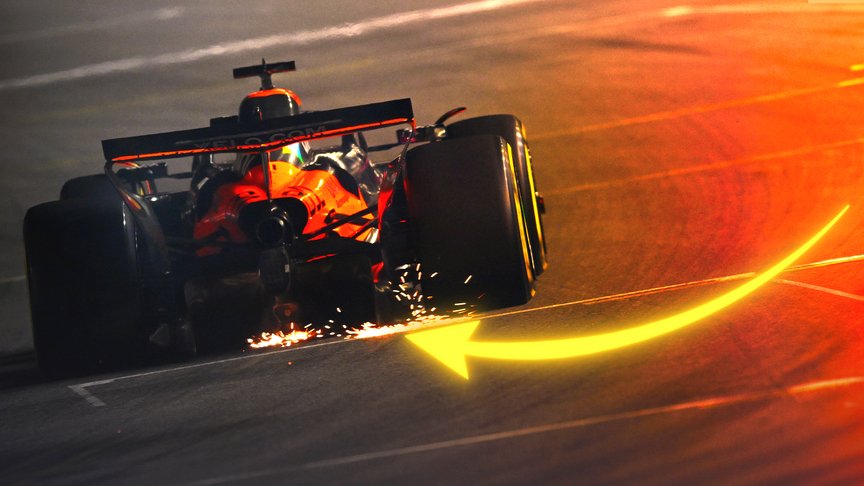
According to Stella, the team became aware very early in the race that something was wrong. He explained that the cars were experiencing higher-than-anticipated levels of porpoising, which produced intense vertical oscillations. These oscillations caused the floor to strike the track more frequently than expected, accelerating skid plate wear.
Telemetry gave the engineers a clearer picture of Norris’s car. Piastri’s car, however, became harder to monitor after one of the key sensors used to assess grounding failed. Despite this challenge, both drivers were instructed to adapt their driving to limit the problem. Their attempts made little difference due to the narrow operating window of the car, combined with the unique characteristics of the Las Vegas street circuit.
Stella also addressed the team’s difficult build-up to the race. FP1 suffered two red flags, severely limiting running time, and Friday practice took place in damp conditions. These disruptions complicated the process of gathering reliable data. Even so, Stella rejected the idea that McLaren had gambled on an aggressive set-up. He said the engineers intentionally added a safety margin to the ride height for qualifying and the race.
The Italian went on to clarify that the true cause of the disqualification was not an overly bold ride height choice but the unexpected scale of the porpoising that emerged under race conditions. He emphasised that practice data did not indicate that such extreme oscillations would occur. The ride height margin that McLaren had built in was effectively erased once the cars began bouncing violently on the straights and through high-speed sections.
Stella described the behaviour as something the team did not foresee. He explained that the combination of surface characteristics, temperatures, and the dynamic loads the cars experienced created a situation that practice simulations could not fully predict. The excessive grounding that followed led directly to the wear levels that triggered the post-race disqualification.
McLaren now turns its focus to the Qatar Grand Prix, seeking to recover the lost points and to ensure that similar issues do not arise again. Stella said the team remains focused on understanding the limits of the MCL38 and implementing measures to prevent another unexpected porpoising episode during the final races of the season.