
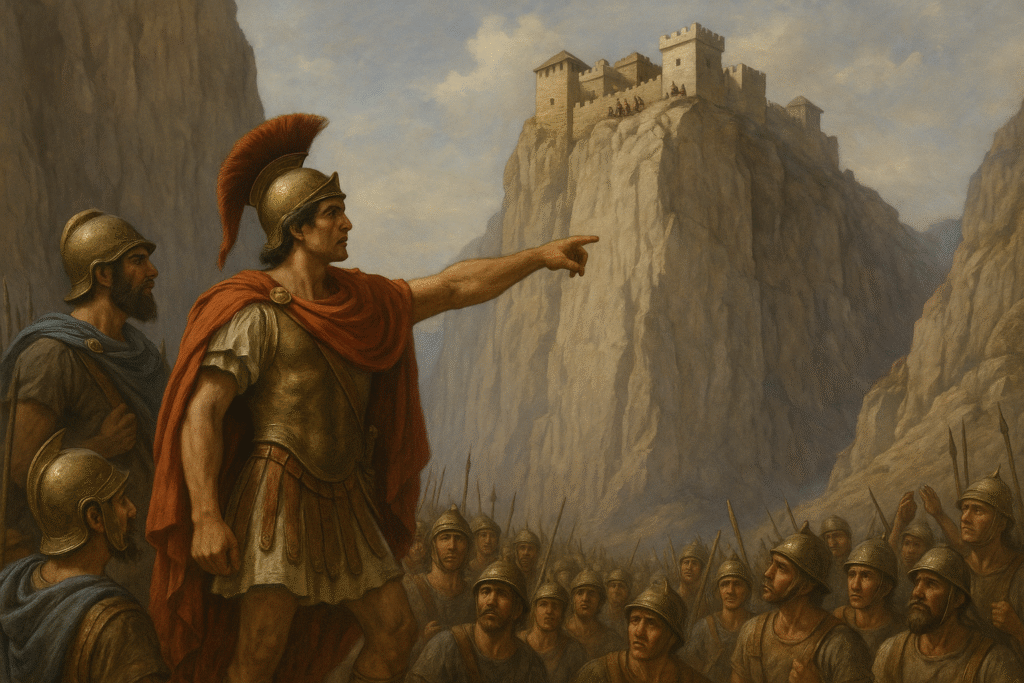
Image Credentials: Image Title: Alexander’s “Winged Men” and the Cliff of Legends Source: (sora.openai) Date: November 2025. Attribution: This image was created using AI-generated imagery (sora.openai) and does not depict a real-world scene.
Inside the ancient tale that transformed a daring mountain assault into one of history’s most persistent military myths
By José Carlos Palma
The ancient world loved stories that blurred the line between fact and legend. Kings were larger than life, and soldiers were expected to demonstrate loyalty that bordered on the unbelievable. Among these dramatic tales, one story has circulated for generations. According to the popular version, a ruthless commander ordered his soldiers to march in single file toward a cliff. The troops obeyed without hesitation, and the first several plunged to their deaths. Only then did the commander halt the procession and demand the surrender of a nearby fortress. Terrified by the spectacle of such obedience, the defenders submitted at once.
This grim episode is often described as Roman. Yet no Roman commander ever performed such an act. The real story traces back to a very different setting, to the campaigns of Alexander the Great in Central Asia. What began as a record of courage and mountain skill slowly evolved into a tale of brutal obedience. The result is a fascinating case study in how history is reshaped over centuries.
A Fortress in the Clouds
In 327 BCE, Alexander arrived before a stronghold known as the Sogdian Rock. The cliff rose nearly four thousand meters above sea level, and its defenders boasted that the city would fall only to men with wings. The remark was meant as a taunt, but Alexander seized it as an opportunity. Instead of launching a conventional siege, he asked for volunteers among his most experienced climbers. Roughly three hundred soldiers stepped forward.
The ascent took place through the night. The climbers relied on ropes, wooden pegs, and remarkable physical endurance. Ancient sources tell us that nearly one in ten fell during the climb and their bodies were left on the cliff face, unreachable by their comrades. By dawn, the survivors stood on the upper rim of the fortress, visible to the defenders who had believed themselves safe.
Alexander sent a herald to shout a simple message. The defenders were told to look upward and see that he had indeed found his men with wings. The psychological shock was immediate. The Sogdian garrison outnumbered the climbers by a wide margin, yet they surrendered at once, aware that further resistance would be futile.
From Mountain Assault to Myth of Obedience
The actual event demonstrates courage, ambition, and a brilliant understanding of psychological pressure. Over many generations, however, the story changed. As it traveled across cultures, languages, and the imaginations of later writers, the climbing soldiers became a column marching calmly over a cliff. Their dangerous ascent was transformed into an act of blind, fatal obedience.
The evolution of the tale is easy to understand. The image of soldiers stepping to their deaths at a commander’s order offers a dramatic parable about loyalty, tyranny, and the terrifying power of military discipline. It also reflects later tastes for morally charged stories in which human lives are treated as expendable pieces on a battlefield.
The Real Legacy of the Sogdian Rock
Stripped of its later embellishments, the true episode remains extraordinary. Alexander’s climbers may represent one of the earliest documented uses of mountaineering techniques during a siege. The willingness of his troops to attempt what must have seemed impossible reveals how deeply they trusted their commander. Their success also shows how fear and awe can be more powerful than any siege engine.
The Sogdian Rock stands as a reminder that history is not fixed. Memory bends. Narratives shift. A daring night climb became a tragic parade over a cliff, and the name of Alexander became intertwined with a lesson about absolute obedience that he never actually tried to teach.
What remains is the dramatic tension between fact and legend. One shows the ingenuity of ancient warfare. The other reveals the enduring human appetite for stories that push the boundaries of belief.