
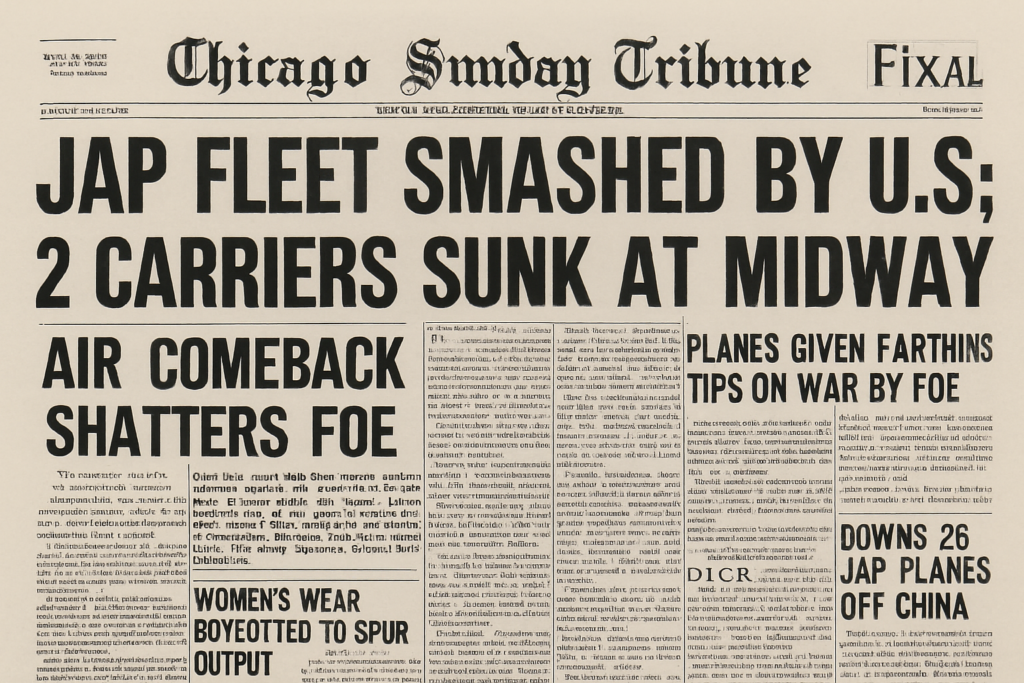
Image Credentials: Image Title: The Midway Leak: How the Chicago Tribune Almost Compromised U.S. Intelligence Source: (sora.openai) Date: December 2025. Attribution: This image was created using AI-generated imagery (sora.openai) and does not depict a real-world scene.
By José Carlos Palma
The most flagrant example of confidential information accidentally making it past World War II censors occurred just six months after the attack on Pearl Harbor, involving the largest newspaper in the Midwest and the most crucial naval battle of the Pacific campaign: the Battle of Midway.
On June 7, 1942, the front page of the Chicago Sunday Tribune celebrated a monumental American victory with the headline, “Jap Fleet Smashed by U.S.; 2 Carriers Sunk at Midway.” While the victory itself was true and a desperately needed morale boost, an accompanying 14-paragraph side story published on the same front page would ignite a firestorm within the highest echelons of the U.S. Navy.
The Code-Breaking Revelation
That side story, headlined “Navy Had Word of Jap Plan to Strike at Sea,” was a stunningly detailed description of the American intelligence coup that made the victory possible. It went far beyond reporting simple battlefield success, openly suggesting, and providing evidence, that the U.S. Navy possessed extensive advanced knowledge of the Japanese fleet’s plans and movements. The details were so specific that they strongly hinted at the existence of a secret operation: the cracking of the Japanese naval code, a program known to intelligence circles as ULTRA.
The publication represented one of the most significant and potentially damaging news leaks of the entire war. The ability to read enemy messages was the single greatest strategic advantage the U.S. had in the Pacific, and the Tribune’s report risked alerting the Japanese command that their codes were compromised, which would have forced them to change systems immediately and nullified the advantage.
The Navy’s Frenzy
The article sent the Navy into an immediate frenzy. The Federal Bureau of Investigation (FBI) was called in to investigate the source of the leak, and a grand jury was hastily convened. The intelligence community viewed the Tribune‘s report as an act of virtual treason, demanding swift action against those responsible for providing the information and those who published it.
However, cooler heads eventually prevailed. Naval authorities feared that a public trial or protracted proceedings would only serve to draw even more attention to the precise details of the leak, thereby confirming to the Japanese what the U.S. suspected they had not yet figured out. The proceedings were eventually dropped in favor of a silent, internal investigation.
The leak was traced back to an officer who had been intimately involved in the Battle of Midway and inadvertently provided too much critical detail to the reporter. Fortunately, the ultimate damage was mitigated by a massive piece of good luck: the Japanese military command, despite the flagrant exposure in a major American newspaper, never picked up on the information or failed to comprehend its significance. The Navy’s invaluable intelligence advantage remained intact, allowing the code-breaking operation to continue its vital work throughout the rest of the war.