
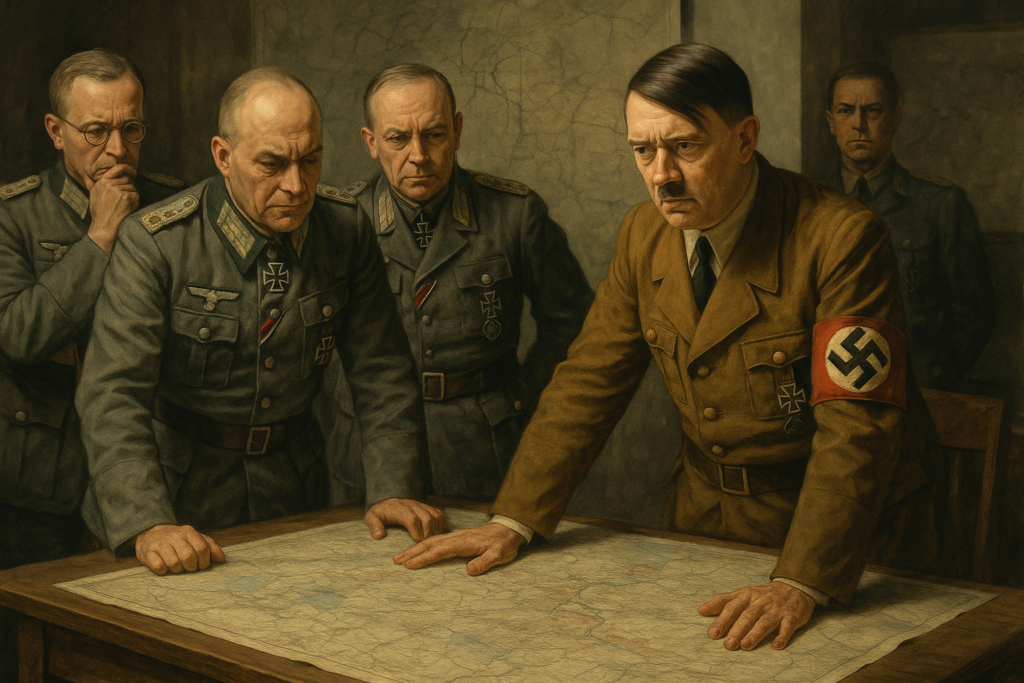
Image Credentials: Image Title: The Fatal Delusion: Why Hitler and the Wehrmacht Underestimated the USSR Source: (sora.openai) Date: December 2025. Attribution: This image was created using AI-generated imagery (sora.openai) and does not depict a real-world scene.
By José Carlos Palma
In the planning rooms leading up to Operation Barbarossa, the German decision to invade the Soviet Union was predicated on a series of colossal intelligence failures and a deeply entrenched, nearly fanatical ideological bias. This potent combination led Adolf Hitler and the Wehrmacht high command to believe a rapid, decisive victory over the USSR was feasible, despite the Soviet Union possessing forces vastly larger and more capable than German estimates.
Hitler’s political goals were shaped by the assessments of his military advisers, and in 1940, German intelligence, which drove the initial planning, estimated the Soviet military strength at a manageable 50 to 75 divisions.
The Catastrophic Underestimation
Even before the invasion launched, the estimates began to unravel. By February 1941, General Franz Halder, Chief of the Army General Staff, had revised the estimate to 155 Soviet divisions, a staggering 100% increase over the previous worst-case scenario. Yet, even this revised figure paled in comparison to the reality: the Soviets possessed approximately 220 divisions and an additional 8 million reserves ready for mobilization.
This inexcusable intelligence failure was not merely a counting error; it was rooted in deep-seated intellectual and ideological arrogance.
Racism and the Delusion of Inferiority
A significant factor contributing to the disastrous miscalculation was the astronomical racial and ideological bias held by German planners, and indeed, by most Western countries, against the Soviet Union. The USSR was viewed as a backward “peasant country” and an “agricultural rump state” run by revolutionaries who had overthrown their rightful Tsar.
Consequently, Soviet achievements in industrialization, which had produced unprecedented growth rates, were dismissed as baseless propaganda. The idea that Soviet factories would soon be churning out more than a thousand tanks a month, with many of those tanks (like the T-34) potentially being superior to the German equivalents, was genuinely considered “laughable” by German commanders. This intellectual refusal to accept the reality of Soviet industrial and human potential proved strategically lethal.
Misreading the Battlefield Commanders
The German high command also drew heavily flawed conclusions from early Soviet military performance. Their view of Soviet capabilities was primarily based on the poor showing of Soviet forces under General Kliment Voroshilov during the Winter War in Finland.
Crucially, the Germans failed to fully register that once Voroshilov was replaced by General Semyon Timoshenko, the Soviets wrapped up the campaign in Finland within three weeks. Similarly, the fact that General Georgy Zhukov had just decisively beaten a highly experienced and dedicated Japanese army in a pitched battle barely registered.
Initial German successes in early 1941, which were primarily victories over inexperienced and unprepared commanders near the border, reinforced the Wehrmacht’s toxic sense of superiority. However, when the Germans finally encountered Zhukov’s meticulously prepared defense of Moscow, they were soundly defeated, a fact the Germans simply “couldn’t quite understand why.”
The Unproductive Mindset
Throughout the early years of the Eastern Front campaign, the prevailing, and, in hindsight, dangerously insane mindset within the Wehrmacht was a constant, delusional belief that the Soviet regime was always “just about to collapse.” This pervasive delusion persisted regardless of how many times German forces were defeated in tenacious, brutal battles.
Ultimately, a corrosive mix of entrenched racism, military arrogance, catastrophically poor intelligence, and a delusional superiority complex convinced German leadership that strategic dominance was feasible. This false idea was never viable and cost Germany the war.