
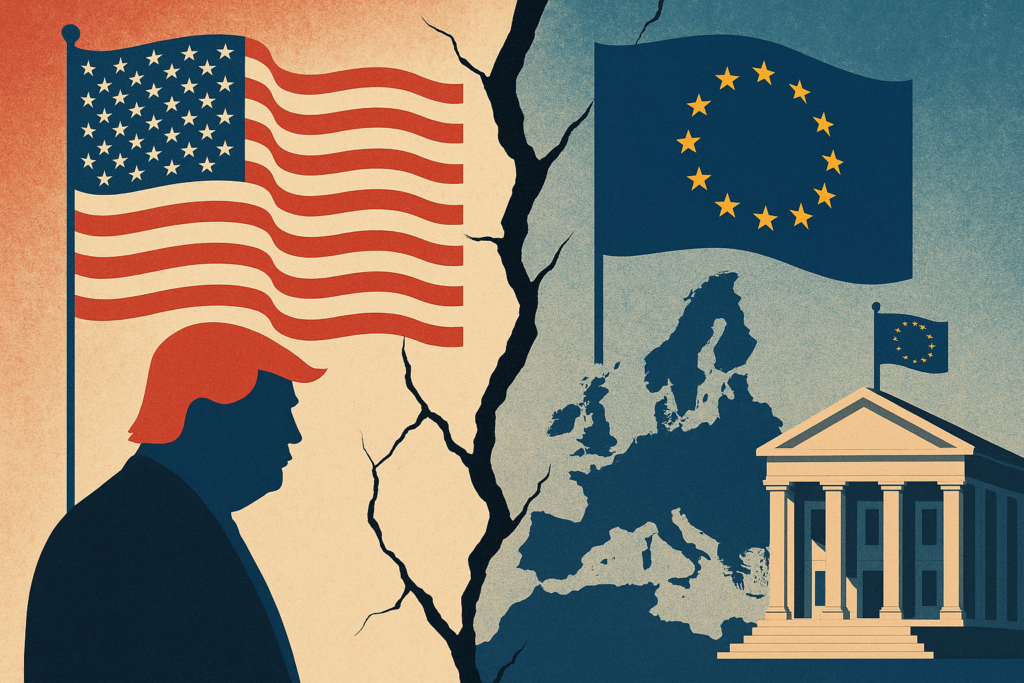
Image Credentials: Image Title: From Union to Federation: Europe’s Path to Sovereignty in the Age of Trump Source: (sora.openai) Date: December 2025. Attribution: This image was created using AI-generated imagery (sora.openai) and does not depict a real-world scene.
By Madison Walker | Senior Editor
The escalating tensions between the United States and its traditional European allies, highlighted by recent, highly critical statements from the Trump administration regarding Europe’s “civilisational erasure” and proposals for a new “Core Five” club that excludes major European powers, have thrust the concept of a Federal Europe back into the geopolitical spotlight.
Faced with a transactional and unpredictable partner across the Atlantic, many European leaders are now openly discussing whether the current European Union (EU) structure is robust enough to act as an independent, unified global player. A move toward a full federation presents both profound advantages and equally daunting disadvantages.
Advantages of a Federal Europe (The Sovereignty Imperative)
A true federation, modeled more closely on the structure of the United States, would fundamentally transform Europe’s ability to act decisively on the world stage, precisely addressing the vulnerabilities exposed by the current U.S. administration.
1. Unified Defense and Foreign Policy (The Ultimate Hedge)
-
Single Voice: Under the current EU model, foreign and defense policy often requires unanimity, crippling rapid responses. A Federal Europe would centralize these powers, creating a single Minister of Foreign Affairs and a single, unified defense force.
-
Strategic Autonomy: This shift would immediately make Europe a peer in security, capable of acting without US permission, and fully shouldering its own defense burden. This is the most crucial advantage in response to the U.S. administration’s threats to withdraw security guarantees or interfere in European domestic politics.
2. Enhanced Global Clout
-
Economic Giant, Political Peer: Europe is already the world’s largest single market. A federation would translate this economic power into unquestioned political weight in global forums like the UN and G7/G20, ensuring Europe cannot be marginalized by rival groupings like the proposed “Core Five.”
-
Streamlined Decision-Making: Replacing complex intergovernmental negotiations with federal legislation would allow for faster, more coherent policy-making on issues from trade to climate change.
3. Increased Democratic Accountability
-
Closing the Legitimacy Gap: Federalists argue that transferring more power from unelected commissions and opaque councils to a strengthened, directly elected European Parliament would help close the current “democratic deficit,” increasing public buy-in for European policies.
Disadvantages of a Federal Europe (The Integration Risks)
The pursuit of a “United States of Europe” is hampered by deep-seated historical and political resistance that forms its greatest hurdles.
1. The Loss of National Sovereignty (The Core Resistance)
-
National Identity: A federation requires member states to surrender ultimate sovereignty over key areas—notably taxation, defense, and budget policy—to the federal government in Brussels. This is fiercely resisted by national governments and is the central argument for nationalist and populist movements across the continent.
-
Fiscal Transfers: A federal system often necessitates significant financial risk-sharing and redistribution (like a federal welfare state). Wealthier nations, like Germany and the Netherlands, would face potentially massive transfers to southern or eastern members, fueling deep domestic resentment.
2. Risk of Division
-
Federal Overreach: Critics fear that centralizing power will lead to excessive, one-size-fits-all regulation that fails to respect local cultures, legal traditions, or regional economic differences, as is often seen in national federations with complex internal borders (e.g., Belgium).
-
Exit Threat: Pushing for deep federalization could easily provoke renewed, potentially devastating crises or even trigger more member states to consider leaving the bloc, following the precedent set by Brexit.
Conclusion: The Unavoidable Choice
The current U.S. administration’s move to explicitly target the EU’s cohesion, by backing nationalist movements and questioning the alliance’s value, forces Europe to face a stark choice: unity or marginalization.
While a Federal Europe is the clear answer to the long-term quest for “strategic autonomy” and the best defense against geopolitical bullying, the political cost of sacrificing national sovereignty remains extraordinarily high. Europe must now balance the existential need for a strong, unified voice against the internal political stability of its member states. The push for a Federal Europe is no longer a philosophical ideal, but a pragmatic calculation driven by the need to survive as a major global power.