
Image: from Hans von der Burchard X@vonderburchard
By Open Chronicle Staff with Agencies
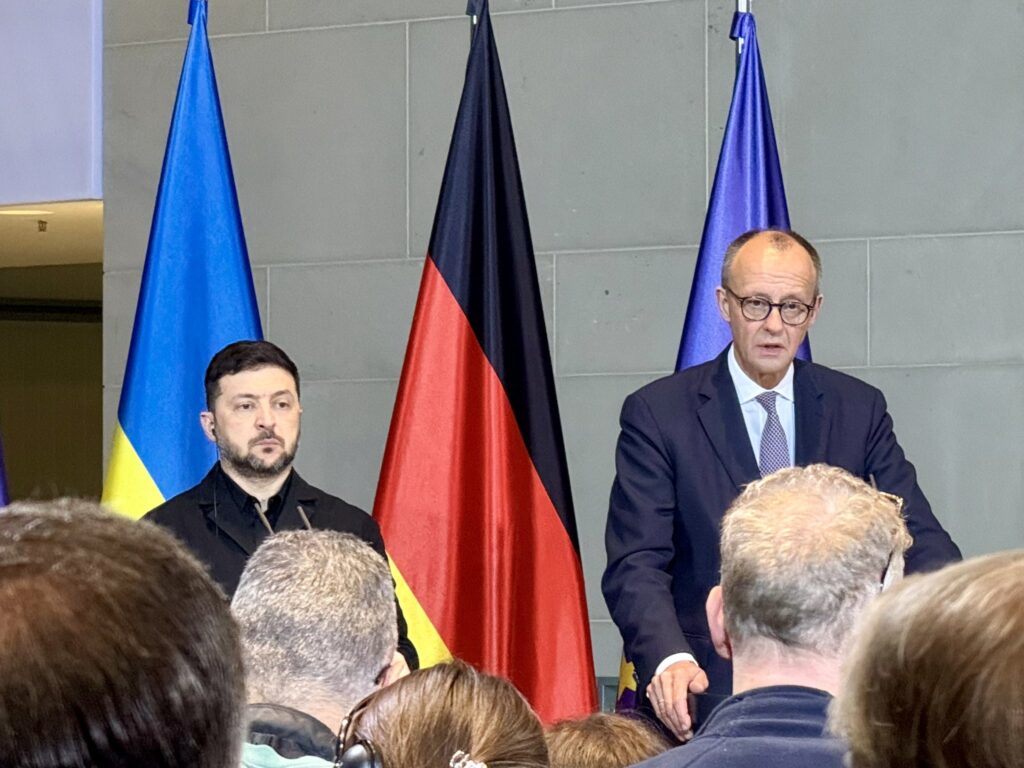
BERLIN, Germany — German Chancellor Friedrich Merz on Monday hailed a significant breakthrough in negotiations aimed at ending the war in Ukraine, stating that two days of talks between Ukrainian and U.S. delegations in Berlin had created the “chance for a real peace process.”
President Volodymyr Zelenskyy met for a second day with U.S. envoys, including President Donald Trump’s special envoy Steve Witkoff and son-in-law Jared Kushner, to advance a U.S.-authored peace proposal. The discussions centered on two main pillars: Ukrainian territorial concessions and the critical issue of post-war security guarantees for Kyiv.
Chancellor Merz specifically praised the U.S. for its new commitment to Ukraine’s defense, calling the offer of guarantees “truly remarkable.”
“We now have the chance for a real peace process,” Merz said during a press conference alongside Zelenskyy. Any ceasefire, he asserted, must be “secured by substantial legal and material security guarantees from the United States and Europe, which the United States has put on the table here in Berlin.”
Zelenskiy in Berlin looking for security guarantees, Reparation Loan must fail – bullet point edition
Optimism here in Berlin is rising that a peace deal to end the war in Ukraine can be struck. Ukrainian President Volodymyr Zelenskiy turned up yesterday to meet… pic.twitter.com/t54vphWEXX
— BenAris (@bneeditor) December 15, 2025
U.S. officials briefed on the negotiations indicated that the proposed guarantees are “Article 5-like,” resembling the mutual defense clause of the NATO treaty, but would be implemented outside of the formal alliance structure. This compromise is seen as a way to provide credible deterrence for Kyiv while circumventing Moscow’s long-standing demand that Ukraine be barred from joining NATO.
European leaders, including those from Britain, France, Italy, Poland, and Finland, were set to join Zelenskyy for a summit later Monday, where they are expected to commit to a European-led “multinational force” that would operate inside Ukraine to secure its skies and assist in rebuilding its defense forces.
While both the German Chancellor and Ukrainian negotiators, who hailed “real progress” in the talks, struck an upbeat tone, significant obstacles remain, particularly concerning territory.
The U.S. peace framework reportedly calls for Ukraine to relinquish control over territories seized by Russia, including the Crimean Peninsula and most of the Donbas region. Zelenskyy, while signaling a willingness to drop the NATO bid in exchange for legally binding security assurances, has maintained his firm refusal to cede any Ukrainian land. U.S. officials acknowledged that differences remain, stating they were still “brainstorming” the future status of the occupied territories, including the possibility of converting some areas into an “economic free zone.”
U.S. officials claimed consensus has been reached on approximately 90% of the peace plan, and President Trump was expected to call Zelenskyy and European leaders later Monday to urge further progress toward a deal.
The evening summit, which Witkoff and Kushner will also attend, is seen as a crucial show of unified support by NATO and EU leaders for Ukraine at a moment of intense diplomatic pressure to end the nearly four-year conflict.