
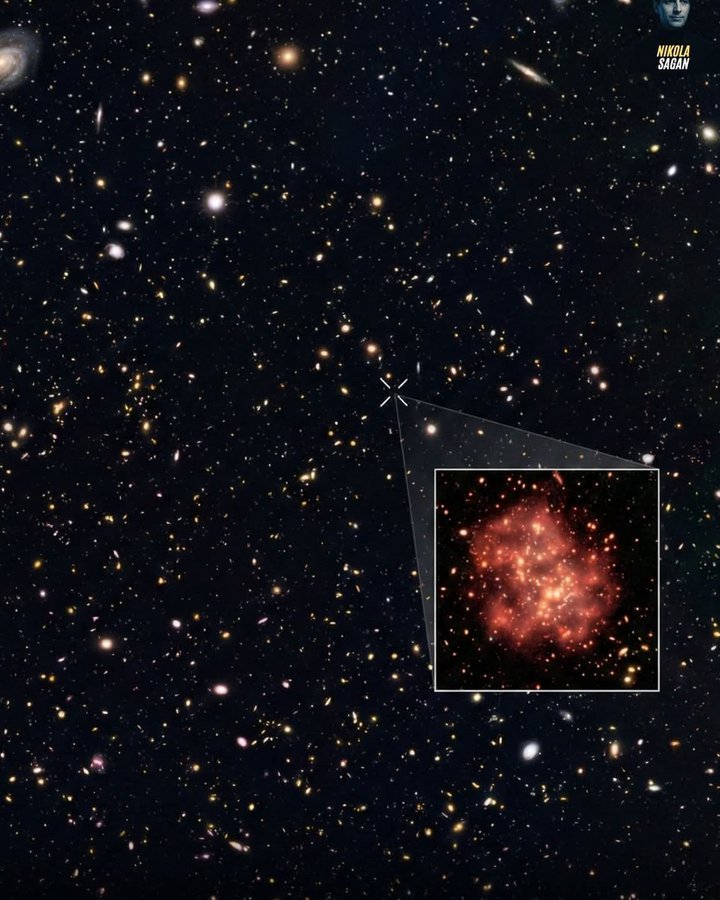
Image: from Black Hole X@konstructivizm
By Lucas Reid | Staff Writer
In a discovery that highlights the “time-machine” capabilities of modern astronomy, NASA’s James Webb Space Telescope (JWST) has identified a supermassive black hole lurking within an ancient galaxy nicknamed “Virgil.” The finding, published in The Astrophysical Journal on November 17, suggests that many of the universe’s most extreme objects may remain invisible unless viewed through infrared eyes.
A Dual Personality
Virgil is being described by astronomers as a “Jekyll and Hyde” galaxy because its appearance shifts dramatically depending on the wavelength of light used to observe it.
- The “Jekyll” Side (Optical/UV): When viewed in ultraviolet and optical light—the spectrum visible to human eyes and telescopes like Hubble—Virgil appears as a peaceful, ordinary star-forming galaxy. To an observer, it seems to be quietly producing new stars without any signs of violent activity.
- The “Hyde” Side (Mid-Infrared): When JWST’s Mid-Infrared Instrument (MIRI) was turned toward the galaxy, the “monster” was revealed. The infrared data exposed a heavily obscured supermassive black hole at the core, pouring out immense quantities of energy.
“Virgil has two personalities,” said George Rieke, an astronomer at the University of Arizona and co-leader of the discovery. “The UV and optical show its ‘good’ side… but when MIRI data are added, Virgil transforms into the host of a heavily obscured supermassive black hole.”
A Glimpse into the Ancient Past
Because light takes billions of years to travel across the vastness of space, observing Virgil is essentially looking back in time. JWST captured the galaxy as it existed just 800 million years after the Big Bang. In a universe estimated to be 13.8 billion years old, Virgil represents a very early stage of cosmic evolution.
The discovery of such a massive black hole so early in time challenges existing models of how these objects grow. Typically, black holes and their host galaxies are thought to grow in tandem, but Virgil suggests that black holes might grow much faster than their surroundings in the early universe.
Solving the Mystery of “Little Red Dots”
Researchers have classified Virgil as a “Little Red Dot” (LRD). These are mysterious, compact red objects found in JWST’s deep-field observations that have puzzled the scientific community since 2022.
Astronomers have debated whether these dots are:
- Extremely dense galaxies packed with hundreds of thousands of stars.
- Active Galactic Nuclei (AGN)—supermassive black holes shrouded in thick cocoons of dust.
The data from Virgil provides strong evidence for the latter. The dust surrounding the central black hole absorbs shorter wavelengths of light (like UV) and re-emits them as heat in the infrared, which explains why the “monster” only becomes visible when using MIRI.
Why This Matters
The discovery indicates that our current census of the early universe might be incomplete. If galaxies like Virgil are common, we may be missing a significant population of “invisible” black holes that are hidden behind curtains of cosmic dust.
As astronomers continue to analyze data from the RUBIES survey and other JWST programs, they hope to find more “siblings” of Virgil to determine if these Jekyll-and-Hyde transformations are the rule, rather than the exception, in the infant universe.