
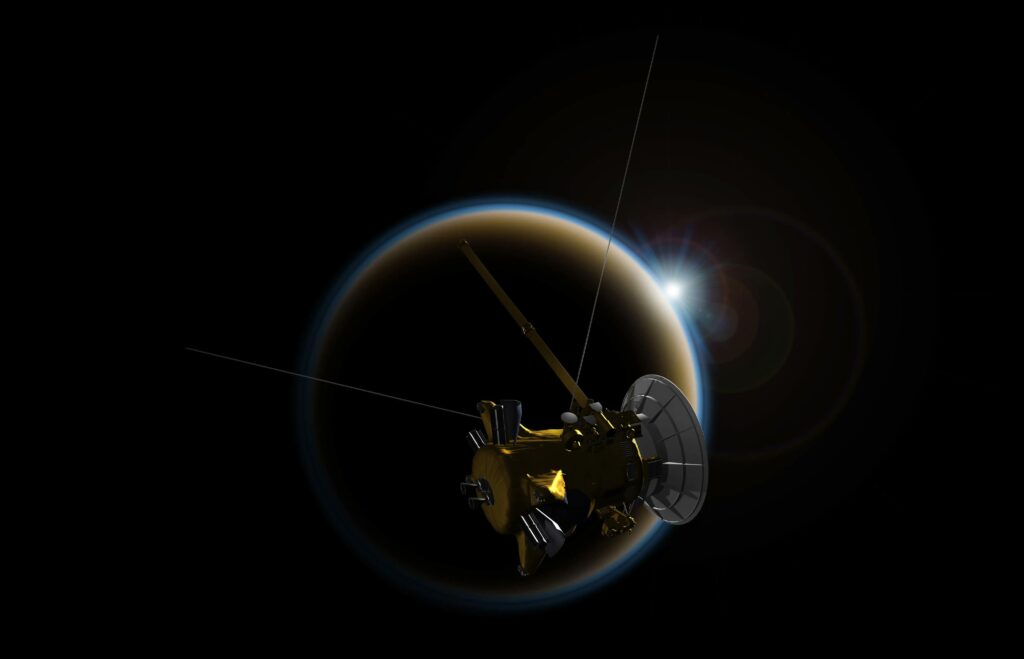
Image: from NASA Solar System  X@NASASolarSystem
By Lucas Reid | Staff Writer
For over a decade, the prevailing scientific consensus was that Saturn’s largest moon, Titan, concealed a vast, global ocean of liquid water beneath its thick crust of hydrocarbons. However, a groundbreaking reanalysis of archival data from NASA’s Cassini mission has revealed a far more complex and “mushy” reality.
The study, led by researchers at NASA’s Jet Propulsion Laboratory (JPL) and published in the journal Nature on December 17, 2025, suggests that Titan’s interior is likely composed of ice, layers of slush, and isolated pockets of warm water rather than a continuous subterranean sea.
The “Smoking Gun” in the Noise
To peer inside Titan, scientists originally studied the Doppler shift in radio communications between the Cassini spacecraft and NASA’s Deep Space Network. As Cassini flew past Titan, the moon’s gravity would cause the craft to speed up or slow down. These subtle variations revealed how much the moon “flexed” under Saturn’s immense gravitational pull, a process known as tidal flexing.
While initial analyses suggested a liquid ocean was necessary to explain Titan’s high degree of malleability, JPL postdoctoral researcher Flavio Petricca and his team applied a novel processing technique to reduce “noise” in the old Doppler data.
What they found was a previously hidden signature: strong energy dissipation deep inside the moon.
“That was the smoking gun,” Petricca said. “The low viscosity of the slush still allows the moon to bulge and compress in response to Saturn’s tides, but it also creates friction, ice crystals rubbing against one another, which generates the heat we now see in the data.”
A New Interior Model
The new model replaces the image of a massive, uniform ocean with a more dynamic, “mushy” mantle:
- Solid Ice Shell: A thick outer layer of frozen water and hydrocarbons.
- Slushy Layers: High-pressure ice and water mixed, which dissipates energy through friction.
- Warm Water Pockets: Small, isolated reservoirs of liquid water, potentially as warm as 20 degrees Celsius (68 degrees Fahrenheit), located near the moon’s rocky core.
“It changes our view of Titan,” explains Jonathan Lunine, Professor of Planetary Science at Caltech and study co-author. “A massive liquid water ocean is replaced by pockets of mushy ice. Titan continues to challenge our understanding of how these planet-sized worlds formed and what lies inside them.”
Implications for Life and Habitability
While the loss of a global ocean might seem to diminish Titan’s status as a “habitable world,” the researchers argue the opposite. The presence of isolated pockets of warm water cycling nutrients from the rocky core through the slushy layers could actually create more concentrated environments for chemistry to occur.
These pockets may rise toward the surface, interacting with organic molecules supplied from below and materials delivered by meteorite impacts from above.
“I think it makes Titan more interesting,” Petricca added. “Our analysis shows there should be pockets of liquid water… cycling nutrients from the moon’s rocky core through slushy layers.”
The Search for “Ground Truth”
The ultimate test for this new theory will come with NASA’s Dragonfly mission, currently scheduled for launch no earlier than 2028. This nuclear-powered rotorcraft will fly to various locations on Titan’s surface, carrying a seismometer. By measuring “Titan-quakes” and seismic activity, Dragonfly may be able to provide the definitive “ground truth” about what exactly lies beneath the hazy, golden clouds of Saturn’s greatest moon.