
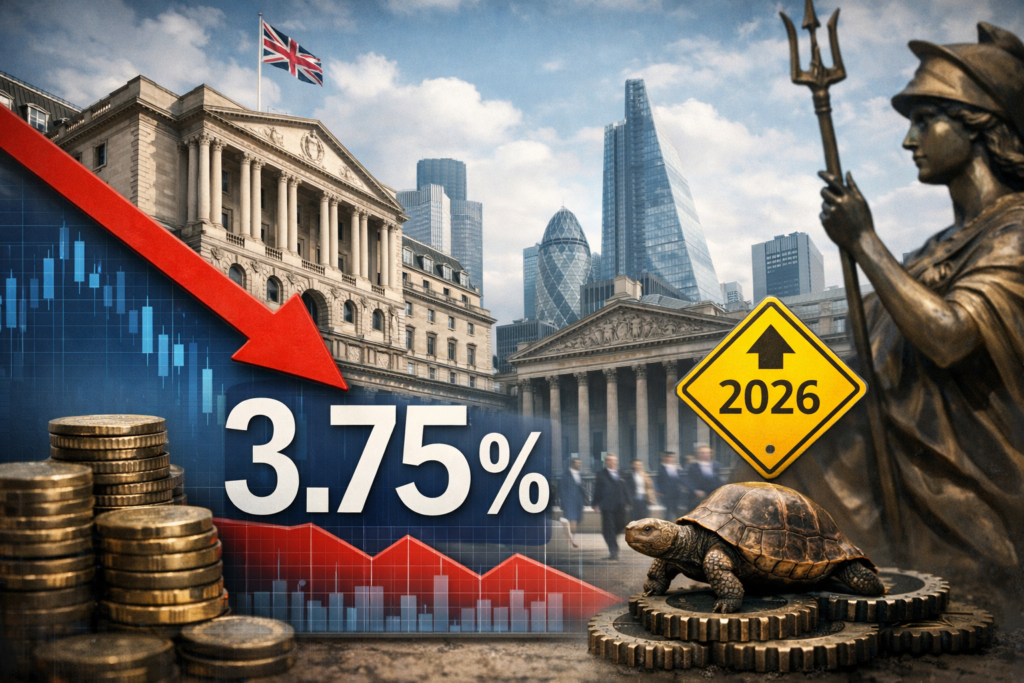
Image Credentials: Image Title: Bank of England Cuts Rates to 3.75% Amid Economic Cooling Source: (sora.openai) Date: December 2025. Attribution: This image was created using AI-generated imagery (sora.openai) and does not depict a real-world scene.
By Open Chronicle Staff with Agencies
The Bank of England (BoE) has implemented its fourth interest rate cut of the year, lowering the key Bank Rate by 25 basis points to 3.75 percent. While the move aims to support a faltering UK economy, the central bank signaled a more cautious “gradual” approach for 2026 as it grapples with stubborn wage growth and services inflation.
The Monetary Policy Committee (MPC) remains deeply split on the path forward, with the decision passing by a narrow 5-4 vote. Governor Andrew Bailey once again cast the tie-breaking vote in favor of the cut.
- The Hawks: Deputy Governor Clare Lombardelli and Chief Economist Huw Pill voted against the cut, arguing that underlying inflation remains well above targets. Lombardelli expressed skepticism that current rates are significantly hindering the economy.
- The Doves: External members Swati Dhingra and Alan Taylor warned of the risks of “over-tightening.” Taylor highlighted the sharp rise in youth unemployment as a precursor to a potential recession, suggesting a “neutral” rate of 3.0 percent should be reached sooner rather than later.
The decision follows a string of data points suggesting the UK economy is stalling:
- Growth: The Bank assumes zero growth for the final quarter of this year.
- Unemployment: Joblessness hit a four-year high in October.
- Inflation: Headline inflation slowed more sharply than expected in November, partly due to retailers’ inability to pass on price increases to struggling consumers.
Governor Andrew Bailey noted that further reductions would be data-dependent: “We think that Bank Rate is likely to fall gradually further in the future, but that will depend on whether variables like pay growth and services inflation continue to ease.”
The MPC also factored in Chancellor Rachel Reeves’ latest budget. The Bank estimates that government measures—including freezing certain administered prices and removing charges from energy bills—could mechanically reduce headline inflation by up to 0.5 percentage points by mid-2025. This is expected to drive the headline rate down to the 2 percent target by the second quarter of next year.
Financial markets reacted to the “hawkish” nature of the 5-4 split. With no members calling for a larger 50-basis-point cut, the British pound strengthened against both the US dollar and the euro as traders lowered their expectations for aggressive easing in early 2026.
For the general public, the cut is expected to offer immediate relief to businesses with floating-rate debt and downward pressure on two-year government bond yields, which typically dictate the pricing of new mortgage deals.