
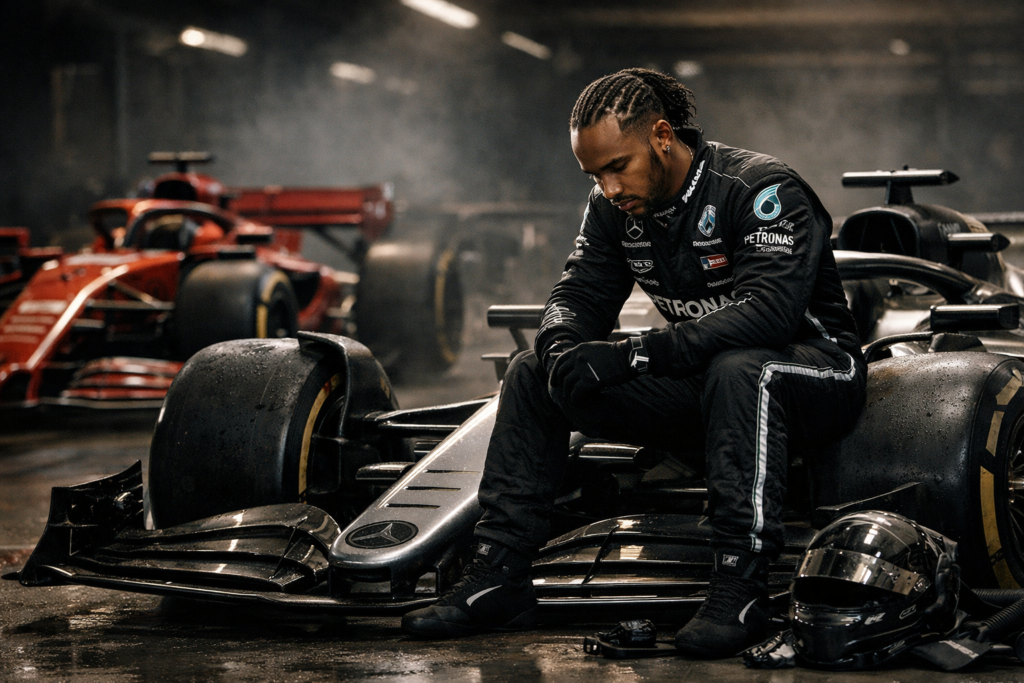
Image Credentials: Image Title: New Rules, New Hope: Why the 2026 Regulations Could Save Lewis Hamilton’s Ferrari Tenure Source: (sora.openai) Date: December 2025. Attribution: This image was created using AI-generated imagery (sora.openai) and does not depict a real-world scene.
By Open Chronicle Staff
The ground-effect era of Formula 1 (2022–2025) will likely be remembered as the most challenging period in Lewis Hamilton’s storied career. As the sport prepares for a massive technical overhaul in 2026, the seven-time world champion is eager to leave behind a generation of cars that fundamentally clashed with his driving DNA.
The Ground-Effect Slump
The statistics from the last four years paint a stark picture. Between 2022 and 2025, Hamilton achieved just two victories and a solitary pole position. The 2025 season—his first with Ferrari—was particularly brutal. For the first time in his career, Hamilton failed to secure a single podium finish, ending the year nearly 100 points behind teammate Charles Leclerc and enduring an embarrassing streak of three consecutive Q1 exits.
While critics suggest the nearly 41-year-old is “over the hill,” technical experts point to a simpler explanation: the cars themselves.
Why 2026 Suits the “Hamilton Style”
The 2026 rules reset marks the end of the Venturi-tunnel dominance and a move toward flatter floor designs. This shift addresses two major hurdles that have hampered Hamilton since 2022:
1. The Death of the “Minimum Speed” Requirement
The ground-effect cars required drivers to carry a high minimum speed through corners to keep the aerodynamic platform stable. This style favored smooth, flowing inputs. Hamilton, conversely, built a career on being a “late-braker”, throwing the car into the corner with aggressive entry speeds.
“Late-braking drivers like Hamilton were at a disadvantage because it was better to carry a higher minimum speed… that wasn’t his style at all,” notes Sky Sports reporter Craig Slater.
2. Ride-Height Sensitivity
Ground-effect cars are notoriously sensitive to ride height; if the floor isn’t millimetre-perfect, performance vanishes. This unpredictability plagued Hamilton’s final years at Mercedes and continued with Ferrari’s SF-25. Mercedes boss Toto Wolff previously noted that the post-2022 cars simply “couldn’t take” Hamilton’s aggression, especially on the knife-edge of a qualifying lap.
The Clean Break
With the differentiator in performance moving away from complex floor aerodynamics in 2026, the playing field returns to mechanical grip and engine parity. For Hamilton, this represents more than just a rule change, it is a chance to prove that his “decline” was a matter of machinery rather than ability.
As Hamilton enters his second season with the Scuderia in 2026, the F1 world will finally see if the “old” Lewis remains under the surface, waiting for a car that allows him to dance on the brakes once again.