
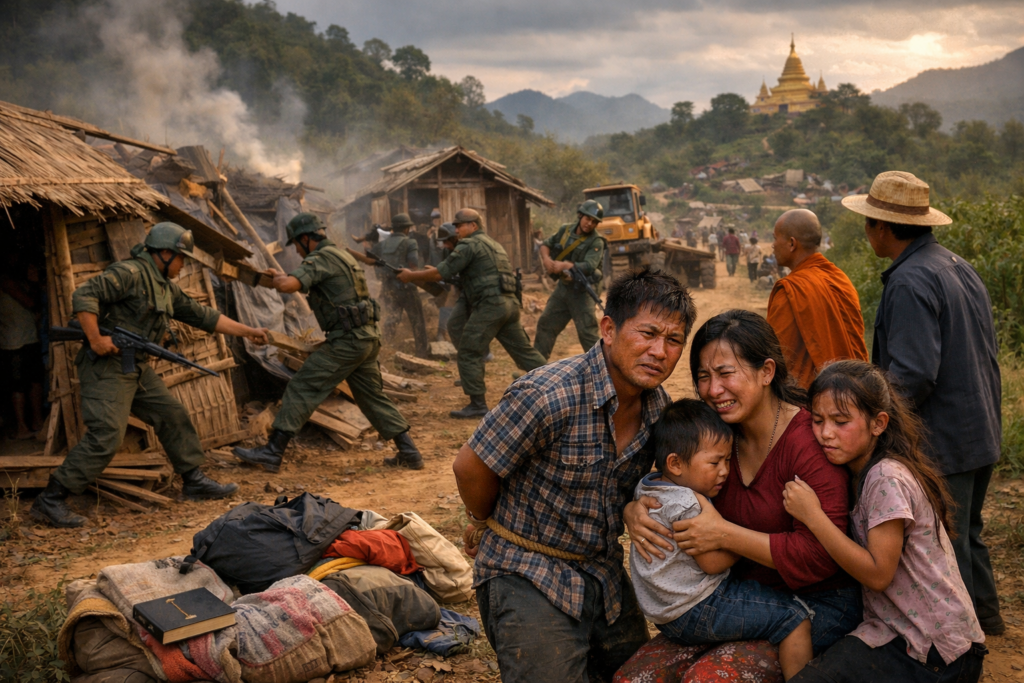
Image Credentials: Image Title: Faith Under Fire: Christian Minority in Laos Faces Violent Expulsion and Land Grabs Source: (sora.openai) Date: December 2025. Attribution: This image was created using AI-generated imagery (sora.openai) and does not depict a real-world scene.
By Open Chronicle Staff with Agencies | December 20, 2025
VIENTIANE, Laos — Despite official constitutional guarantees of religious freedom, the Christian minority in Laos is facing an escalating crisis of violent displacement, arbitrary arrests, and what many observers describe as state-sanctioned land grabbing. In the predominantly Buddhist nation, where Christianity is often stigmatized as a “Western import,” rural believers are increasingly finding themselves targets of both local prejudice and institutional neglect.
Christian aid organizations, including Barnabas Aid International and Open Doors, have issued urgent reports detailing how families are being forcibly driven from their homes. In many cases, these expulsions appear to be motivated as much by a desire for their land as by religious intolerance.
“No One Will Protect Them”
According to humanitarian workers on the ground, local village chiefs often operate with impunity, knowing that higher-level authorities are unlikely to intervene on behalf of a religious minority.
“Often, they just want the land. Christians are an easy target; they are a minority, and no one will protect them,” an aid worker told UCA News, speaking on the condition of anonymity. The human cost of these displacements is severe, with reports of families, including young children, hiding in forests to escape violence. “No one should have to live like this—children in the jungle and in the rain. It is inhumane.”
The Law of the Rural Land
Anthony Williams, a researcher for Barnabas Aid, noted that the disparity between urban and rural religious freedom is vast. While cities like Vientiane may see a modicum of tolerance, rural leaders frequently ignore national laws.
“The law is often ignored in rural villages, whether through ignorance or malice,” Williams told UCA News. He highlighted several systemic issues:
-
Documentation Denial: Authorities reportedly discriminate by refusing to issue birth certificates or essential identity documents to known Christians.
-
Lack of Accountability: Provincial and central governments rarely take action to enforce the Law on the Evangelical Church (Decree 315) when local leaders violate it.
-
Social Hostility: Communities often fear that the presence of Christians will offend local spirits (phi), leading to deadlines for believers to recant or face expulsion.
A Pattern of Violence
The persecution has taken a lethal turn in recent months. In July, Pastor Thongkham Philavanh, a prominent leader within the Lao Evangelical Church, was shot dead in his home in Oudomxay province by masked gunmen. Philavanh had recently been released from a four-year prison sentence served for his evangelistic work and had been repeatedly warned by police to sign documents renouncing his faith.
His death follows a string of similar incidents, including the 2022 killing of Pastor Sy Sengmane, who also bore signs of torture. Williams warns that as the Christian population grows, the intensity of these attacks is likely to increase. “If the Church continues to grow, persecution will increase both in scale and intensity.”
Rare Glimmers of Hope
Despite the grim outlook, there have been rare instances of government intervention. In February 2025, a mob attacked and destroyed a house church in the Xonboury district. Surprisingly, just one month later, district-level authorities overruled the village leadership, officially permitting the church’s reconstruction and guaranteeing the community’s right to peaceful worship.
For the thousands of Christians currently displaced or living in fear, such interventions remain the exception rather than the rule. As the international community looks on, the question remains whether the central government in Vientiane will take the necessary steps to protect all its citizens, regardless of their faith.