
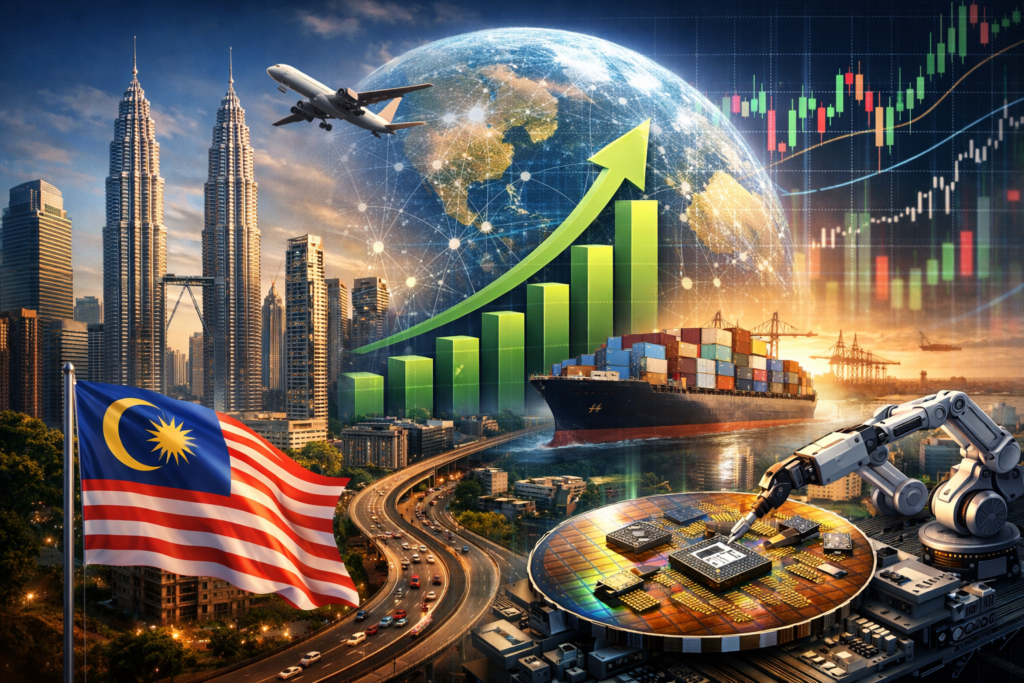
Image Credentials: Image Title: Faith Under Fire: Christian Minority in Laos Faces Violent Expulsion and Land Grabs Source: (sora.openai) Date: December 2025. Attribution: This image was created using AI-generated imagery (sora.openai) and does not depict a real-world scene.
By Open Chronicle Staff with Agencies | December 20, 2025
KUALA LUMPUR — Malaysia’s economy has demonstrated remarkable resilience throughout 2025, maintaining a healthy growth trajectory despite a backdrop of escalating global trade tensions and policy uncertainty. According to the International Monetary Fund (IMF), the nation’s performance is a result of a worldwide technology upcycle and disciplined domestic economic management.
Masahiro Nozaki, the IMF Mission Chief for Malaysia, noted that the country’s growth this year has been largely underpinned by robust domestic consumption, strong investment, and solid employment gains.
Strategic Trade and Prudent Policy
A pivotal moment for the Malaysian economy occurred in October 2025, with the signing of the Malaysia-US Agreement on Reciprocal Trade. IMF officials stated that this landmark deal significantly alleviated uncertainty for both businesses and consumers, providing a clearer framework for trade during a period of shifting global alliances.
“The strong performance in part reflects sound economic management,” Nozaki said following the 2026 Article IV Consultation discussions. “The authorities have maintained prudent macroeconomic and financial policies, which have built the necessary buffers to navigate the ‘new normal’ of global uncertainty.”
Key Projections and Economic Resilience
While 2025 has been a year of expansion, the IMF suggests a slight cooling period ahead as external pressures begin to weigh on the export-oriented nation.
-
2025 Growth: Estimated at 4.6%.
-
2026 Forecast: Projected to ease to 4.3%.
-
Inflation: Averaged 1.4% through October 2025, with expectations to stabilize near the 2.0% long-term average.
The projected dip in 2026 primarily reflects the anticipated impact of higher US tariffs on Malaysian exports. As a highly open economy, Malaysia remains vulnerable to protectionist measures and financial market volatility.
Risks and Upside Factors
IMF officials warned that risks to growth are currently “skewed to the downside.” Beyond trade protectionism, potential threats include:
-
AI Sector Volatility: The risk of a “bursting bubble” in artificial intelligence-related investments.
-
External Demand: Weaker demand from major trading partners if global growth slows.
However, several “upside” factors could boost the economy beyond current forecasts. These include a stronger-than-expected recovery in the tourism sector, breakthroughs in broader global trade negotiations, and the accelerated implementation of structural reforms under the Madani Economy framework.
Looking Toward the 13th Malaysia Plan
As the country moves into 2026, the IMF emphasized the importance of the 13th Malaysia Plan (2026–2030). Key priorities identified by the fund include labor market reforms, increasing female labor force participation, and deeper ASEAN trade integration to ensure that growth remains inclusive and driven by domestic strength.
Finance Minister II Datuk Seri Amir Hamzah Azizan welcomed the assessment, stating that the government remains committed to reducing the fiscal deficit to 3.5% of GDP by 2026, underscoring Malaysia’s path toward long-term fiscal sustainability.