
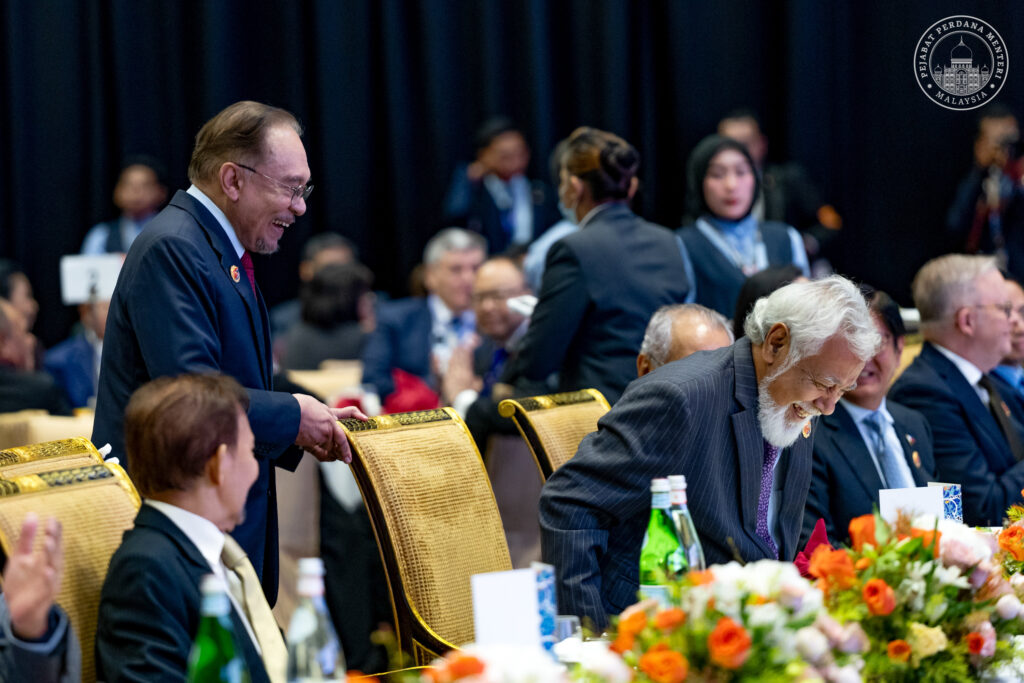
Image: from Anwar Ibrahim X@anwaribrahim
By Open Chronicle Staff with Agencies | December 21, 2025
DILI — Following the historic 47th ASEAN Summit in Kuala Lumpur this October, Timor-Leste has finally taken its seat as the eleventh member of the Association of Southeast Asian Nations. This milestone marks the end of a 23-year diplomatic journey and signals a potential shift in the region’s geopolitical architecture, particularly in the evolving relationship between China and the ASEAN bloc.
While Timor-Leste is the smallest economy in the regional grouping, its unique history and strategic location between Indonesia and Australia position it as a potential “proof-of-concept” for Chinese developmental engagement within ASEAN.
Hari pertama Sidang Kemuncak ASEAN Ke-47 semalam menyaksikan negara kita menjadi pusat diplomasi dunia dengan kehadiran puluhan pimpinan dunia dari ASEAN, Amerika Syarikat, Brazil, Afrika Selatan, Kanada, Australia, Kesatuan Eropah dan PBB, mencerminkan keyakinan global terhadap… pic.twitter.com/33UN6hACuO
— Anwar Ibrahim (@anwaribrahim) October 27, 2025
A Millennium of Trade and Resistance
The ties between Dili and Beijing are far from a modern invention. For centuries, Timor-Leste was a critical node in maritime trade, supplying sandalwood and spices to East Asian powers. In more recent history, Beijing was a staunch supporter of the 1975 declaration of independence and was among the first to recognize the nation in 2002.
Today, this relationship is built on three critical pillars:
-
Infrastructure: Chinese state-owned enterprises have been pivotal in building Timor-Leste’s backbone, from the Tibar Bay Port (a joint venture with China Harbour Engineering) to critical highways and public health facilities.
-
Trade & Diversification: China is currently Timor-Leste’s second-largest trading partner.5 As the nation faces the depletion of its $17.4 billion Petroleum Fund within the next two decades, Chinese investment is seen as a lifeline for industrial upgrading and economic diversification.
-
Diplomatic Elevation: In 2024, President José Ramos-Horta elevated bilateral ties to a “Global Strategic Partnership,” paving the way for deeper involvement in the Belt and Road Initiative (BRI).
Timor-Leste as an “ASEAN Neutrality Anchor”
Since its formal admission on October 26, 2025, Timor-Leste has moved quickly to establish its role as a stabilizing force. One of its first acts of full membership was acceding to the Southeast Asia Nuclear-Weapon-Free Zone (SEANWFZ) Treaty, completing the geographical coverage of the zone.
Researchers suggest that Timor-Leste can contribute to Sino-ASEAN synergy in three ways:
-
Proof-of-Concept: If China can successfully help Dili develop without the “debt trap” tropes often seen in Western media, it will assuage skepticism among other ASEAN members regarding Chinese aid.
-
Moral Authority: President Ramos-Horta, a Nobel Peace Prize laureate, carries immense cultural cachet. His affirmation of China’s constructive role could bridge gaps in a bloc where policymakers often have mixed reactions to Beijing’s geostrategy.
-
Trilateral Cooperation: Dili offers a logical starting point for trilateral institution-building, where seasoned technocrats from Singapore, Indonesia, or Malaysia work alongside Chinese counterparts to bolster Timorese governance.
The Road to 2030
The challenges remain significant. With a GDP of only $2.13 billion, Timor-Leste enters the bloc as its poorest member. The Post-Accession Plan 2026–2030 aims to transform the nation into a “capable, connected, and competitive” state.
| Economic Indicator (2025) | Timor-Leste |
| GDP | $2.13 Billion |
| Primary Trading Partners | Indonesia, China, Australia |
| Main Exports | Crude Petroleum, Coffee |
| Strategic Goal | Full Integration by 2030 |
As China and the US continue their trade negotiations on the sidelines of regional summits, Timor-Leste’s strategy of “equidistance” will be put to the test. For now, the “ASEAN family” is finally complete, and the focus shifts to whether this small democracy can truly become the new anchor for regional neutrality.