
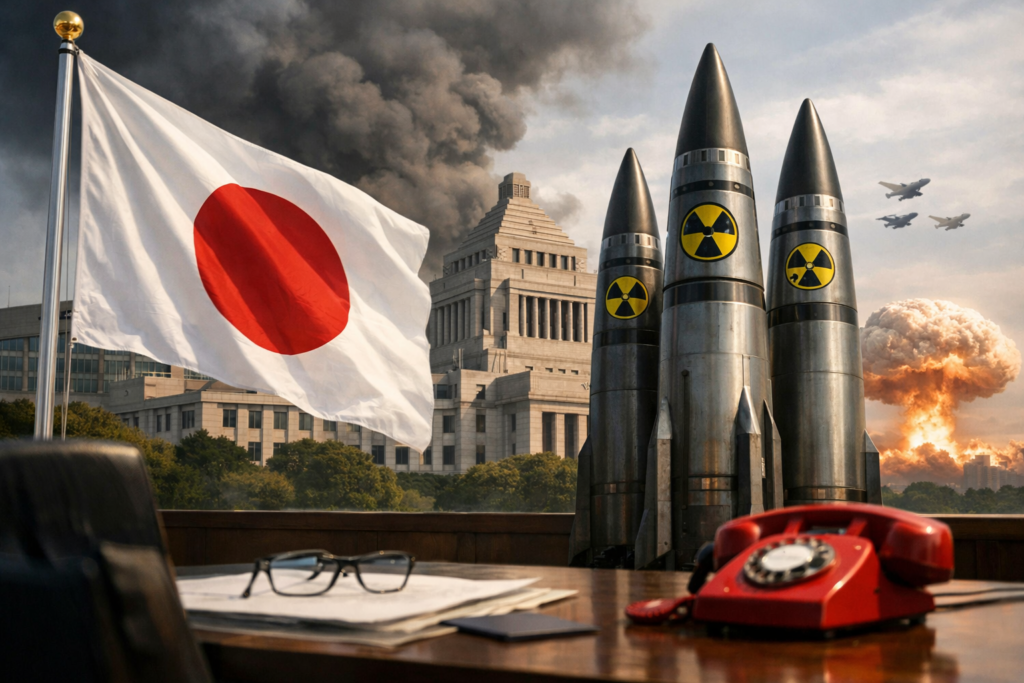
Image Credentials: Image Title: Taboo Broken: Japan PM’s Office Source Suggests Need for Nuclear Weapons Source: (sora.openai) Date: December 2025. Attribution: This image was created using AI-generated imagery (sora.openai) and does not depict a real-world scene.
By Open Chronicle Staff with Agencies | December 21, 2025
TOKYO — A political firestorm has erupted in Japan following explosive remarks from a senior source within Prime Minister Sanae Takaichi’s office, who suggested that the country “needs nuclear weapons” to ensure its long-term survival. The comments, made during an informal exchange with reporters on Thursday, represent a radical departure from the nation’s long-standing “non-nuclear principles” and have sparked immediate calls for dismissals from opposition leaders.
“I think we should possess nuclear weapons,” the source, who is deeply involved in shaping the government’s security policy, reportedly stated. “In the end, we can only rely on ourselves.”
While the source acknowledged that such a move is currently “unrealistic” and likened the difficulty of procurement to something that cannot be done, like just going to a convenience store,” the mere suggestion has shattered a decades-old political taboo in the only nation to have ever suffered atomic bombings.
An unnamed national security advisor to Prime Minister Takaichi made off-the-record remarks to the media that they personally believe Japan should have nuclear weapons.
It has prompted negative reactions from both China and the United States. pic.twitter.com/IrJbKYESE5 https://t.co/gxJLJQX9Sk— Jeffrey J. Hall 🇯🇵🇺🇸 (@mrjeffu) December 20, 2025
A Challenge to the “National Credo”
The remarks strike at the heart of Japan’s post-war identity, specifically the Three Non-Nuclear Principles:
-
Non-possession of nuclear weapons.
-
Non-production of nuclear weapons.
-
Non-introduction (prohibiting the entry of nuclear arms into Japanese territory).
These principles were first articulated in 1967 by Prime Minister Eisaku Sato, who later won the Nobel Peace Prize for the declaration. For over half a century, they have been viewed as a “national credo,” supported by a pacifist Constitution and the ardent wishes of the Hibakusha (atomic bomb survivors).
Takaichi’s Security Overhaul
The controversy comes as Prime Minister Sanae Takaichi, who took office in late October, prepares to revise Japan’s National Security Strategy in 2026. Takaichi, known for her hawkish stance, has previously hinted that the principles, specifically the ban on “introducing” weapons, could be a “hindrance” during an extreme security crisis.
The shifting security landscape in East Asia has fueled this internal debate:
-
China: Rapid expansion of its nuclear arsenal and increased maritime assertiveness.
-
North Korea: Continued development of ICBMs capable of evading current defense systems.
-
Russia: Deepening military cooperation with Pyongyang and Beijing.
Backlash and Diplomatic Friction
The fallout was swift. On Friday, Chief Cabinet Secretary Minoru Kihara attempted to downplay the remarks, reaffirming that the government firmly upholds the non-nuclear principles. However, opposition leader Yoshihiko Noda of the Constitutional Democratic Party demanded the official’s immediate removal, calling it “problematic” that someone with such views is close to the Prime Minister.
Internationally, the remarks have heightened tensions:
-
China: Foreign Ministry spokesman Guo Jiakun called the situation “quite serious,” urging the international community to be “highly vigilant.”
-
United States: While Washington confirmed Japan remains a “global leader” in nonproliferation, the U.S. State Department implicitly urged Tokyo to maintain its current stance despite the reliance on the U.S. “nuclear umbrella.”
Historical Precedent
The gravity of the situation is underscored by history. In 1999, then-Parliamentary Vice Defense Minister Shingo Nishimura was forced to resign after suggesting Japan should consider nuclear armament. Whether the current official, believed to be a senior security advisor, will face a similar fate remains the focus of intense scrutiny in the Diet.
| Event | Date |
| Three Non-Nuclear Principles Adopted | 1967 |
| Sato Wins Nobel Peace Prize | 1974 |
| Takaichi Hints at Policy Review | November 2025 |
| PM Office Source Remarks | December 18, 2025 |
| Opposition Demands Resignation | December 19, 2025 |
As Japan approaches the 80th anniversary of the end of World War II, the debate over nuclear deterrence versus disarmament appears poised to dominate the nation’s political landscape well into the coming year.