
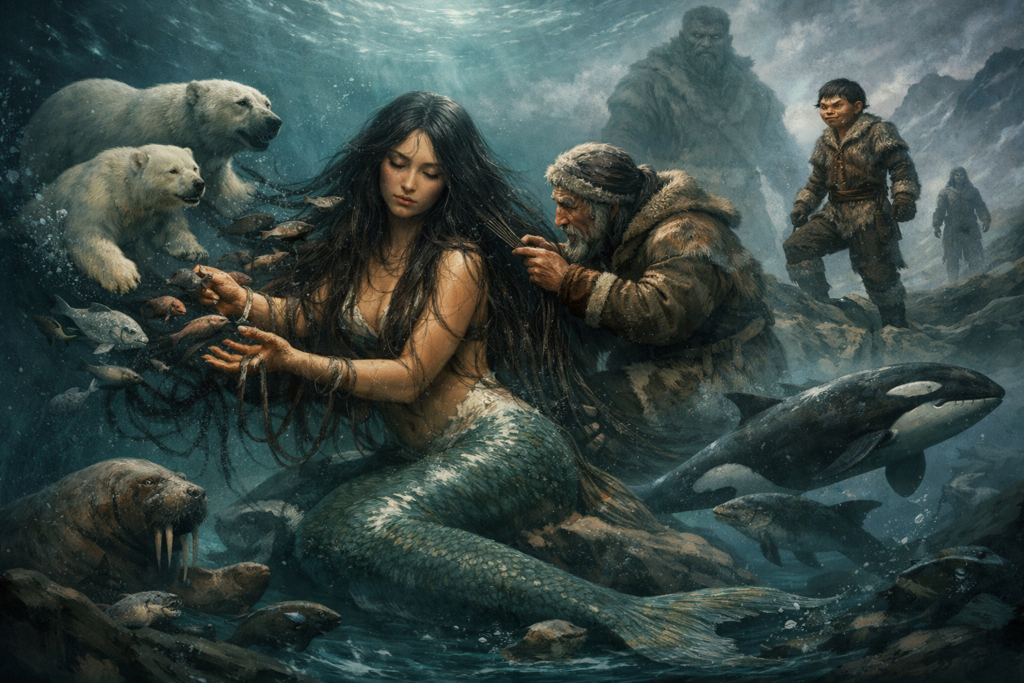
Image Credentials: Image Title: Spirits of the Ice: The Living Mythology of Greenland Source: (sora.openai) Date: December 2025. Attribution: This image was created using AI-generated imagery (sora.openai) and does not depict a real-world scene.
By Open Chronicle Staff | December 23, 2025
NUUK, Greenland — While the world’s superpowers debate Greenland’s strategic value and mineral wealth, the heartbeat of the island remains rooted in a “nature religion” that has survived for millennia. In Greenland, the environment is not merely a resource to be extracted; it is a sentient force governed by ancient laws, powerful shamans, and spirits that still haunt the modern imagination.
The Mother of the Sea: Keeper of the Taboos
At the center of Inuit cosmology is Sassuma Arnaa, the Mother of the Sea (known as Sedna in other Arctic regions). Her story is a tragic foundation for the Inuit moral code. Legend tells of a young girl thrown overboard by her father; as she clung to the kayak, he chopped off her fingers and hands.
-
Creation from Loss: Her severed fingers became the seals and fish, while her hands transformed into polar bears and whales.
-
The Shaman’s Quest: When humans break social taboos, the Mother’s hair becomes matted and filthy with their sins, entangling the sea creatures and causing famine. Only the Angakkoq (shaman) can save the community by traveling in a trance to the bottom of the ocean to comb her hair and soothe her anger.
Kaassassuk: The Legend of Resilience
While the Mother of the Sea governs the natural world, the legend of Kaassassuk the Orphan governs the human spirit. Ostracized by his settlement and forced to sleep with dogs, Kaassassuk was famously lifted by his nostrils as punishment, leading to a distinctive physical appearance in Inuit art.
On long, lonely hikes, he encountered a giant who bestowed upon him supernatural strength. This power allowed him to eventually overcome those who mistreated him, but the legend serves as a dual warning: one can achieve great goals alone, but one must never let power lead to arrogance. Today, a massive sculpture of Kaassassuk stands before the Greenland Self-Rule buildings in Nuuk. It has become a tradition for newly graduated students to dance around him, symbolizing their own transition into strength and adulthood.
Modern-Day Shadows: The Qivittoq
The ancient myths are not dusty relics; they evolve. In modern Greenland, the most common supernatural sighting is the Qivittoq, a “mountain wanderer.”
Historically, a Qivittoq was a person who left society due to shame or anger to live in the wilderness. Because surviving Greenland’s harsh climate alone was deemed impossible, it was believed these exiles gained supernatural powers or turned into spirits. Even in 2025, it is not uncommon for locals to return from hunting trips or northern lights tours with stories of glimpsing a Qivittoq in the mist.
Cultural Preservation in the 21st Century
Greenlandic mythology is a “living literature,” originally passed down through oral histories to teach moral codes and survival skills.
-
In Art: Famous street art by Icelandic artist Mottan in Nuuk reimagines these myths for a new generation.
-
In Education: Legendary literature remains a cornerstone of Greenlandic identity, often recounted during long winter nights.
“The figure of Kaassassuk has become symbolic,” notes a local cultural guide. “It teaches our youth that even the most marginalized can become the strongest, provided they remain grounded.”
References
-
Kaassassuk & The Mother of the Sea:
-
Rasmussen, K. (1921). Eskimo Folk-Tales. Gyldendal. (Original oral histories collected during the Fifth Thule Expedition).
-
Greenland.com. (2025). The Legend of Kaassassuk and the Mother of the Sea. Official Tourism Board of Greenland.
-
Kleivan, I. (1984). The Central Eskimos: Arctic Mythology. In Handbook of North American Indians, Vol. 5.
-
-
Modern Legends:
-
Pettersen, R. (2023). Qivittoq: The Mountain Wanderer in Modern Greenlandic Folklore. University of the Arctic Research Paper.
-