
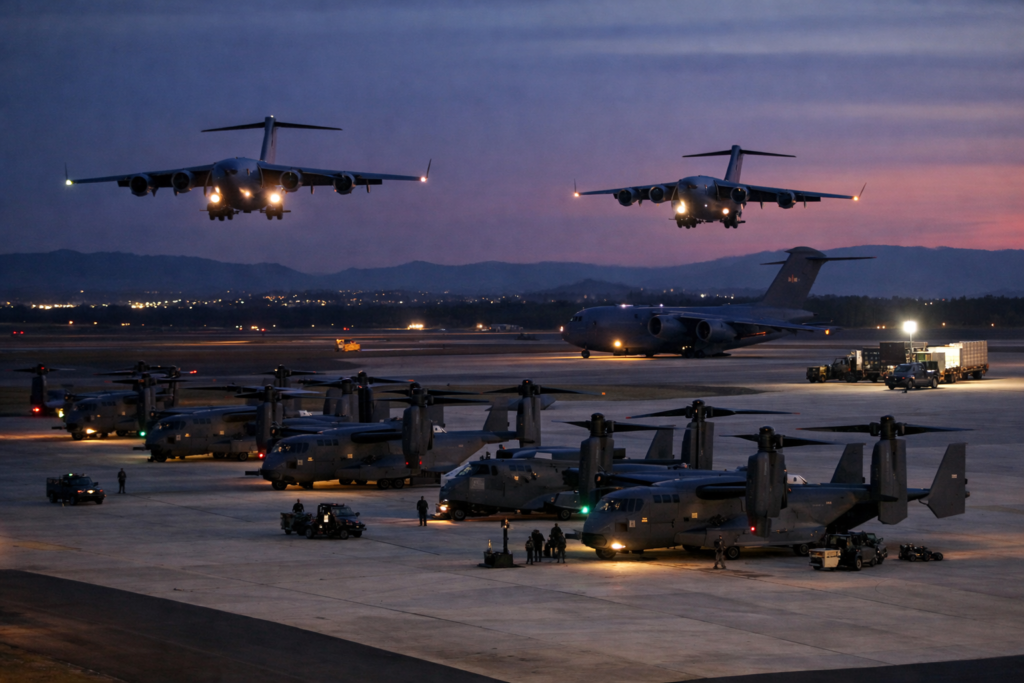
Image Credentials: Image Title: “The Biggest Armada”: US Surges Special Ops Aircraft to Caribbean Amid Venezuela Standoff Source: (sora.openai) Date: December 2025. Attribution: This image was created using AI-generated imagery (sora.openai) and does not depict a real-world scene.
By Open Chronicle Staff | December 23, 2025
SAN JUAN, Puerto Rico — The United States has significantly escalated its military footprint in the Caribbean, deploying a high-profile contingent of special operations aircraft and elite troops. The move, characterized by President Donald Trump as the assembly of the “biggest armada” in the history of South American operations, signals a transition from a purely maritime blockade toward a potential multi-domain pressure campaign against the government of Nicolás Maduro.
According to reports first published by The Wall Street Journal, the buildup centered on a rapid influx of specialized air assets on Monday night.
-
CV-22 Osprey Surge: At least 10 CV-22 Osprey tilt-rotor aircraft—platforms specifically designed for the infiltration, exfiltration, and resupply of special operations forces—arrived in the region from Cannon Air Force Base in New Mexico.
-
Heavy Lift Support: In coordination with the Ospreys, C-17 Globemaster III cargo planes were tracked flying from Fort Stewart and Fort Campbell to Puerto Rico, reportedly carrying additional personnel and heavy equipment.
While U.S. Southern Command (SOUTHCOM) officially labeled the movements as “routine,” officials privately confirmed the arrivals represent a deliberate reinforcement of “rapid-response capabilities” in the theater.
The hardware arrival aligns with increasingly assertive statements from the White House. Speaking to reporters on Monday, President Trump boasted of the sheer scale of the naval and aerial force currently encircling Venezuela.
“We have a massive armada formed, the biggest we’ve ever had, and by far the biggest we’ve ever had in South America,” Trump stated.
Most notably, the President hinted that the mission—currently focused on a maritime oil blockade—may soon expand. “Soon we will be starting the same program on land,” Trump added. While ambiguous, military analysts interpret this as a reference to increased special operations missions, cross-border pressure, or the deployment of ground-based interdiction units.
The troop surge provides a “boots on the ground” component to the “total and complete blockade” of Venezuelan oil tankers announced last week.
-
The U.S. Position: Washington maintains the deployment is necessary to dismantle drug trafficking networks and corruption used to fund the Maduro administration.
-
The Global Backlash: The Venezuelan government and its primary ally, Russia, have condemned the buildup as a violation of sovereignty. Russian envoy Vassily Nebenzia recently warned the UN that this “cowboy-like conduct” is a prelude to a full-scale regime change operation aimed at seizing Venezuela’s oil reserves.
| Asset Type | Origin | Role |
| CV-22 Osprey | Cannon AFB, NM | Special Ops Infiltration/Transport |
| C-17 Globemaster III | Fort Stewart/Campbell | Logistics & Heavy Equipment |
| Naval Armada | US Atlantic Fleet | Maritime Blockade & Interdiction |
Regional Implications
The presence of the CV-22 Ospreys is particularly significant due to their versatility. Unlike traditional helicopters, the Osprey’s speed and range allow special forces to strike deep into territory and return without the need for localized forward operating bases. This deployment suggests that Washington is now prepared for a wide range of contingencies, from targeted extraction missions to high-stakes interdiction on Venezuelan soil.