
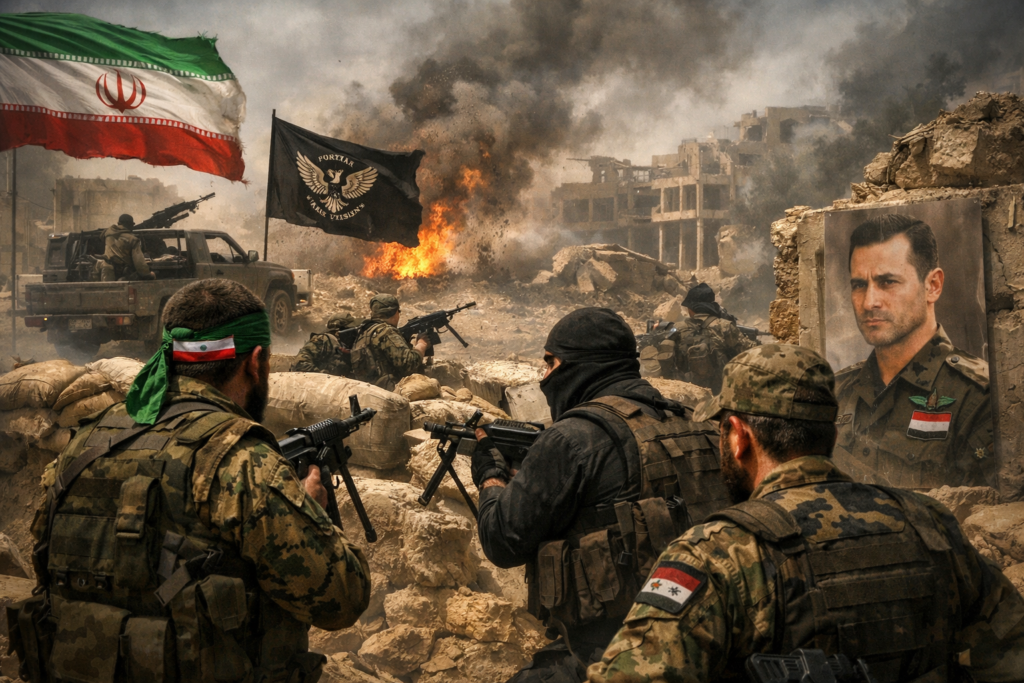
Image Credentials: Image Title: Tehran’s Proxy Gambit: Iran Mobilizes Fourth Division Remnants to Destabilize Post-Assad Syria Source: (sora.openai) Date: December 2025. Attribution: This image was created using AI-generated imagery (sora.openai) and does not depict a real-world scene.
By Open Chronicle Staff with Agencies | December 29, 2025
As the dust settles on the collapse of the Bashar al-Assad government, new reports indicate that Iran is actively working to ignite a fresh wave of unrest within Syria. According to regional security sources and investigative reports from Syria TV and The New York Times, Tehran has begun mobilizing remnants of the elite Fourth Division, a unit formerly commanded by Maher al-Assad, to conduct insurgent operations and re-establish Iranian influence in the Levant.
The Architecture of the Insurgency
Iran is reportedly leveraging high-ranking former regime officers to lead this underground movement. The mobilization, which intensified in early December 2025, centers on several key figures:
-
Ghiyath Dalla: The former commander of the Fourth Division, known for his close ties to Tehran.
-
Maj. Gen. Kamal Hassan: Former head of military intelligence.
-
Maj. Gen. Ghassan Bilal: A high-ranking officer previously embedded within the Fourth Division’s command structure.
The Islamic Revolutionary Guard Corps (IRGC) is currently housing dozens of these officers in secure camps located along the Iraqi-Syrian border, the Hermel region in Lebanon, and areas in eastern Syria. The goal is a coordinated return to Syrian territory to launch a “new wave” of security operations against the nascent transitional authorities and local factions.
Exile Lobbying and the “Alawite Stronghold”
While the IRGC focuses on the ground insurgency, The New York Times reveals a parallel effort by former regime elites to rebuild power from abroad. This dual-track strategy involves:
-
Armed Insurgency: Building a paramilitary movement from exile to challenge the current status quo.
-
Washington Lobbying: At least one high-profile former official is reportedly funding a multi-million dollar lobbying campaign in Washington, D.C. The objective is to secure international backing, or at least neutrality, for a plan to establish an autonomous region in Syria’s coastal provinces, the traditional stronghold of the Alawite sect.
Strategic Motivations: Iraq, Israel, and Hezbollah
Iran’s decision to fuel Syrian unrest is not merely an act of revenge for the fall of the Assad family; it is a calculated move to protect its regional “Axis of Resistance.”
1. Diverting US Pressure in Iraq
In Baghdad, the US envoy has been increasingly successful in pressing Iraqi factions to disband. By stoking a fire in Syria, Tehran hopes to create a regional distraction, forcing the US to pivot its attention and resources away from the Iranian border and Iraqi internal politics.
2. Protecting Hezbollah
With the fall of the central government in Damascus, Hezbollah has lost its vital land bridge. Iran believes that an active insurgency in Syria will:
-
Grant Hezbollah “maneuvering room” rather than leaving them in a purely defensive posture in Lebanon.
-
Stave off intensifying international pressure for Hezbollah’s complete disarmament.
3. Countering Israel
Tehran intends to use these Fourth Division remnants as a “forward-deployed” intelligence network. By maintaining a presence in Syria, they can track Israeli military movements preemptively and provide an early warning system against potential strikes on Iranian soil.
A Fragile Future
More than 13 years after the initial civil war began, Syria remains a tinderbox. Iran’s mobilization of “ghost units” from the Fourth Division suggests that while the face of the Syrian government has changed, the shadow war for control over the heart of the Middle East is entering a dangerous new chapter.