
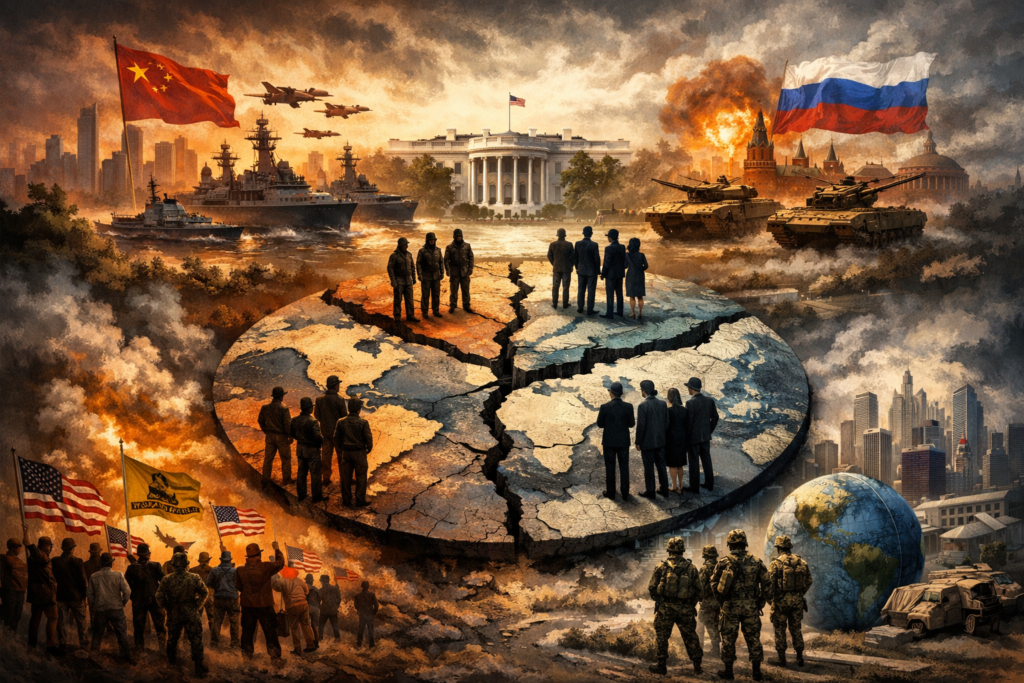
Image Credentials: Image Title: The Great Unraveling: Navigating the Contending Visions of U.S. Foreign Policy Source: (sora.openai) Date: December 2025. Attribution: This image was created using AI-generated imagery (sora.openai) and does not depict a real-world scene.
By José Carlos Palma *
The “unipolar moment” that followed the Cold War has officially passed, leaving in its wake a fragmented and intense debate within the American foreign policy community. While there is a rare consensus that the post-9/11 era was marked by significant strategic overreach, there is no agreement on what comes next. As the United States grapples with a rising China, a revisionist Russia, and domestic polarization, four distinct ideological camps have emerged to compete for the soul of American grand strategy.
None of these groups are “isolationist” in the classic 1930s sense; all acknowledge that the U.S. must remain connected to the world. However, they differ radically on the purpose, scale, and tools of that connection.
1. The Nationalists: Sovereignty and Transactionalism
Primarily associated with the “America First” movement, the Nationalists view foreign policy through the lens of domestic prosperity and national sovereignty.
-
Core Philosophy: Unilateralism. The U.S. should act alone when its narrow interests are at stake.
-
Approach: Highly skeptical of multilateral organizations (UN, WTO) and “sacred” alliances.
-
Tools: They favor economic coercion (tariffs) and decisive, short-term military force over long-term entanglements or nation-building.
2. The Liberal Internationalists: Alliances and Global Order
A mainstay of the traditional establishment, this group believes that American security is inextricably linked to the health of the international system.
-
Core Philosophy: Multilateralism. Alliances are not just tools but “sacred commitments” that multiply American power.
-
Approach: Strengthening supranational organizations and upholding international law.
-
Tools: Diplomacy and democracy promotion. They seek to build a world safe for democracy, though they have become more cautious about military interventionism than their predecessors.
3. The Realists (Restrainers): Prioritization and Balance
The Realist camp argues that the U.S. has been “overly adventurous” and must now face the reality of limited resources.
-
Core Philosophy: Balance of Power. The U.S. should only intervene to prevent a single power from dominating a key region (like Eurasia).
-
Approach: Strategic retrenchment. This involves narrowing U.S. interests to focus on core security rather than global stability or human rights.
-
Tools: Off-shore balancing and military restraint. They argue that being “everywhere at once” actually makes America weaker.
4. The Progressives: Global Justice and Non-Military Power
A burgeoning force within the Democratic Party, Progressives are attempting to redefine “leadership” away from the Pentagon.
-
Core Philosophy: Global Solidarity. Addressing transnational threats like climate change, inequality, and kleptocracy.
-
Approach: A “Better World” strategy that eschews military solutions in favor of peaceful engagement, even with rivals like China.
-
Tools: Economic reform, anti-corruption measures, and climate diplomacy. While ambitious, their specific tactical roadmap remains the least defined of the four.
The Competing Strains: A Summary Table
| Camp | Primary Goal | View on Alliances | Preferred Tool |
| Nationalists | U.S. Sovereignty | Burden / Transactional | Economic Coercion |
| Liberal Internationalists | Rules-based Order | Sacred / Essential | Multilateral Diplomacy |
| Realists | Regional Balance | Functional / Limited | Military Restraint |
| Progressives | Global Justice | Transformative | Non-military Engagement |
The debate raging today is healthy and necessary. The U.S. is no longer a hegemon that can dictate terms to the world; it is a powerful nation that must make choices. Whether it chooses to lead through a reformed liberal order, retreat into a nationalist shell, or adhere to the cold logic of realism will determine the geopolitical landscape of the mid-21st century.
What is clear is that the “unipolar” consensus is dead. The future of American power will be defined by which of these four visions can most effectively mobilize a weary American public.
References
-
Posen, Barry R. Restraint: A New Foundation for U.S. Grand Strategy. Ithaca, NY: Cornell University Press, 2014.
-
Walt, Stephen M. The Hell of Good Intentions: America’s Foreign Policy Elite and the Decline of U.S. Primacy. New York: Farrar, Straus and Giroux, 2018.
-
Mearsheimer, John J. The Great Delusion: Liberal Dreams and International Realities. New Haven, CT: Yale University Press, 2018.
-
Ikenberry, G. John. A World Safe for Democracy: Liberal Internationalism and the Crises of Global Order. New Haven, CT: Yale University Press, 2020.
-
Nye, Joseph S., Jr. Do Morals Matter? Presidents and Foreign Policy from FDR to Trump. New York: Oxford University Press, 2020.
-
Biden, Jr., Joseph R. “Why America Must Lead Again: Rescuing U.S. Foreign Policy After Trump.” Foreign Affairs 99, no. 2 (March/April 2020).
-
Anton, Michael. The Stakes: America at the Point of No Return. San Diego: Harcourt, 2020.
-
Lighthizer, Robert E. No Trade Is Free: Changing Course, Taking on China, and Helping America’s Workers. New York: Broadside Books, 2023.
-
Mead, Walter Russell. “The Jacksonian Tradition and American Foreign Policy.” The National Interest, no. 58 (Winter 1999/2000): 5–29.
-
Beinart, Peter. “A New Strategy for the Left.” The Atlantic, 2021.
-
Duss, Matt. “A Better Way to World: Putting People First in U.S. Foreign Policy.” Foreign Affairs, 2023.
-
Khanna, Ro. Dignity in a Digital Age: Making Tech Work for All of Us. New York: St. Martin’s Press, 2022.
-
Krauthammer, Charles. “The Unipolar Moment.” Foreign Affairs 70, no. 1 (1990/91): 23–33.
-
Brands, Hal. The Twilight Struggle: What the Cold War Teaches Us About Great-Power Rivalry Today. New Haven, CT: Yale University Press, 2022.
-
Council on Foreign Relations (CFR). “The End of the Post-Cold War Era.” Global Memo, 2024.
The Grand Strategy Institute
Continue Exploring Strategic Analysis
Return to The Grand Strategy Institute for strategic assessments, long-form analysis and research examining geopolitics, military affairs, international security, emerging technologies and the changing international order.
← Back to The Grand Strategy Institute