
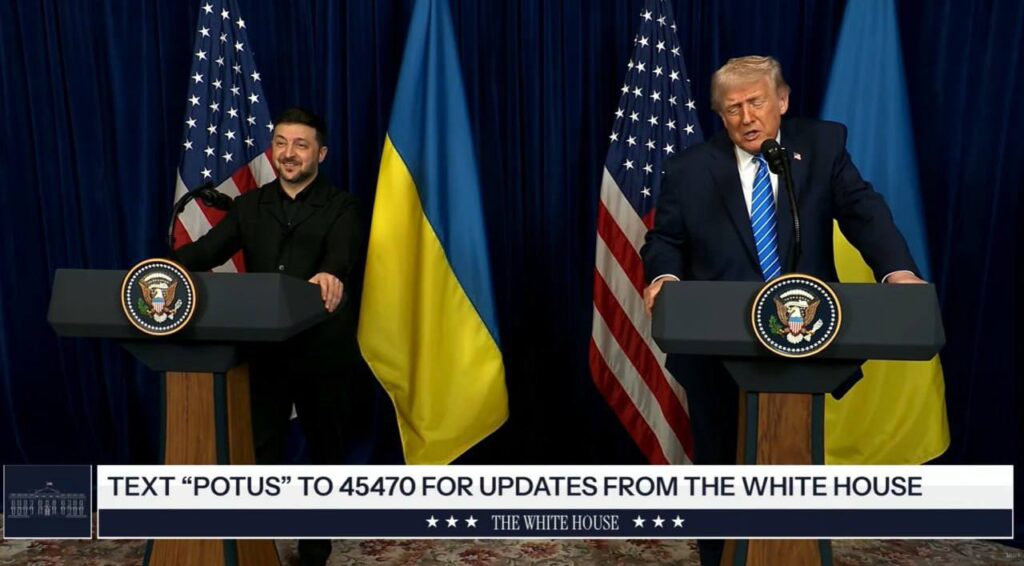
Image: from MilitaryNewsUA X@front_ukrainian
By Open Chronicle Staff with Agencies | December 28, 2025
PALM BEACH, FL — Following a high-stakes summit at his Mar-a-Lago residence, U.S. President Donald Trump announced on Sunday that “significant progress” has been made toward ending the Russia-Ukraine war. Characterizing the nearly four-year conflict as the most “deadly” and “biggest” since World War II, Trump suggested a final peace deal could be reached within weeks if negotiations continue at the current pace.
The Road to Washington: A January Summit
President Volodymyr Zelenskyy confirmed that the momentum from the Florida talks will carry over into the new year. Trump is set to host Zelenskyy and several key European leaders in Washington, D.C., in January 2026 to finalize the framework of the agreement.
“We agreed that our teams will meet in the upcoming weeks to finalize all discussed matters,” Zelenskyy stated, following what he described as a productive dialogue aimed at stopping a conflict that has devastated the region since early 2022.
🚨 BREAKING: President Trump says the proposed peace deal includes provisions to help Ukraine rebuild.
“There are significant economic upsides for Ukraine in this agreement — the country has a lot of rebuilding ahead,” he explained. pic.twitter.com/53MxFzeZKQ
— Commentary 🇺🇸 Tom Homan (@HomanNews) December 28, 2025
The Reconstruction Deal: Russia’s Role
In a surprising diplomatic development, Trump revealed that he has discussed Ukraine’s post-war reconstruction directly with Russian President Vladimir Putin. According to the U.S. President, Moscow has committed to assisting in the rebuilding process.
-
Energy & Utilities: Russia would reportedly supply Ukraine with energy and electricity at “very low prices” to jumpstart the recovery.
-
Economic Cooperation: While specific financial figures were not disclosed, the involvement of Moscow in the reconstruction is seen as a pivotal, if controversial, component of the peace plan.
Trump says "very close" to Russia Ukraine peace deal after Zelensky meeting
"Some say we are 95% there, probably 🅱️iggest since WW2"
Called European leaders, commissioner and UK PM during Mar-a-Lago talks
Discussed security guarantees, territorial issues and economic recovery pic.twitter.com/CB48SHtLgi
— Boi Agent One (@boiagentone) December 28, 2025
The “Thorny Issues”: Land and Sovereignty
Despite the optimism, Trump acknowledged that “one or two very thorny issues” remain. The most significant hurdle involves the status of territories currently occupied by Russian forces.
-
Timeline: Trump estimated that if negotiations go “really well,” a deal could be struck in a few weeks. If obstacles persist, the timeline will extend.
-
Direct Intervention: In a move showing his personal commitment, Trump offered to address the Ukrainian Parliament (Verkhovna Rada) to push the peace plan forward. “If it would help save 25,000 lives a month… I would certainly be willing to do that,” Trump told reporters.
Global and Russian Reaction
The response from the Kremlin’s side has been cautiously positive. Kirill Dmitriev, Putin’s special envoy for investment and economic cooperation, praised the American initiative on social media.
“The whole world appreciates President Trump and his team’s peace efforts,” Dmitriev wrote, signaling a rare moment of alignment between Washington and Moscow regarding the necessity of a ceasefire.
Comparison of the Proposed Peace Framework
| Feature | Pre-2025 Negotiations | Trump-Mar-a-Lago Framework |
| Primary Facilitator | UN / Normandy Format | Direct U.S. Executive Mediation |
| Russia’s Financial Role | Reparations (Rejected by Moscow) | Reconstruction via Low-Cost Energy |
| Territorial Status | Full Withdrawal (Kiev’s Stance) | Disputed / Under Negotiation |
| Security Guarantees | NATO Membership (Proposed) | Regional Neutrality / U.S. Reinforcement |
As the world looks toward the January summit in Washington, the prospect of an end to the “most deadly war since World War II” appears closer than at any point in the last four years. However, the resolution of the “thorny” land disputes remains the ultimate test for this new diplomatic architecture.