
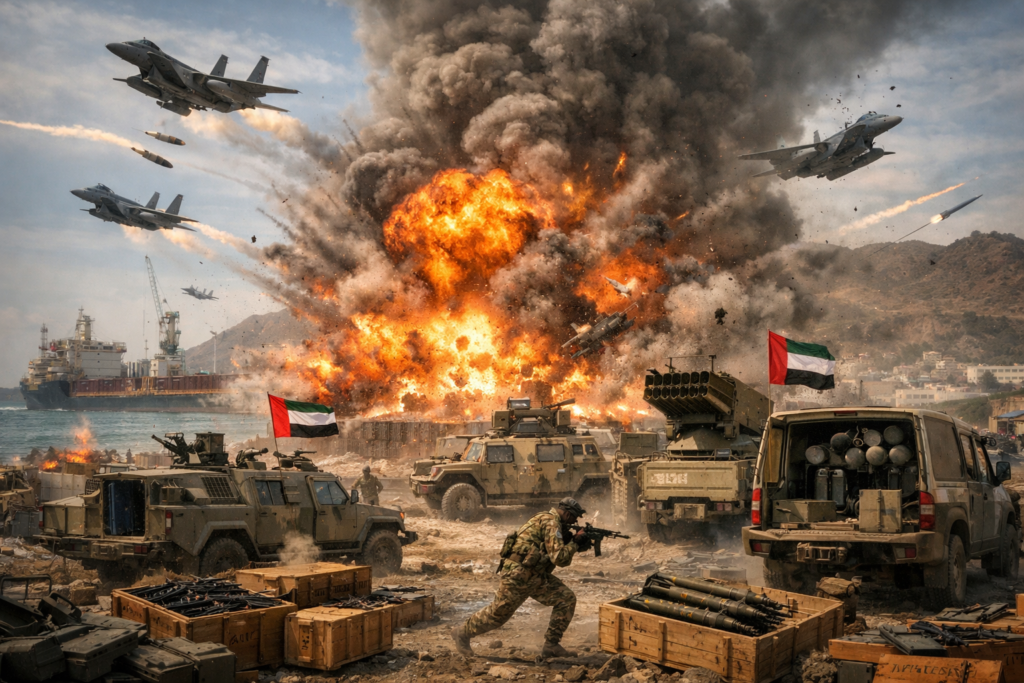
Image Credentials: Image Title: Fault Lines in the Peninsula: Saudi Airstrikes on Mukalla Ignite New Front in Yemen’s War Source: (sora.openai) Date: December 2025. Attribution: This image was created using AI-generated imagery (sora.openai) and does not depict a real-world scene.
By Open Chronicle Editorial Team with Agencies | December 30, 2025
The long-standing but fragile alliance between Saudi Arabia and the United Arab Emirates (UAE) reached a dramatic breaking point this Tuesday. In a move that threatens to fracture the coalition against Houthi rebels, Saudi warplanes bombed the Yemeni port city of Mukalla. The target: a massive shipment of weapons and combat vehicles delivered by the UAE to southern separatist forces.
The Midnight Shipment and the Saudi Ultimatum
The crisis began when the Greenland, a St. Kitts-flagged vessel, arrived in Mukalla after departing from Fujairah in the UAE. According to a military statement from the Saudi Press Agency, the crew disabled tracking devices before offloading armored vehicles and heavy weaponry intended for the Southern Transitional Council (STC).
Riyadh’s response was swift and lethal. Citing an “imminent threat to peace and stability,” the Saudi-led coalition conducted a “limited airstrike” to destroy the offloaded hardware. While the STC’s AIC satellite channel showed smoke rising from the port, they pointedly avoided showing the extent of the damage to the armored units.
“The steps taken by the sisterly United Arab Emirates are extremely dangerous.” — Official Statement, Saudi Foreign Ministry
A War Within a War: The STC Advance
The bombing is the culmination of weeks of tension in the Hadramout and Mahra governorates. The UAE-backed STC has been aggressively pushing out the National Shield Forces, a rival group supported by Saudi Arabia.
-
Secessionist Fever: Demonstrators across the south have been flying the flag of the former South Yemen (1967–1990), demanding a return to independence.
-
The Strategic Shift: By seizing Mukalla, 480 kilometers northeast of Aden, the STC has effectively challenged the authority of Yemen’s Presidential Leadership Council (PLC).
The UAE’s Exit Strategy?
The diplomatic fallout was immediate. The Emirati Foreign Ministry denied the weapons allegations, claiming the vehicles were for their own forces and that Riyadh had been notified. However, in a startling pivot, the UAE Defense Ministry announced it would withdraw its remaining troops from Yemen, citing “potential repercussions on the safety of counter-terrorism operations.”
Mohammed al-Basha, a Yemen expert and founder of the Basha Report, notes that while the UAE may withdraw its formal military presence, the groundwork for a proxy conflict is set. “I expect a calibrated escalation. The STC is likely to respond by consolidating control, even as the flow of weapons is curtailed by Saudi control of the airspace,” al-Basha said.
Humanitarian and Regional Implications
The escalation comes at a dire time for Yemen, already the Arab world’s poorest nation. Jens Laerke of the U.N. humanitarian office warned that disrupting the port of Mukalla “risks affecting already dire humanitarian supply chains.”
As the U.S. continues its own airstrikes against Houthi rebels in the Red Sea corridor, this internal fracture among anti-Houthi allies introduces a volatile new variable. The “No Kings” protests and the global Gen Z revolutions of late 2025 provide a backdrop of global instability to a region that is once again on the brink of a total civil explosion.