
Image: from NASA Ames  X@NASAAmes
By Open Chronicle Science Desk | December 31, 2025 Source: NASA *
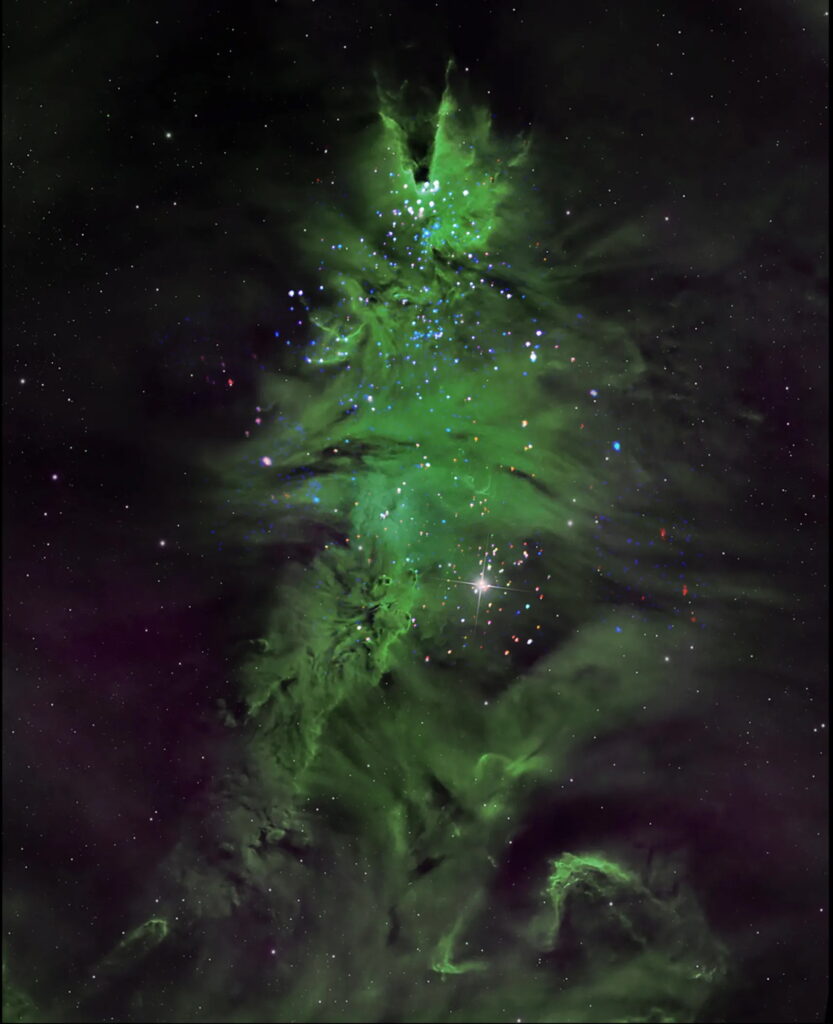
Just in time for the 2025 holiday season, astronomers have released a breathtaking new composite of NGC 2264, a sprawling star-forming region that bears an uncanny resemblance to a decorated fir tree. Spanning nearly 80 light-years, this celestial “Christmas Tree” serves as a vivid laboratory for studying the chaotic birth of stars and the powerful radiation that sculpts the galaxy.
A Festive Alignment in Monoceros
Located approximately 2,700 light-years from Earth in the constellation Monoceros (the Unicorn), NGC 2264 is a complex assembly of young stars, glowing gas, and dark dust. Positioned near the celestial equator and the flat disk of our galaxy, it is a frequent target for both professional observatories and amateur stargazers.
The “tree” is a composite of several distinct astronomical features:
-
The Christmas Tree Cluster: A triangular arrangement of newborn stars that forms the “body” of the tree.
-
The Cone Nebula: A dark, pillar-like structure at the apex, serving as the “tree topper.”
-
The Fox Fur Nebula: A textured, swirling cloud of gas at the base, resembling the soft fur of a fox.
「クリスマスツリー星団」とも呼ばれる若い星団NGC 2264。地上望遠鏡で撮影された可視光と赤外線の画像に、チャンドラX線望遠鏡がとらえたX線画像を重ねたもの。X線を放つ星々を点滅させています。https://t.co/aPamOdGVNW
Image Credit: X-ray: NASA/CXC/SAO; Optical: T.A. Rector (NRAO/AUI/NSF… pic.twitter.com/Mm9OaIr6tn
— アストロピクス 宇宙画像情報サイト (@Astropics_bb) December 24, 2025
NGC 2264: By the Numbers
| Attribute | Measurement |
| Distance from Earth | ~2,700 Light-Years |
| Actual Physical Span | ~80 Light-Years |
| Apparent Size | 1.5 Degrees (roughly the width of 3 Full Moons) |
| Star Cluster Age | ~1 to 5 Million Years (Astronomically “Very Young”) |
| Constellation | Monoceros (The Unicorn) |
| Primary Star | S Monocerotis (Variable Star) |
The Mechanics of Cosmic Decoration
The vibrant colors of NGC 2264 aren’t just for show; they are the result of intense physical processes.
Emission vs. Reflection
The “lights” on this cosmic tree are young stars that ionize the surrounding hydrogen gas, causing it to glow a deep crimson—a phenomenon known as an emission nebula. Conversely, in regions where dust is hit by the light of hot, blue stars, the light is scattered rather than absorbed, creating the soft blue hues of reflection nebulae.
S Monocerotis: The Star of the Show
At the heart of the cluster lies S Monocerotis, a bright, massive variable star. It acts as a primary energy source for the region, its intense ultraviolet radiation sculpting the surrounding dust into the dramatic shapes we see today.
Immense Scale and Visual Breadth
While it appears as a singular object in a telescope, the scale of NGC 2264 is staggering. In our night sky, the region covers about 1.5 degrees, roughly equivalent to the width of three full moons.
Dynamic Sculpting
The Cone Nebula is perhaps the most scientifically significant part of the structure. It is a “pillar of creation”—a dense cloud of cold gas and dust that is being slowly eroded by the stellar winds of the nearby cluster. As the radiation pushes against the cloud, it compresses the gas, potentially triggering the birth of yet another generation of stars inside the cone itself.
As 2025 comes to a close, NGC 2264 stands as a reminder of the dynamic nature of our universe—a festive, glowing nursery where the “decorations” are the very building blocks of the galaxy.
* Story Source:
Materials provided by NASA. Note: Content may be edited for style and length.