
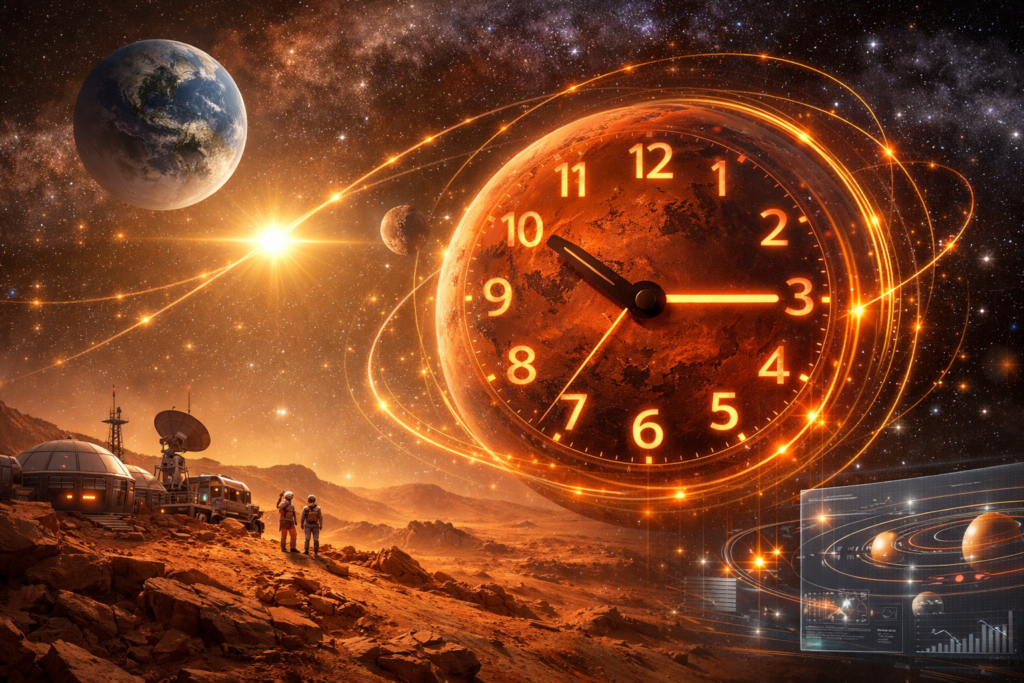
Image Credentials: Image Title: Relativity in the Red Planet: Why Time Ticks Faster on Mars Source: (sora.openai) Date: December 2025. Attribution: This image was created using AI-generated imagery (sora.openai) and does not depict a real-world scene.
By Open Chronicle Science Desk | December 31, 2025 Source: National Institute of Standards and Technology (NIST)*
As humanity edges closer to a permanent presence on the Red Planet, scientists have finally resolved a fundamental mystery: What time is it on Mars? In a landmark study published in The Astronomical Journal on December 30, 2025, physicists from the National Institute of Standards and Technology (NIST) proved that time on Mars flows at a significantly different rate than on Earth, a discovery with profound implications for future navigation and the creation of a “Solar System Internet.”
The Einstein Effect: Gravity and the Flow of Time
The phenomenon is rooted in Albert Einstein’s theories of relativity, which dictate that time is not a universal constant. Instead, the rate at which a clock ticks is influenced by two primary factors:
-
Gravitational Time Dilation: Time moves slower in stronger gravitational fields. Because Mars is smaller and less dense than Earth, its gravity is roughly five times weaker, causing clocks to “speed up.”
-
Velocity Time Dilation: The speed at which a planet moves through space also alters the passage of time.
The Calculations: 477 Microseconds and Counting
NIST physicists Bijunath Patla and Neil Ashby determined that, on average, a clock on the surface of Mars ticks 477 microseconds (millionths of a second) faster per day than a clock on Earth.
However, unlike the Moon, where time consistently runs about 56 microseconds faster per day, Mars’ time difference is highly volatile. Due to its “eccentric” or stretched orbit, the distance between Mars and the Sun changes significantly throughout the Martian year. This fluctuation causes the time gap to vary by as much as 226 microseconds per day.
“A three-body problem is extremely complicated. Now we’re dealing with four: the Sun, Earth, the Moon, and Mars. The heavy lifting was more challenging than I initially thought.”
— Bijunath Patla, NIST Physicist
Why Microseconds Matter: Navigation and the “Galactic Web”
While a fraction of a millisecond seems negligible (it’s about 1,000 times faster than a human blink), it is catastrophic for modern technology.
-
Navigation: Deep-space GPS and rover guidance systems rely on synchronization within nanoseconds. Without accounting for these relativistic shifts, a Mars rover could end up kilometers off-course.
-
Communication: 5G and future 6G systems require timing accuracy within 0.1 microseconds.
-
Solar System Internet: To achieve “real-time” feel in communication across millions of miles, synchronized interplanetary networks are essential.
A New Planetary Time Zone
To reach these conclusions, researchers had to establish a Martian “sea level” at the equator to serve as a reference point. They accounted for the gravitational pull of not just Mars, but the massive influence of the Sun, which holds 99% of the solar system’s mass.
Timekeeping Comparison: Earth vs. The Solar System
| Planetary Body | Daily Time Offset (vs. Earth) | Variational Flux |
| The Moon | +56$ Microseconds | Low (Stable orbit) |
| Mars | +477$ Microseconds | High (Up to $226$ $\mu$s drift) |
| Mars Day (Sol) | \sim 24$ hours $40$ minutes | N/A |
| Mars Year | 687$ Earth Days | N/A |
Scientific Frontier
Beyond practical logistics, the NIST study provides a new testing ground for general relativity. Measuring how clocks behave on a distant world validates Einstein’s math in ways that were previously purely theoretical. As Neil Ashby noted, while it may be decades before humans walk the Martian surface, establishing the “physics of the clock” today is the first step toward the science-fiction vision of a multi-planetary civilization.
Story Source:
Materials provided by National Institute of Standards and Technology (NIST). Note: Content may be edited for style and length.
Journal Reference:
- Neil Ashby, Bijunath R. Patla. A Comparative Study of Time on Mars with Lunar and Terrestrial Clocks. The Astronomical Journal, 2025; 171 (1): 2 DOI: 10.3847/1538-3881/ae0c16