
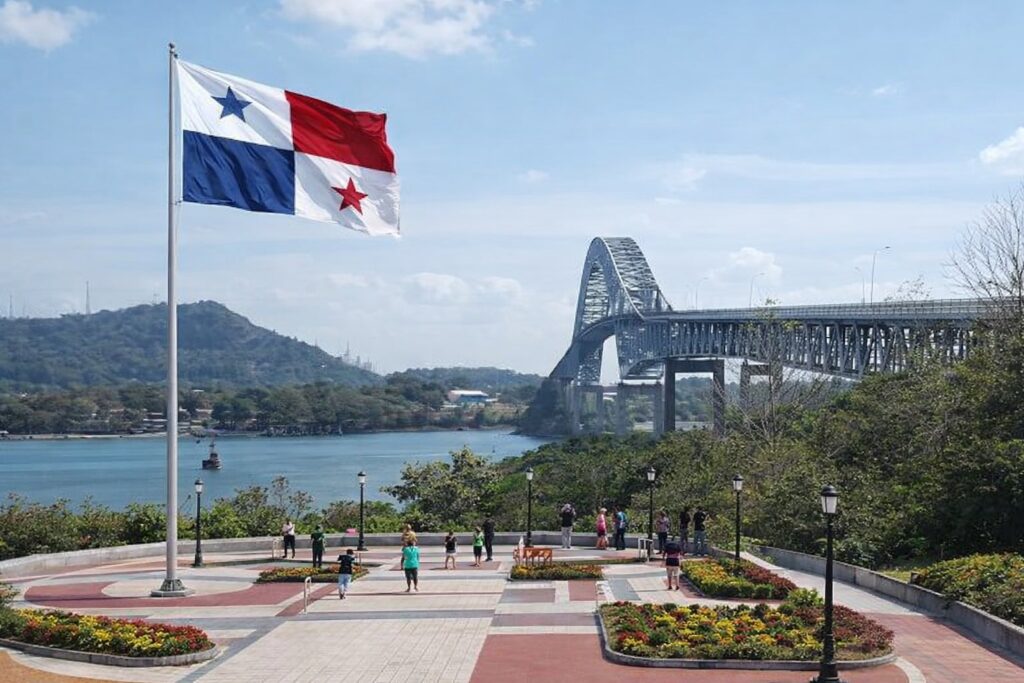
Image: from Alex Bal Chiari X@alexbal7
By Open Chronicle Global Affairs Desk with Agencies | December 31, 2025
A monument that stood for over two decades as a symbol of bilateral cooperation was reduced to rubble Saturday night, marking a sharp escalation in the struggle for influence over the Panama Canal. The demolition of the Chinese “Friendship” monument in Arraiján has ignited a diplomatic firestorm, pitting local municipal orders against national leadership and drawing the eyes of both Washington and Beijing.
The Midnight Demolition
The monument, erected in 2004 to celebrate the contributions of the Chinese community and China’s role as a major canal user, was torn down by order of the Mayor’s Office of Arraiján. Located at a strategic lookout overlooking the Bridge of the Americas, the site was a prominent landmark for those entering the 80-kilometer waterway.
-
Official Reason: The municipality claimed the structure suffered from “structural damage” that posed a safety risk to the public.
-
The Scene: Police cordoned off the area as heavy machinery dismantled the stone and plaques. Local videos showed members of Panama’s 300,000-strong Chinese community being held back by security forces as they tried to protest the destruction.
A las 9 pm del 27, llegaron videos: excavadoras demolían el Mirador del Puente de las Américas y el Monumento por los 150 años de la presencia china en Panamá.
Corrí al lugar, pero ya estaba en el suelo.
Paisanos intentaron proteger los restos, pero se lo impidieron.
Este… pic.twitter.com/7SFVR0to0h— Xu Xueyuan徐学渊 (@ChEmbPa) December 28, 2025
Washington’s Shadow: Trump and the “Retake” Rhetoric
The timing of the demolition is widely seen as a response to shifting winds in Washington. In recent months, U.S. President Donald Trump has intensified rhetoric regarding the canal, which was under U.S. control from 1914 to 1999.
-
The Influence Claim: Trump has repeatedly alleged that Beijing exerts “excessive influence” over canal operations, threatening to “retake control” or demand preferential conditions for U.S. vessels to protect national security.
-
Economic Maneuvers: This political pressure coincides with major shifts in infrastructure ownership. Hong Kong-based Hutchison Holdings recently agreed to sell its two pivotal port operations on the Atlantic and Pacific sides to the U.S. investment giant BlackRock, a move many see as a strategic “de-risking” from Chinese assets.
Panama Canal Control Timeline
| Era | Controlling Authority | Key Context |
| 1914 – 1999 | United States | The canal was built by the U.S. and operated as a U.S. territory for 85 years. |
| 1999 – Present | Panama | Sovereignty was transferred to Panama following the Torrijos-Carter Treaties. |
| Late 2025 | Contested | U.S. claims of Chinese “soft control” and port acquisitions lead to significant diplomatic friction. |
Diplomatic Fallout: “An Unforgivable Act”
The demolition has created a rare rift between Panama’s local and national governments. President José Raúl Mulino took to social media to denounce the move in the strongest possible terms.
“There is no justification whatsoever for the barbarity committed. This is an unforgivable act of irrationality.” — José Raúl Mulino, President of Panama
China’s Ambassador to Panama, Xu Xueyuan, who visited the site shortly after the demolition, expressed “great pain,” calling the act an insult to the Chinese-Panamanian people. The Chinese Embassy has officially demanded a “thorough investigation” and sanctions against those responsible for what they termed “vandalistic” actions.
A Critical Choke Point
The Panama Canal facilitates approximately 5% of global maritime trade. With the U.S. and China serving as its two largest users, any instability, symbolic or structural, reverberates through global supply chains.