
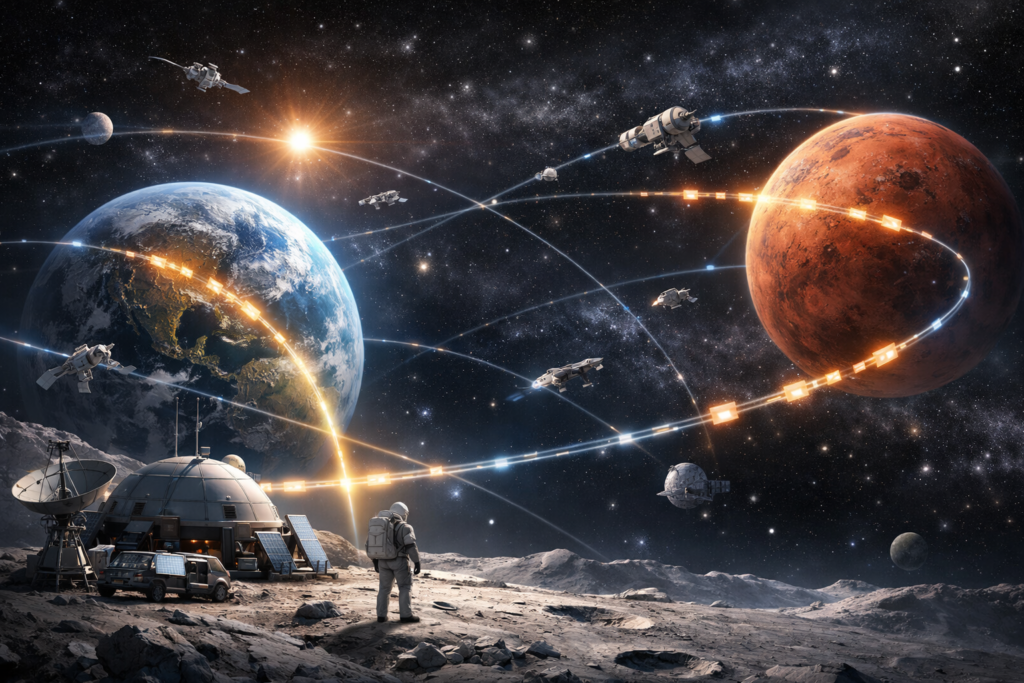
Image Credentials: Image Title: The Solar System Internet: Connecting the Final Frontier Source: (sora.openai) Date: December 2025. Attribution: This image was created using AI-generated imagery (sora.openai) and does not depict a real-world scene.
By Open Chronicle Science Desk | December 31, 2025
As we establish a permanent presence on the Moon and look toward Mars, the biggest challenge isn’t just getting there, it’s staying connected. The Solar System Internet (SSI) is the technological framework designed to bridge the millions of miles between planets, ensuring that data, navigation, and communication flow seamlessly across the void.
1. The Core Innovation: Disruption Tolerant Networking (DTN)
The standard internet protocol we use on Earth (TCP/IP) assumes a constant, near-instant connection. In space, this is impossible. Signals are often blocked by planets or interrupted by solar flares, and light-speed delays can reach up to 24 minutes between Earth and Mars.
To solve this, NASA and international partners developed Disruption Tolerant Networking (DTN).
-
Store-and-Forward: Unlike Earth’s internet, which drops data if the path is broken, DTN nodes (satellites or landers) store data packets until the next “hop” is available.
-
Automatic Resumption: Once a line of sight is restored, for example, as a satellite orbits back around Mars, the data transmission resumes automatically without human intervention.
2. The Interplanetary Infrastructure
Building a “galactic web” requires more than just code; it requires hardware strategically placed across the solar system.
-
LunaNet (The Lunar Backbone): As of 2025, NASA is aggressively deploying LunaNet. This is a framework of satellites around the Moon that provides “WiFi,” GPS-like positioning, and weather alerts to astronauts on the lunar surface.
-
Mars Relay Network: Currently, missions like the Perseverance rover use older orbiters (like the Mars Reconnaissance Orbiter) to bounce signals to Earth. Future “backbone” orbiters are being designed to handle much higher data loads.
-
Optical (Laser) Communications: In a major 2025 milestone, NASA’s DSOC (Deep Space Optical Communications) proved that lasers can transmit data at rates 10 to 100 times faster than traditional radio waves, allowing for 4K video streaming from deep space.
3. Why Timing is the “Secret Sauce.”
As recently proven by NIST, time actually runs 477 microseconds faster on Mars than on Earth. For a Solar System Internet to work, the network must account for:
-
Relativistic Synchronization: Routers on Mars and Earth must “handshake” using a relativistic time standard so data packets don’t arrive out of sequence.
-
Precision Navigation: Just as GPS requires perfectly synced clocks, the SSI will serve as a planetary positioning system for rovers and humans.
4. Technical Comparison: Earth vs. Space Internet
| Feature | Terrestrial Internet (TCP/IP) | Solar System Internet (DTN) |
| Connectivity | Continuous and stable | Intermittent and “bursty” |
| Latency | Milliseconds | Minutes to hours |
| Data Storage | Minimal at intermediate nodes | Extensive “bundle” storage at nodes |
| Primary Medium | Fiber optics / 5G / Satellite | Radio waves / High-frequency Lasers |
5. The Future: A Multi-Planetary Web
The goal for the 2030s is to create an “always-on” experience for explorers. A scientist on Mars should be able to access an Earth-based database, or an astronaut on the Moon should be able to send a message to their family with the same ease we use a smartphone today, albeit with a natural “light-speed” delay.
The Solar System Internet isn’t just about sending pictures back to Earth; it is the foundation of a digital civilization that spans multiple worlds.
References
- Ashby, N., & Patla, B. (2025). “Relativistic Time Scales and Coordinate Transformations for Mars Exploration.” The Astronomical Journal.
- National Institute of Standards and Technology (NIST). (2025, December 30). “NIST Physicists Calculate Precise Time for Mars.” NIST News and Reports. [nist.gov/news-events]
- Patla, B. (2024). “A Framework for High-Precision Timekeeping on the Moon.” The Astronomical Journal.
- Einstein, A. (1915). “The Foundation of the General Theory of Relativity.” Annalen der Physik.
- NASA. (2025). “LunaNet: Interoperability Specifications for Lunar Communication and Navigation Services.” NASA Technical Reports Server (NTRS).
- Cerf, V. G., et al. (2023). “Delay-Tolerant Networking Architecture.” IETF RFC 4838.
- Deep Space Optical Communications (DSOC) Project. (2024–2025). “Summary of High-Bandwidth Laser Transmissions from Deep Space.” NASA Jet Propulsion Laboratory (JPL).
- Burleigh, S., & Scott, K. (2025). “Bundle Protocol Version 7: Implementation and Field Testing for Mars Relay.” Journal of Aerospace Information Systems.
- NASA Jet Propulsion Laboratory (JPL): jpl.nasa.gov – Source for real-time data on the Mars Relay Network and Deep Space Network (DSN) status.
- Interplanetary Networking Special Interest Group (IPNSIG): ipnsig.org – Leading body for the development of the Solar System Internet.
- European Space Agency (ESA): “Moonlight Initiative: Connecting the Earth and Moon.” (2025).