
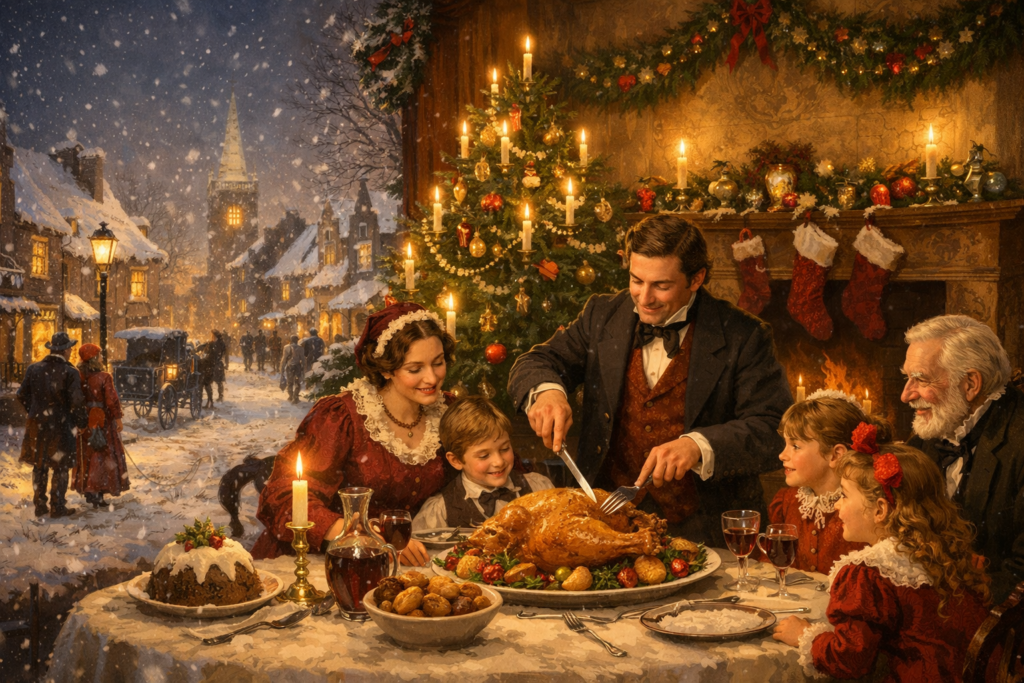
Image Credentials: Image Title: The Victorian Invention of Christmas: How the 19th Century Created the Modern Holiday Source: (sora.openai) Date: December 2025. Attribution: This image was created using AI-generated imagery (sora.openai) and does not depict a real-world scene.
By Open Chronicle History Desk | December 31, 2025
When we close our eyes and imagine a “traditional” Christmas, snow-dusted streets, glowing candles on a pine tree, and a family gathered around a roast turkey, we are looking through a lens crafted almost entirely by the Victorians. Before Queen Victoria took the throne in 1837, Christmas was a fading, muted affair. By the time of her death in 1901, it had been transformed into the grand, family-centric spectacle we recognize today.
The Royal Influence: Prince Albert and the Christmas Tree
The most iconic symbol of the holiday, the Christmas tree, was a German import. While the custom had existed in Germany since at least the 16th century, famously attributed to reformer Martin Luther, it remained an obscure foreign curiosity in Britain until the 1840s.
Everything changed in 1848 when The Illustrated London News published a drawing of Queen Victoria and Prince Albert gathered around a lushly decorated tree at Windsor Castle. Albert, deeply nostalgic for his German childhood, had introduced the tradition to the royal household. Once the public saw the royal family “making merry” around the evergreen, the trend exploded.
Before the safety of electric LEDs, these trees were illuminated by real wax candles. To prevent the resin-rich branches from catching fire, families had to trim back the foliage and use specialized foil dishes to catch dripping wax. It wasn’t until 1882 that the Edison Electric Light Company debuted the first electric “fairy lights” as a publicity stunt, though they wouldn’t become affordable for the average home until the 1930s.
The Evolution of Father Christmas
The figure of Father Christmas underwent a radical rebranding during this era. Historically, he was a personification of adult revelry, a “Lord of Misrule” associated with feasting and drinking. However, as the Victorian focus shifted toward the innocence of childhood, Father Christmas was reimagined as the benevolent, gift-bearing magical figure we know today.
Simultaneously, gift-giving moved from New Year’s Day to Christmas Day. The industrial revolution allowed shop-bought toys to replace simple homemade trinkets, turning Christmas into a major commercial event for the first time.
The Birth of the Christmas Card and Carols
Communication changed the holiday as much as culture did. Two major developments in the 1840s launched a global tradition:
-
The Penny Black (1840): The introduction of the first adhesive postage stamp made sending mail affordable for the masses.
-
The First Christmas Card (1843): Sir Henry Cole commissioned the first commercial card, featuring a family toast.
The Victorians also “revived” the singing of carols, many of which had been suppressed or forgotten in previous centuries, and popularized the custom of kissing under the mistletoe, transforming an ancient pagan ritual into a staple of festive romance.
Turkey and the Railway
Before the 19th century, the centerpiece of a wealthy Christmas dinner was often a boar’s head or a goose. Turkeys were luxury items, often walked hundreds of miles from Norfolk to London, losing weight and increasing in price along the way.
The development of the railway changed the menu forever. Suddenly, turkeys could be transported quickly and cheaply. By the mid-Victorian period, the bird had become the star attraction of the middle-class table.
Charles Dickens: The Man Who “Saved” Christmas
No individual did more to cement the Victorian Christmas spirit than Charles Dickens. In 1843, the same year the first Christmas card appeared, Dickens published A Christmas Carol.
Written after Dickens witnessed the harrowing poverty in northern England, the story of Ebenezer Scrooge was intended as a social critique. However, its themes of charity, nostalgia, and family struck a profound chord. The book’s first edition sold out in days, and its depiction of the Cratchit family’s meager but joyful dinner (featuring a roast turkey!) essentially provided a “how-to” guide for the perfect Christmas spirit.